
Why your video calls sound terrible (it's not your platform, it's your room)
Most bad video-call audio is not the platform or the microphone. It is the conference room sending reflections into the mic.
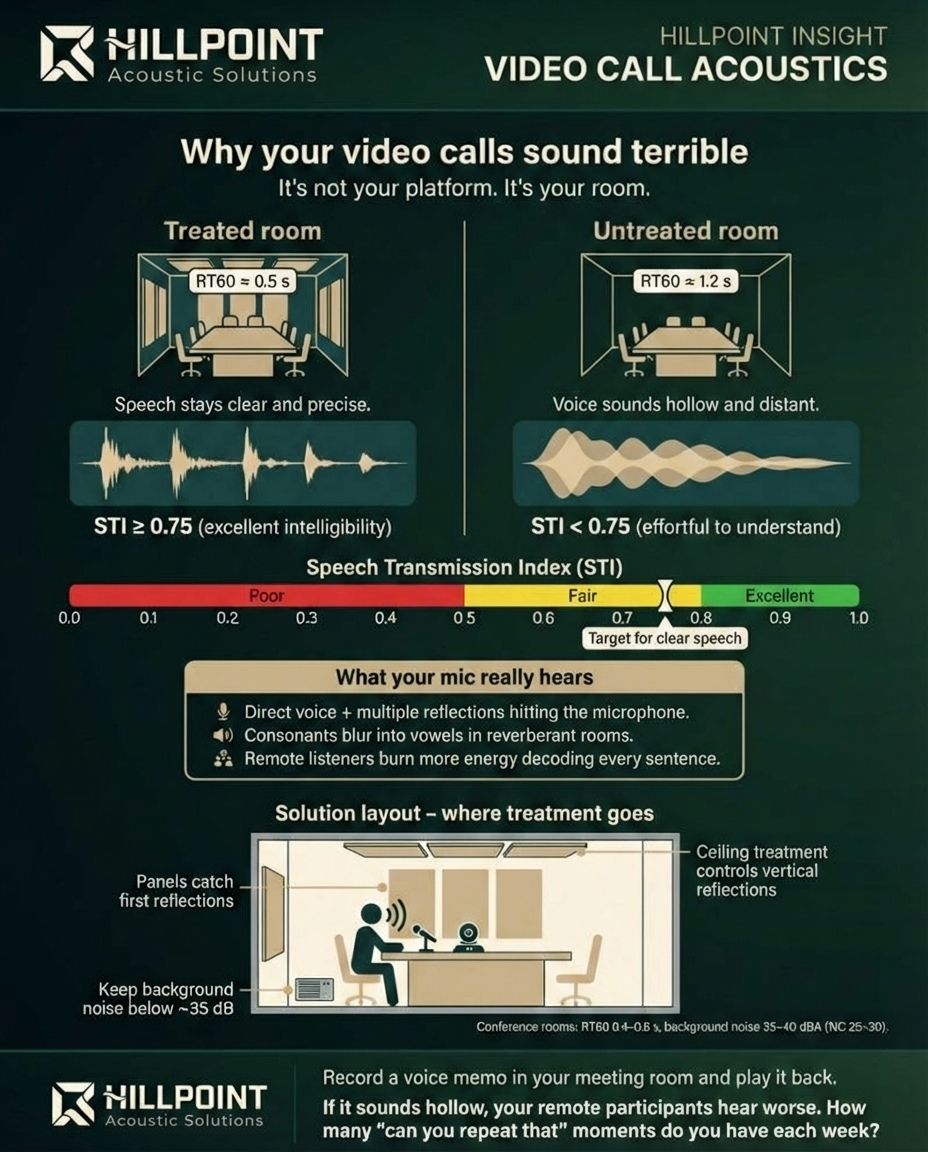
"Can you repeat that?" might be the most expensive phrase in modern business.
Every video call from a reverberant room forces listeners to work harder. They are decoding garbled audio. Thirty minutes in, they are tired. An hour in, they have stopped paying full attention. Nobody says "the acoustics in this room are bad." They just assume the Wi-Fi is slow or the microphone is cheap. Most of the time, it is neither.
What the microphone actually hears
The microphone captures your voice plus every reflection bouncing around the room. Your direct voice and then, milliseconds later, copies of it arriving from the ceiling, the walls, the table, the glass partition behind you. What reaches the other side is a muddy mix where consonants blur into vowels.
There's a measurement for this: Speech Transmission Index, or STI. It runs from 0 to 1, and anything below 0.75 means understanding what someone says takes real effort. Most untreated conference rooms fall well below that threshold. The remote participants are working harder than the people in the room, and nobody realizes it because the in-room experience feels fine. You hear your own voice directly. They hear it through a microphone that cannot distinguish your voice from its reflections.
The numbers that matter
Conference rooms need reverberation times between 0.4 and 0.6 seconds for clear speech. Most untreated rooms hit 1.0 seconds or higher. That extra half second does not sound like much, but it makes "thirty" sound like "thirteen." For a financial services firm or a medical consultation, that is not just annoying, it is a real problem.
Background noise matters too. If the ambient level in the room is above 35 dB, the microphone starts picking up HVAC hum, which competes with the speaker voice. Noise criteria of NC 25-30 is the target for conference rooms. Most untreated rooms are above NC 35.
Where treatment actually goes
The fix isn't complicated, but placement matters more than quantity. Panels behind speakers catch the first bounce before it reaches the mic. That's the most important surface to treat, and it's the one most people miss because the speaker faces away from it. A few Comfy fabric panels on the wall behind the usual presenter position make a noticeable difference on the very first call.
Ceiling treatment stops vertical reflections. If the conference table sits under an untreated hard ceiling, every voice bounces up and comes back down across the whole table. A Contour cloud or a few Comfy Tile panels above the seating area catches that bounce.
Side walls are third priority. In small conference rooms, say 6-8 seats, treating the back wall and ceiling often gets you below 0.6 seconds RT60 without touching the sides. Bigger rooms usually need treatment on at least two walls.
One more thing that gets overlooked: the glass. If the conference room has a glass wall or glass door, that surface is reflecting close to 100% of the sound hitting it. You don't need to cover it. But you need to compensate with more absorption on the other surfaces. A room with one glass wall needs roughly 30% more absorptive surface elsewhere to hit the same RT60 target.
A simple test
Record a voice memo in your conference room. Play it back. If it sounds hollow or distant, your remote participants hear worse. That's because your ear-brain system is good at filtering reflections in real time, but a microphone isn't. What sounds fine to you in person can sound genuinely bad through the mic.
If you are speccing treatment for conference rooms, our product range covers the main surfaces: Comfy panels and Tract stretch systems for walls, Contour panels and Comfy Tile for ceilings, and Acousstop acoustic doors if sound leaking in and out of the room is part of the problem. The product pages have NRC and STC ratings for each.
Technical Guides
Need the full acoustic treatment and soundproofing guides?
The long-form acoustic panels India guide covers panel types, NRC logic, standards, and room treatment. The soundproofing solutions India guide covers STC logic, doors, walls, floors, and the block-and-isolate side of the same design problem.