Absorb
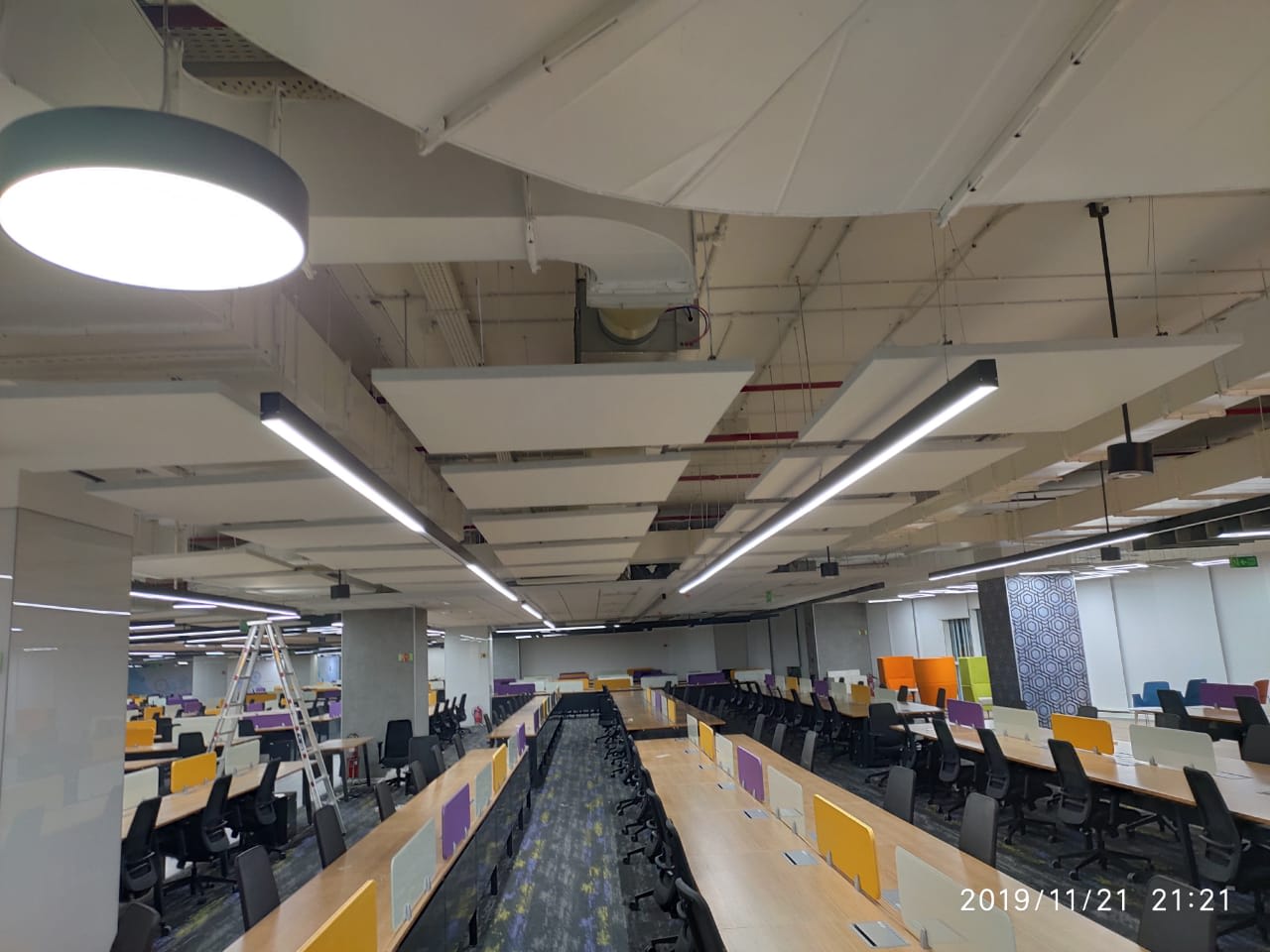
Panels, baffles, clouds, and acoustic ceilings control reverberation inside the room itself.
Technical Guide
Search for acoustic panels in India and you mostly land on product lists. Useful when you already know the panel family, not very useful when you are still deciding what to specify for an office floor, a classroom block, an auditorium, or a hospitality project.
This guide fills the practical middle ground between a catalogue and a technical consultation. It explains what acoustic panels actually do, how NRC should be read, which standards matter on Indian commercial projects, and how HillPoint fits when the brief moves from browsing to specification.
5
Main panel families
NRC
Explained honestly
India + GCC
Project coverage
Project-ready
Commercial projects
An acoustic panel absorbs reflected sound inside a room. That is what improves speech clarity, reduces echo, and lowers listening fatigue. It does not stop a lightweight wall or a poorly sealed door from leaking conversations to the next room.
That distinction matters because many commercial projects accidentally specify an absorption product to solve a blocking problem. If the complaint is room echo, start with panels. If the complaint is speech privacy or bass leakage, the answer usually sits in the wall, the door, the floor build-up, or the ceiling isolation rather than more wall panels. The soundproofing solutions India guide covers that block-and-isolate side in detail.
Panels, baffles, clouds, and acoustic ceilings control reverberation inside the room itself.
Doors, partitions, seals, glazing choices, and heavier wall assemblies control sound transfer between rooms.
Membranes, floating floors, resilient mounts, and vibration products handle structure-borne noise and low-frequency trouble.
Sections
Five categories account for most acoustic panel specifications on Indian commercial interiors. Each one solves a slightly different mix of performance, finish, durability, and budget constraints.
Typically NRC 0.50 to 0.95 depending on thickness and mounting
PET is the workhorse category for offices, classrooms, and ceiling-led retrofits. It is light, colour-flexible, and a strong fit for projects chasing low-emission or recycled-content targets. The trade-off is surface softness in high-impact locations.
See HillPoint PET systemsOften NRC 0.40 to 0.90 depending on perforation, backing, and build-up
Wooden systems are chosen when acoustic control has to sit inside a more architectural finish language. They show up in auditoriums, boardrooms, lobbies, feature walls, and premium ceiling zones where timber is part of the design brief.
See wooden panel examplesCommonly NRC 0.80 to 0.95
Fabric-wrapped panels are usually the fastest route to high absorption in meeting rooms, boardrooms, and focused speech spaces. They work well when performance matters more than a harder surface, but they are less forgiving in dusty or high-touch public zones.
See fabric panel optionsPerformance depends heavily on perforation ratio, backing, and cavity
Metal systems are less about chasing the biggest headline NRC number and more about durability, cleanability, and harder-wearing architectural environments such as transit, industrial, service, and back-of-house zones.
See metal systemsCan test well on paper, but are rarely the best visible commercial answer
Foam appears often in studio and budget-retail searches because it is familiar and inexpensive. On many commercial interiors it loses out on durability, finish quality, and compliance questions, which is why many architects and project teams now prefer PET, fabric, wood, or metal instead.
A sixth category worth knowing is woodwool cement board. It is less universal than the five above, but it can be a strong answer in rugged education, utility, and industrial settings where texture and durability matter as much as the absorption value.
NRC is the Noise Reduction Coefficient. It is a single-number average of how much sound a material absorbs across the mid-frequency speech bands: 250 Hz, 500 Hz, 1000 Hz, and 2000 Hz. It is useful, but only when you understand what it leaves out.
The first limit is low frequency. NRC says nothing meaningful below 250 Hz, which is where HVAC rumble, traffic energy, bass, and some of the most stubborn nuisance noise actually live. A panel that looks excellent at NRC 0.95 can still be mediocre at 125 Hz.
The second limit is mounting. A panel bonded directly to a hard wall behaves differently from the same panel installed on clips, over insulation, or with an air cavity behind it. The tested mounting has to match the specified assembly or the published number is no longer describing the same system.
The third limit is thickness. Two products can both claim a strong NRC, but the thicker build-up usually performs better lower down the frequency range. That is why experienced project teams ask for the octave-band chart, not only the summary line.
If the project is sensitive to low-frequency noise or plant-room rumble, the octave-band data tells a more honest story than the single NRC number.
If the report uses a cavity, suspension, or backing layer, the site detail needs to mirror that tested condition for the rating to mean anything.
NRC is helpful for narrowing options quickly, but room geometry, panel coverage, and adjacent-surface behaviour still decide the final result.
For a deeper dive into the number itself, the NRC ratings guide explains the test logic in more detail.
The best acoustic specification is not only about performance. It also has to survive fire review, indoor-air-quality requirements, consultant paperwork, and procurement scrutiny. That is where standards matter.
Ceilings, corridors, and public-area surfaces often need product-specific fire documentation. Do not rely on a generic certificate for a whole category when the substrate, finish, or backing changes the actual result.
IGBC, GRIHA, LEED, WELL, and similar frameworks all push the conversation toward low-emission finishes. PET systems usually perform well here, while wood and fabric systems need the adhesive and finish layers checked carefully.
Look for test methods such as ISO 354 or ASTM C423 when absorption is being claimed, and for a real lab report rather than an isolated marketing number with no method attached.
Architects and project teams often look beyond the product and ask whether the manufacturer runs a documented quality operation, can hold finish consistency, and can respond with usable technical paperwork under time pressure.
On WELL, education, and consultant-led projects, the acoustic brief should start from the target thresholds and room use, not from whichever panel happens to appear first in the catalogue.
If a supplier cannot tell you the test method, the mounting condition, and the exact product configuration behind the claim, treat the number carefully.
The panel category comes late in the process. The smarter sequence starts with the room, the target outcome, and the surfaces available to do the work.
Step 1
Meeting rooms, classrooms, open offices, auditoriums, and healthcare spaces do not share the same reverberation target. Set the room goal first so the product choice does not happen in a vacuum.
Step 2
A Sabine-style calculation tells you how much total absorption the room needs. Once you subtract what the room already gets from furniture, occupants, flooring, and existing finishes, you can see what the panel system actually has to contribute.
Step 3
In many offices, classrooms, and training rooms, the ceiling is the highest-leverage surface. Treating it well often covers most of the absorption requirement before wall decisions get difficult.
Step 4
Once the sabin gap is understood, then the design brief can decide whether PET, timber, fabric, metal, or a mixed system is the right visible answer.
Step 5
Thickness, cavity, backing, clips, ceiling grid, and substrate all affect the final performance. The acoustic system is the whole build-up, not only the decorative face.
Step 6
Boardrooms, classrooms, gyms, hospital corridors, and exposed-service ceilings all ask different questions of the surface. The best acoustic answer still has to survive how the room is actually used.
If the brief crosses absorption, privacy, and vibration all at once, the architectural acoustics page is the better next step because the room may need more than panel selection alone.
The same product family behaves very differently depending on room type and project priorities. These are the sector patterns that show up most often in real commercial work.
Ceiling-led absorption usually does most of the work, with targeted wall treatment in meeting rooms and privacy-sensitive spaces.
Office acousticsClassrooms depend heavily on ceiling control and speech clarity, while auditoriums often combine wooden and fabric systems with stronger finish expectations.
Education acousticsRestaurants, banquet spaces, and lobbies need absorption, while guest-room privacy often depends more on doors, walls, and floor build-ups.
Hospitality acousticsThese rooms need a balance of absorption and controlled reflection rather than blanket deadening, especially when speech reinforcement is involved.
Auditorium acousticsWaiting rooms and consultation spaces benefit from absorption, but privacy and cleanability can become the deciding factors in material choice.
Healthcare acousticsDurability and low-frequency behaviour matter more here than headline mid-band absorption. Impact and vibration issues often sit outside the panel scope.
Gym acousticsRoom absorption is only one layer. Isolation, bass control, and door performance become just as important as the wall finish.
Cinema acousticsManufacturer-direct supply changes more than price. It affects lead time, sample speed, revision control, and how easy it is to keep the specified finish aligned with what arrives on site.
HillPoint supports Indian projects through the Bangalore corporate office and the manufacturing team in Tamil Nadu, with regional coordination also available for GCC work through Qatar, UAE, and Saudi Arabia. That is useful when the job needs both technical paperwork and on-the-ground project conversations.
HillPoint operates its manufacturing unit in Coimbatore, Tamil Nadu, with commercial coordination from Bangalore and regional support across the GCC. That setup matters because acoustic projects rarely fail on the face material alone. They fail in the gap between design intent, fabrication, procurement, and installation.
When the same company can move from the acoustic brief to the product selection, the submittal package, the sample review, and the site installation logic, there are fewer opportunities for the approved system to get diluted halfway through the job.
If you already know which part of the HillPoint story you need, the cluster below is the faster route: the manufacturer page goes deeper on specification support, the architectural acoustics page covers the absorb-block-isolate view, the ceiling systems page narrows the focus to the highest-leverage surface, and the Bangalore page handles city-level commercial intent.
These portfolio links show the room types that sit behind the guidance above: offices, education, auditoriums, and cinema-scale environments where acoustic decisions are visible in the built result.
If you are moving from education to product selection, these links are the cleanest route into the current HillPoint range and the published values already on the site.
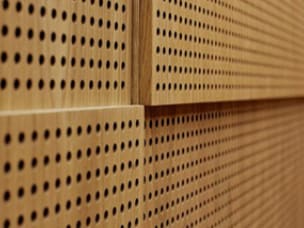
Acousstop Wooden Panels
Perforated wooden panels for visible wall and ceiling treatment where architectural finish and absorption both matter.
View guide
SOF Panels – PET
PET ceiling baffles for exposed-service ceilings, open offices, and retrofit acoustic control.
View guide
Acousstop Wooden Panels
High-performance ceiling tiles for classrooms, training rooms, and office floors where the ceiling does the heaviest acoustic work.
View guide
Comfy Panels-Fabric
Fabric-wrapped wall panels for speech-focused rooms, boardrooms, and video-conference spaces.
View guide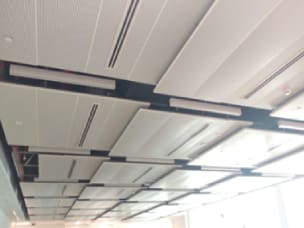
Specialized Products
Perforated metal systems for durable, cleanable, and harder-wearing acoustic environments.
View guide
Doors and Movable Partitions
Acoustic doors for projects where privacy leakage, not reverberation, is the real weak point.
View guideThese are the questions architects, consultants, and commercial buyers usually ask once the shortlisting starts.
For most offices, ceiling-led absorption gives the best first return because the ceiling is usually the largest uninterrupted reflective surface. PET and ceiling-tile systems are often the most efficient starting point, with wooden or fabric panels added where the design or room type needs them.
There is no single national rate that is useful across all projects. Installed cost changes with the panel family, coverage area, ceiling height, access, finish, fire requirements, and whether the brief also includes doors or sound-isolation work. The fastest way to get a real number is to send the room list, drawings, and target acoustic outcome.
Many commercial acoustic panels are available with tested fire performance, but the rating depends on the exact substrate, finish, and assembly. Always ask for the specific report for the specific product and configuration you are specifying.
Yes. Custom sizes, finishes, perforation patterns, edge details, and project-specific build-ups are common on commercial work. Custom programs usually need drawing approval and a longer lead time than standard formats.
Maintenance depends on the surface. Metal and many PET systems are low maintenance, wooden panels benefit from periodic cleaning, and fabric-wrapped panels need more care in high-touch or dusty areas. Serviceability should be part of the specification decision, not an afterthought.
Acoustic panels absorb sound inside a room, reducing reverberation and improving clarity. Soundproofing reduces sound transfer between rooms by using mass, sealing, and isolation. Many projects need both, but they are not the same intervention.
Specification Support
Send the room schedule, floor plan, or the target RT60 and privacy goals you are working from. HillPoint can respond with the product mix that fits the job instead of making you reverse-engineer the answer from the catalogue.
India corporate office
No. 3, 2nd Floor, Dasarahalli Main Road, Opposite Karagadamba Temple, Dasarahalli, Hebbal Post, Bangalore 560024, Karnataka
contactindia@hillpointglobal.comGCC project contacts