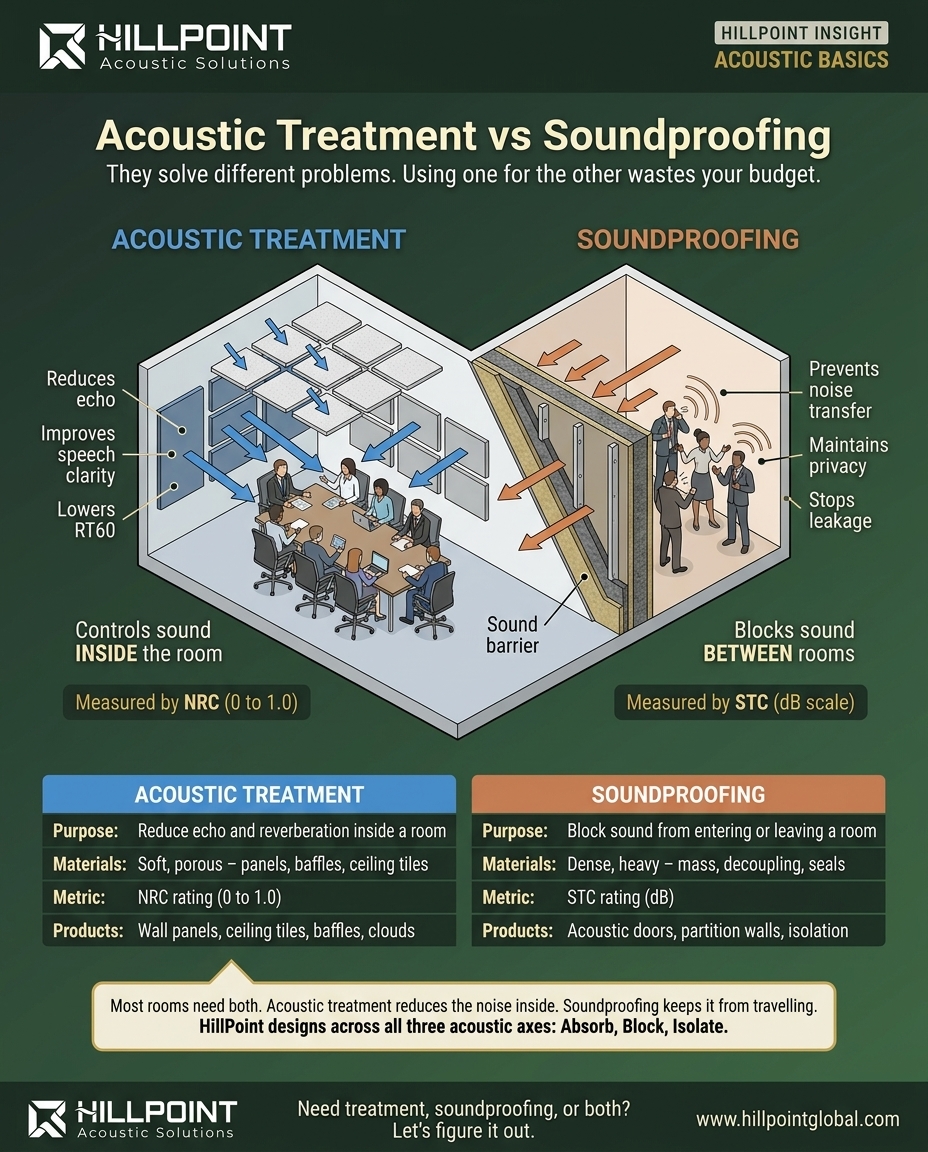
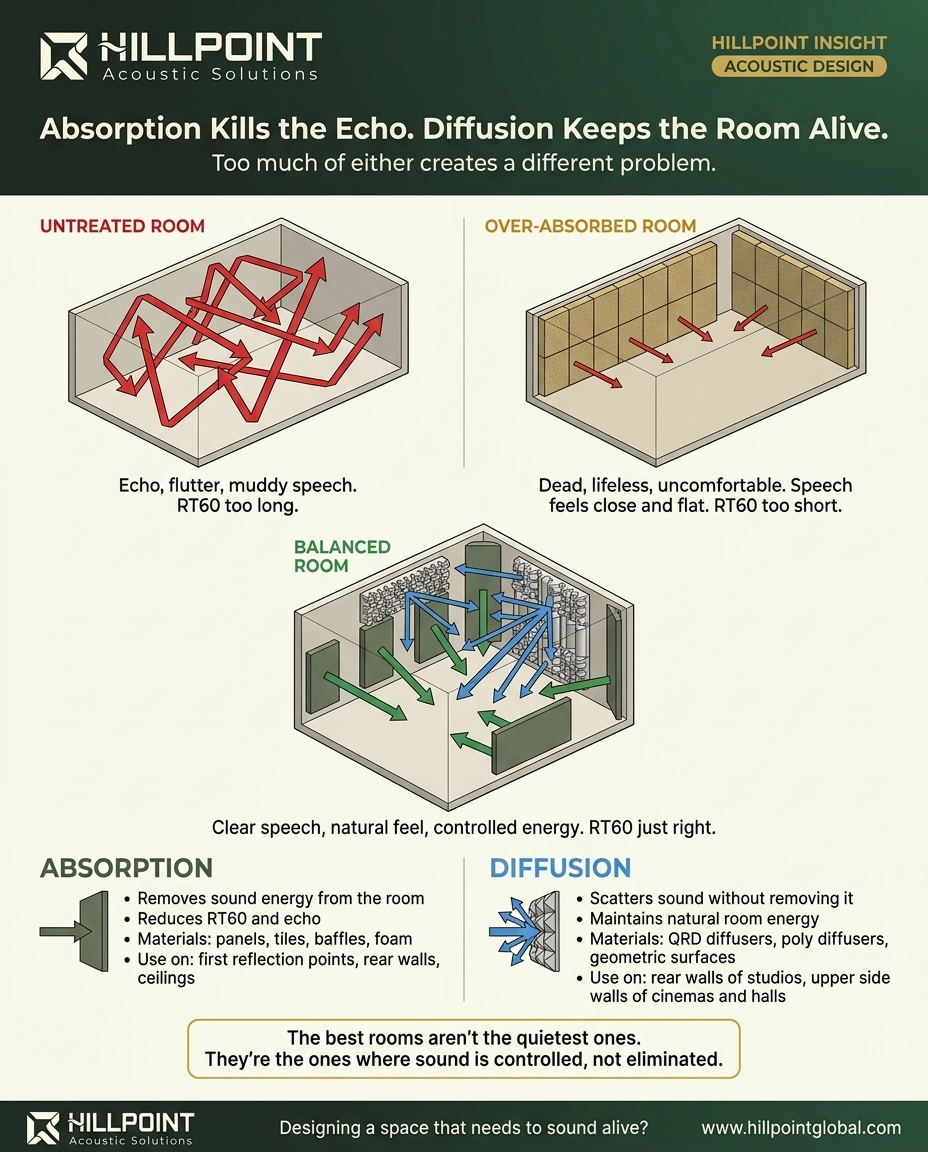
NRC ratings: what the number actually means (and what it hides)
NRC is a useful shorthand for acoustic absorption, but it leaves out the frequency range, panel thickness, and mounting details that decide how a product performs in a real room.
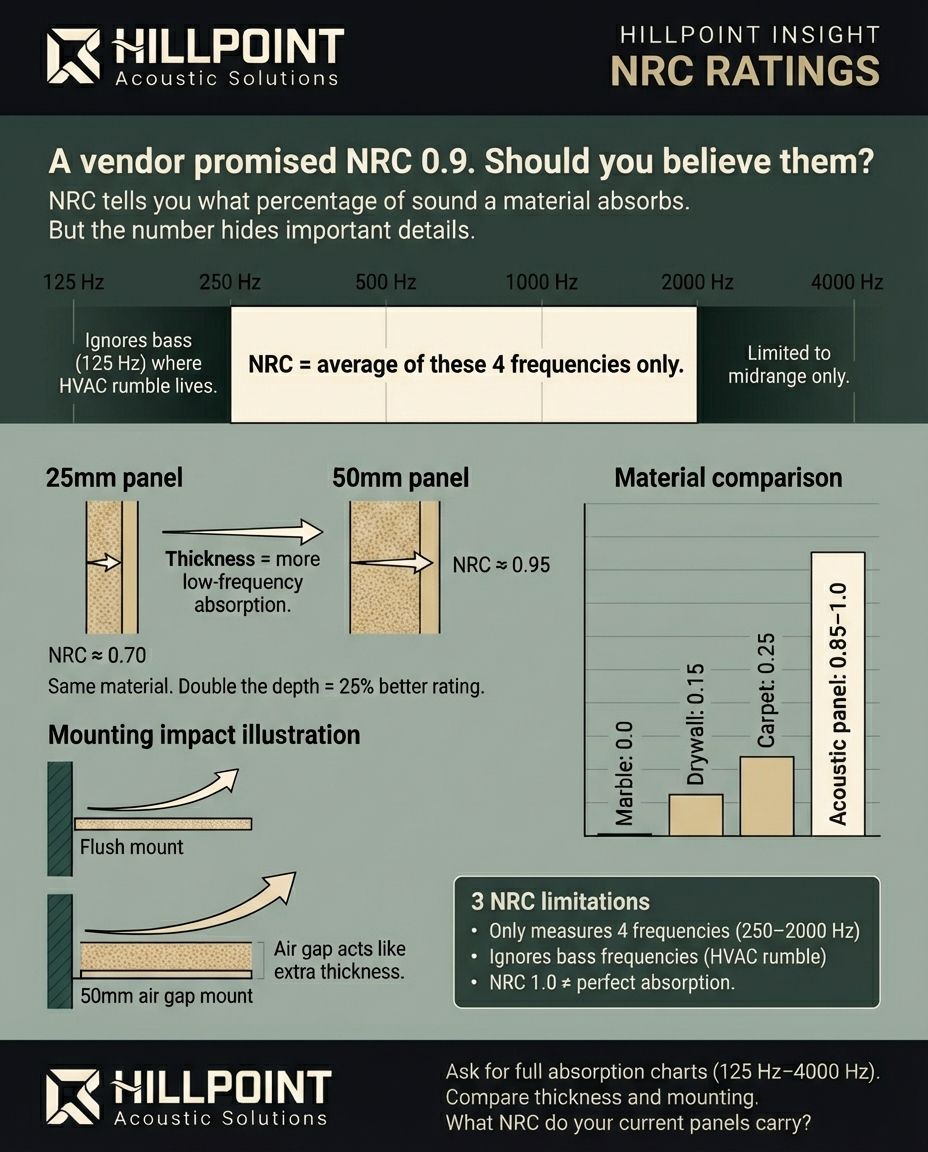
A vendor just promised you NRC 0.9 panels. Should you believe them?
NRC tells you what percentage of sound a material absorbs. An NRC of 0.85 means 85% absorption. Simple enough. But the number hides important details that most spec sheets do not mention, and if you are making purchasing decisions based on NRC alone, you might end up with panels that look great on paper and disappoint in the room.
What NRC actually measures
NRC only covers four frequencies: 250, 500, 1000, and 2000 Hz. It ignores bass frequencies where many acoustic problems live. A panel can score NRC 0.9 while doing nothing for the 125 Hz rumble from your building's HVAC system.
It also ignores everything above 2000 Hz, though that matters less for most office environments since the speech frequency range falls mostly within the NRC measurement window. For music rooms and recording studios, NRC alone isn't enough. You would want the full absorption coefficient chart.
The thing that catches people off guard is how much the same material can vary. A 25mm panel might hit NRC 0.7. The same material at 50mm reaches NRC 0.95. That extra depth lets it absorb longer wavelengths that the thinner version misses entirely. This is why our Comfy Panels come in 20, 40, and 50mm thicknesses. The 20mm version works fine for treating high-frequency flutter echo. If you need to pull down the overall reverberation time in a large room, you probably want the 50mm.
Mounting changes everything
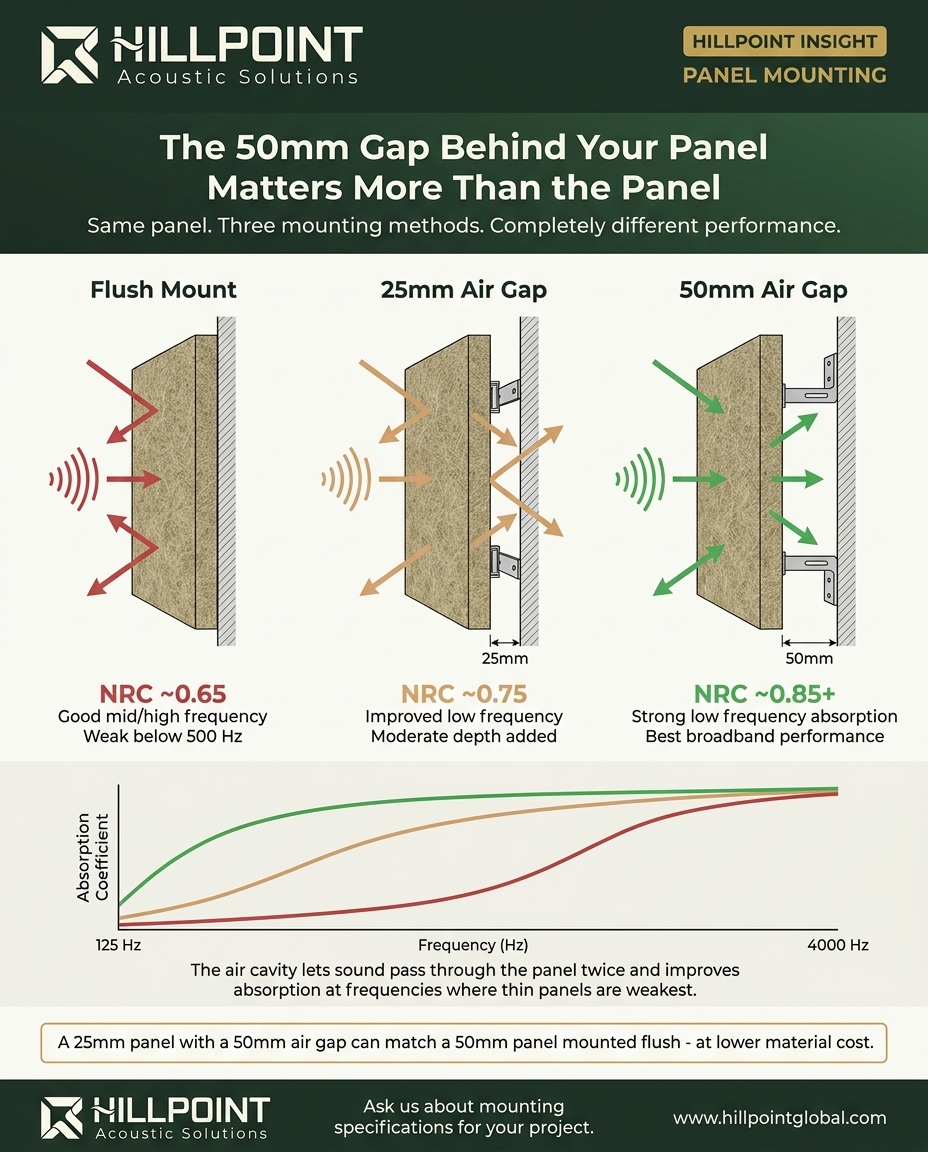
A panel flush against the wall absorbs less than one mounted with a 50mm air gap behind it. That gap acts like additional thickness, extending low-frequency performance without extra material. It's essentially free absorption, and it's the reason we recommend the Z-profile mounting system for most wall installations rather than direct adhesive mounting.
This is one of those details that gets lost in product comparisons. Two panels with the same NRC rating, tested at different mounting depths, will perform differently in your room. The one tested with an air gap will look better on paper but might not match that performance if you flush-mount it. Always check the test mounting condition.
How to compare products honestly
When evaluating acoustic products, ask for the full absorption coefficient chart across all frequencies from 125 Hz to 4000 Hz. Don't just take the single NRC number. Compare thickness and mounting conditions. Check whether the test was done to ASTM C423 or ISO 354, because the sample sizes and room conditions differ between the two standards, and results are not always directly comparable.
NRC 1.0 doesn't mean perfect. It means 100% absorption at those four specific mid-band frequencies. A material can even score above 1.0 in reverberation room testing because of edge diffraction effects, which is a testing artifact, not some kind of super-absorption.
For context, here's what common materials score. Marble floors sit near NRC 0.0, basically perfect reflection. Standard drywall is around 0.05 to 0.10. Carpet gets you to about 0.25. Our acoustic panels range from NRC 0.7 for thinner wooden panels like the Niche series, up to NRC 0.9 for the 50mm Comfy fabric panels. The difference between carpet and an acoustic panel is massive, and it's why just putting carpet in a room doesn't fix acoustic problems.
NRC rating chart: quick reference
Use this as a first-pass NRC chart, not a final specification: marble, tile, and concrete sit near NRC 0.00; painted drywall is usually around 0.05 to 0.10; carpet is often around 0.20 to 0.30; standard mineral ceiling tiles may sit around 0.50 to 0.60; wooden acoustic panels commonly range from 0.70 to 0.85; PET and fabric acoustic panels usually range from 0.80 to 0.90; high-performance acoustic ceiling panels can reach 0.90 to 0.95.
The useful question is not simply which product has the highest NRC. The useful question is which surface you can treat, how much area is available, what thickness fits the design, and whether the tested mounting condition matches the site. A 0.95 ceiling panel in the right location can outperform a 0.95 wall panel placed where little sound energy reaches it.
When NRC isn't the right metric
NRC works well for offices, classrooms, conference rooms, and most commercial spaces where speech clarity is the priority. For those environments, the four frequencies NRC measures are the ones that matter.
But if you're building a recording studio, a performance space, or a room where low-frequency sound matters, NRC won't give you the full picture. You need the broadband absorption data, including 63 Hz and 125 Hz performance. Products like our Spume foam panels and Silenz sound barrier membrane are designed for those applications, and their spec sheets include the full frequency breakdown.
If you're not sure which metric matters for your project, that's a good thing to sort out early in the design conversation. Ask for the full absorption charts (125 Hz to 4000 Hz), compare thickness and mounting conditions, and don't assume that a higher NRC number automatically means a better product for your specific room. If you need a manufacturer-level overview before drilling into product pages, our acoustic panel manufacturer page is the right next stop.
Technical Guides
Need the full acoustic treatment and soundproofing guides?
The long-form acoustic panels India guide covers panel types, NRC logic, standards, and room treatment. The soundproofing solutions India guide covers STC logic, doors, walls, floors, and the block-and-isolate side of the same design problem.