Absorption vs Diffusion in Acoustics: What Each Does and When to Use Them
Absorption removes sound energy. Diffusion scatters it. Too much of either creates a problem. Here is how to balance both for rooms that sound natural.
Most acoustic treatment conversations start and end with absorption. Panels on the walls, tiles on the ceiling, baffles from the structure, all designed to soak up sound energy and reduce the reverberation time. That's the right starting point for most rooms. But absorption is only half the toolkit.
Diffusion is the other half, and in certain room types, getting the balance between absorption and diffusion is what separates a room that sounds controlled from one that sounds dead.
What absorption does
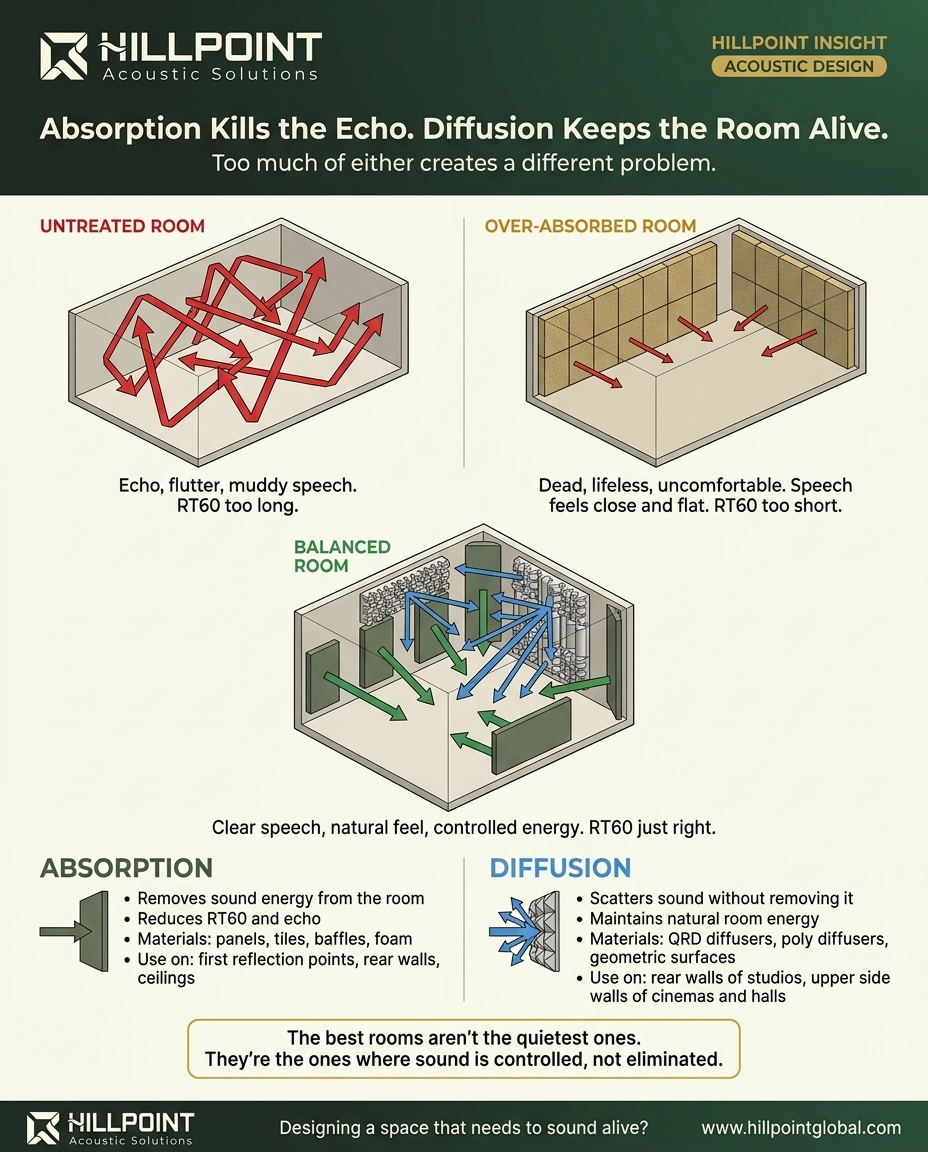
Absorption converts sound energy into heat. Porous materials like mineral wool, PET felt, and fabric-wrapped panels trap sound waves in their fibrous structure, where air friction dissipates the acoustic energy. The sound that hits an absorptive surface doesn't bounce back into the room. It's gone.
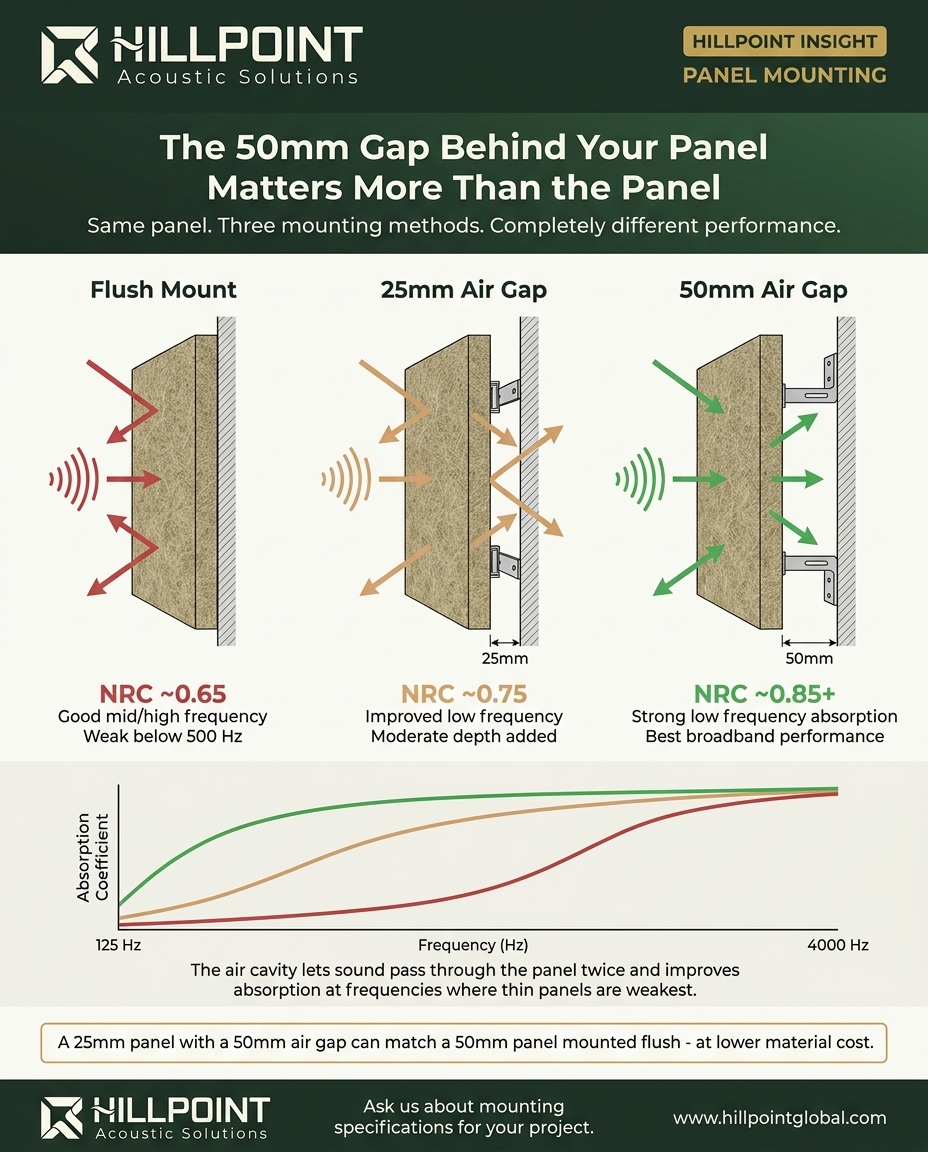
The effect is a shorter RT60 (less time for sound to decay), reduced echo, and improved speech clarity. The metric is NRC, where a higher rating means more energy absorbed. HillPoint's panels range from NRC 0.70 to NRC 0.95 depending on the product and mounting.
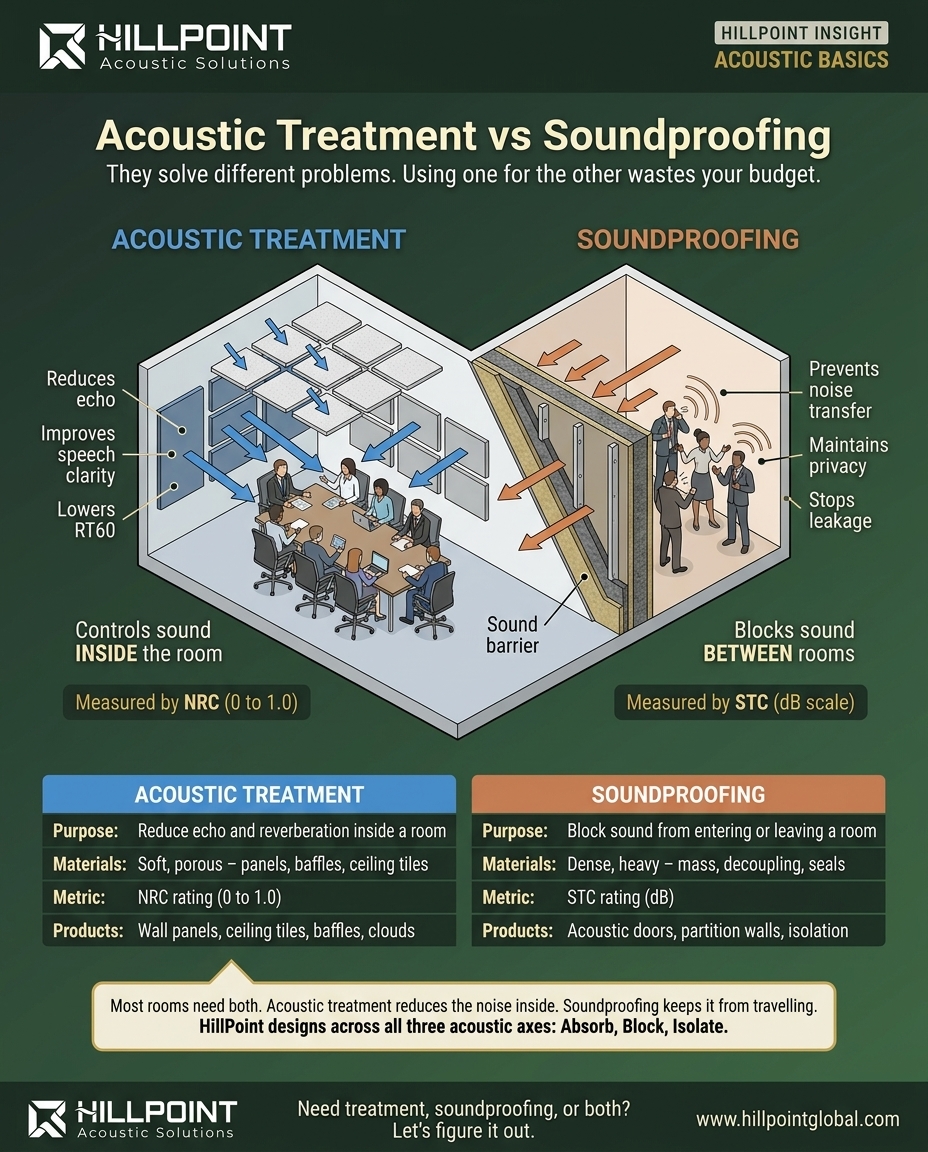
Absorption is the right treatment for most commercial spaces. Offices, classrooms, conference rooms, hospitals, and restaurants primarily need to reduce unwanted reflections and bring the RT60 down to a comfortable range. For speech-focused rooms, absorption does most of the work.
What diffusion does
Diffusion scatters sound waves in multiple directions without removing them from the room. A diffuser surface has a geometric profile, typically a pattern of wells or convex shapes at varying depths, that breaks up an incoming sound wave and redirects the energy across a wide angle.
The effect is that the room retains acoustic energy (the RT60 isn't shortened as dramatically as with absorption alone) but the problematic direct reflections are broken up into many smaller, quieter reflections arriving from different angles. The brain perceives this as a natural, spacious sound rather than a focused echo or a dead silence.
Diffusion doesn't have a single metric like NRC. Diffuser performance is characterised by scattering coefficients across frequency bands, which describe how evenly the surface distributes reflected energy across angles.
Why the balance matters
An untreated room with hard parallel surfaces creates the problems everyone recognises: echo, flutter, muddy speech. The RT60 is too long and reflections arrive as strong, focused copies of the original sound that interfere with intelligibility.
A room covered entirely in absorption material creates a different problem. The RT60 drops too low (below 0.3 seconds in extreme cases), the room feels dead and claustrophobic, speech sounds uncomfortably close and intimate, and there are no spatial cues for the brain to gauge room size. People in over-absorbed rooms often report feeling uneasy without being able to explain why.
A balanced room uses absorption where it's needed most, typically at first reflection points, rear walls, and ceilings, and diffusion where the room needs to retain some acoustic energy, typically on upper side walls and parts of the rear wall in performance spaces.
Where to use each
For conference rooms, classrooms, and offices: primarily absorption. The goal is speech clarity, and reducing the RT60 to 0.4 to 0.6 seconds is best achieved with ceiling tiles, wall panels, and possibly cloud panels above meeting tables. Diffusion isn't typically needed in speech rooms unless the room is very large.
For auditoriums and performance spaces: a mix of both. Absorption at ear height on side walls to control early reflections. Diffusion on upper walls and rear walls to maintain the sense of spaciousness that music and performances need. The auditorium RT60 target is longer than a classroom (1.0 to 2.0 seconds depending on use), so over-absorption is a real risk.
For cinemas: absorption dominates the lower walls, rear wall, and ceiling for dialogue clarity, with diffusion on the upper side walls to preserve the enveloping quality of surround sound. The RT60 target of 0.6 to 0.7 seconds needs careful calibration.
For recording studios: bass traps and broadband absorption on the front wall and first reflection points, diffusion on the rear wall to maintain a sense of room without creating a focused rear reflection. The rear diffuser is what separates a professional control room from an over-damped box.
HillPoint manufactures the absorption products: wooden panels, PET panels, fabric panels, ceiling tiles, and baffles. For diffusion, we advise on surface geometry and placement as part of the acoustic design process, because the diffuser specification depends on the room dimensions, the frequency range, and the listener position.
The 60 percent guideline
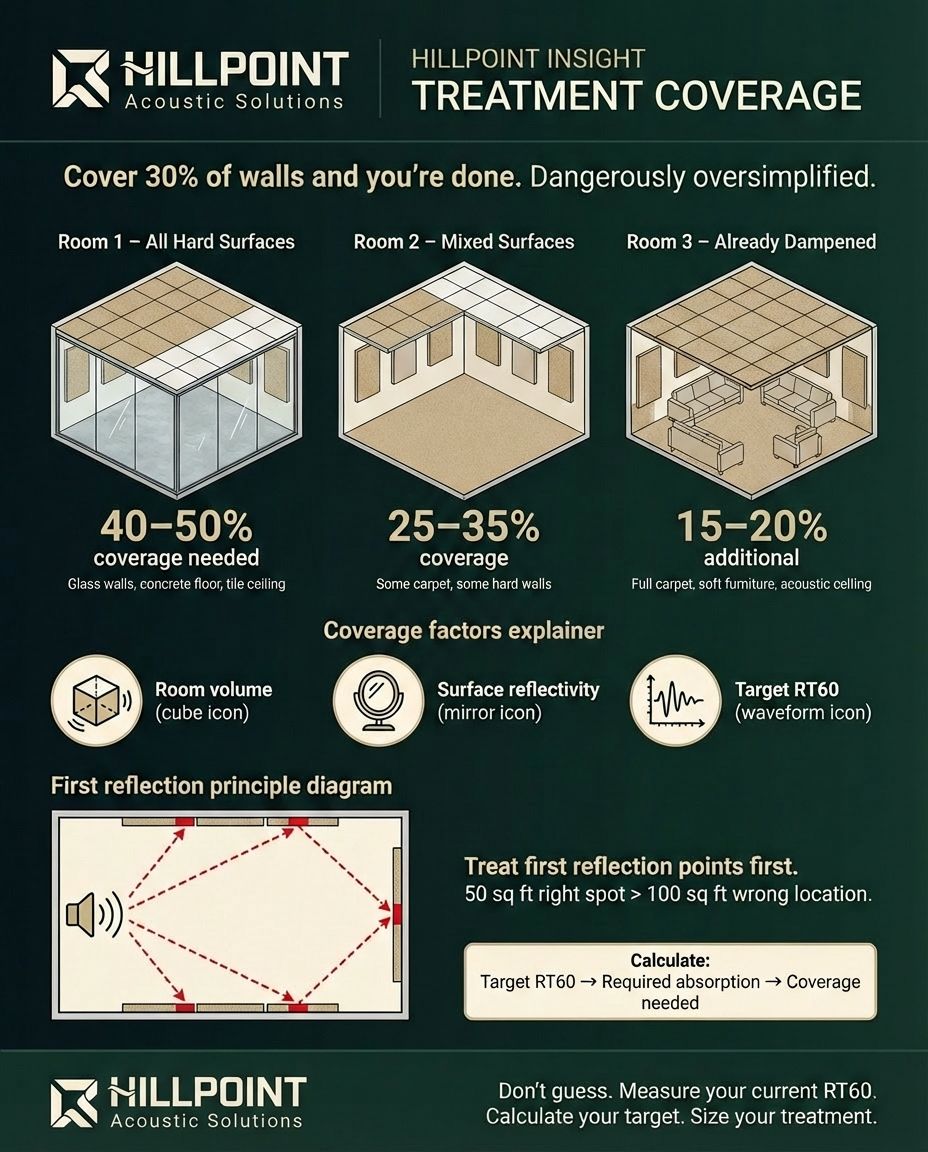
A rough working rule for speech-focused rooms: covering 40 to 60 percent of the total surface area with absorption usually brings the RT60 into the target range without making the room feel dead. Going beyond 60 percent coverage starts to over-damp the space, and the returns diminish rapidly. The remaining surfaces can be left reflective or, in rooms where the acoustic design needs more refinement, fitted with diffusers to maintain natural room character.
For music and performance spaces, the absorption coverage is typically lower (30 to 40 percent) with diffusion making up an additional 15 to 25 percent of the surface area. The exact balance depends on the room volume and the target RT60.
Technical Guides
Need the full acoustic treatment and soundproofing guides?
The long-form acoustic panels India guide covers panel types, NRC logic, standards, and room treatment. The soundproofing solutions India guide covers STC logic, doors, walls, floors, and the block-and-isolate side of the same design problem.