How much acoustic panel coverage does your room actually need?
Panel coverage is not a fixed percentage. Room volume, existing finishes, target RT60, and first reflection points decide how much treatment a space actually needs.
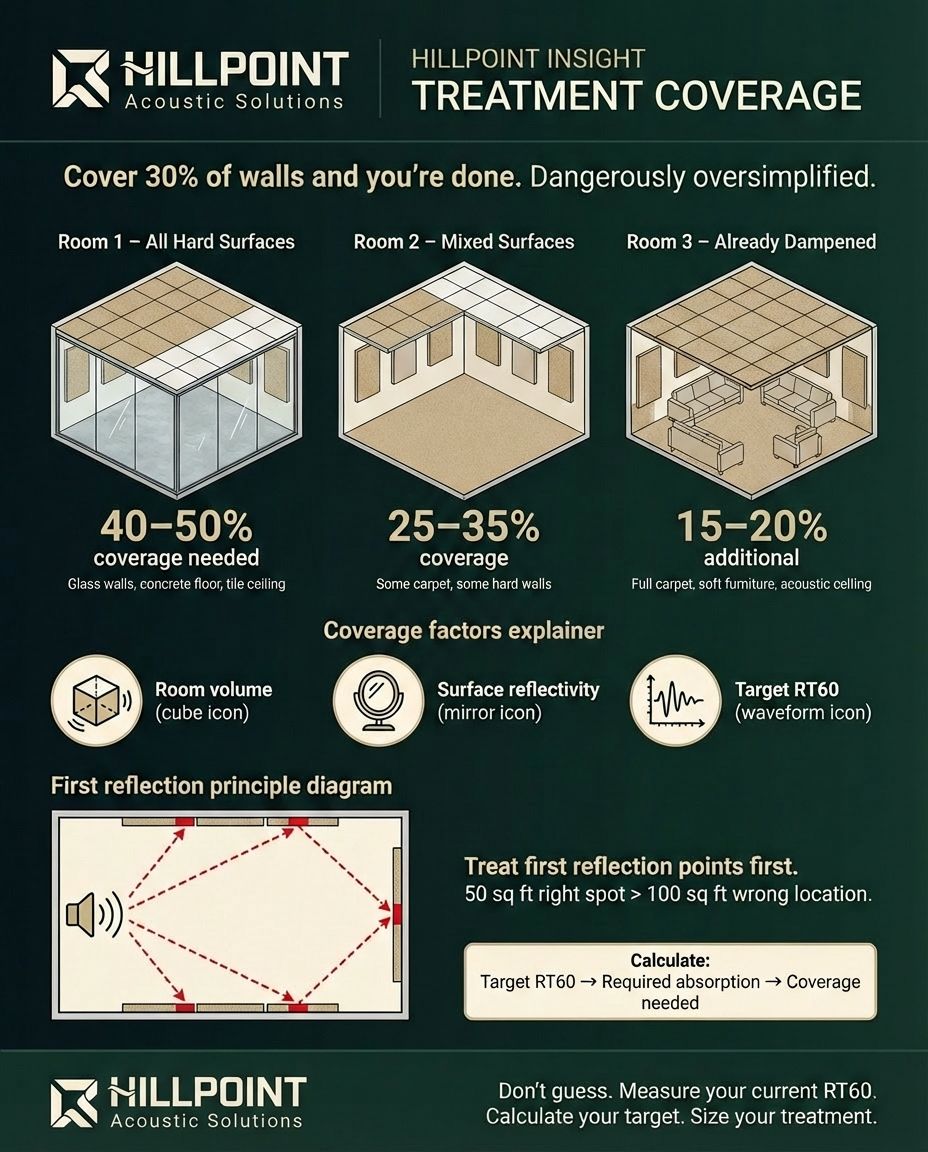
The 30% coverage rule for acoustic panels gets thrown around a lot. Cover 30% of your wall and ceiling area and you're done. It's not wrong exactly, but it skips over why 30% works in some rooms and fails completely in others.
A 2000 sq ft open office with concrete ceilings and glass walls is a completely different problem than a carpeted meeting room that already has acoustic ceiling tiles. The first one probably needs 40 to 50% of its surfaces treated. The second might only need 15 to 20% more than what's already there. Most mixed-surface spaces fall somewhere around 25 to 35%. The room tells you what it needs, not a rule of thumb.
The room that broke the rule
We had a 7,000 sq ft floor in Bengaluru where the RT60 was sitting at 2.2 seconds. That's closer to a cathedral than an office. To bring the reverberation time down to 1.1 seconds we ended up treating 45% of the surface area with a mix of ceiling baffles and wall panels. If someone had gone in with the 30% rule, that room would still sound like a cafeteria.
The reason the rule doesn't work universally is that it ignores what's already in the room. A space with carpet, upholstered furniture, and an acoustic drop ceiling already has significant absorption. Adding 30% more panel coverage to that room might actually over-damp it and make it feel uncomfortably dead. Meanwhile, a room with polished concrete floors, glass partitions, and an exposed concrete ceiling has almost zero existing absorption, so even 30% coverage barely makes a dent.
How to actually calculate what you need
The way to figure it out is to work backwards from your RT60 target using the Sabine equation. Add up whatever absorption the room already has from carpet, furniture, curtains, ceiling tiles. The gap between that total and your target reverberation time tells you exactly how many square metres of acoustic panel you need.
It's not complicated math, but it does require someone to measure the space first. Or at minimum, know the room dimensions and the surface materials. The calculation gives you a number in sabins, the unit of sound absorption, and from there you can divide by the absorption coefficient of whatever panel you're planning to use to get the area needed.
For context: a panel with NRC 0.85 absorbs 0.85 sabins per square foot. So if you need 200 sabins to hit your target, you need roughly 235 sq ft of NRC 0.85 panels. Simple division, once you have the inputs.
Where you put them matters as much as how many
Placement isn't random. Treating first reflection points, the surfaces directly facing speakers and listeners, does more than spreading the same amount of panels evenly across every wall. We've seen 50 sq ft placed at the right first reflection points do more than double that placed randomly.
The first reflection point on the ceiling is directly above the speaker-listener axis. On the walls, it's the point where sound from a speaker would bounce off the wall and arrive at the listener's ear. Treat those surfaces first, then fill in secondary reflections, then worry about coverage on remaining walls.
One caveat: the Sabine formula assumes a fairly diffuse sound field, which doesn't always hold in long narrow rooms or spaces with odd geometry. For those you're probably looking at more detailed acoustic modelling with software, which is where an acoustic consultant earns their fee. But for typical rectangular offices, meeting rooms, and classrooms, the Sabine calculation gets you close enough for spec purposes.
Technical Guides
Need the full acoustic treatment and soundproofing guides?
The long-form acoustic panels India guide covers panel types, NRC logic, standards, and room treatment. The soundproofing solutions India guide covers STC logic, doors, walls, floors, and the block-and-isolate side of the same design problem.