Acoustic Treatment vs Soundproofing: Two Different Problems, Two Different Solutions
Acoustic treatment absorbs echo inside a room. Soundproofing blocks sound between rooms. Different problems, different products. Here is how to tell which you need.
About half the calls we get at HillPoint start with someone saying they need to "soundproof" a room. When we dig into the actual problem, it usually falls into one of two categories, and the distinction matters because the products, the installation approach, and the budget are completely different.
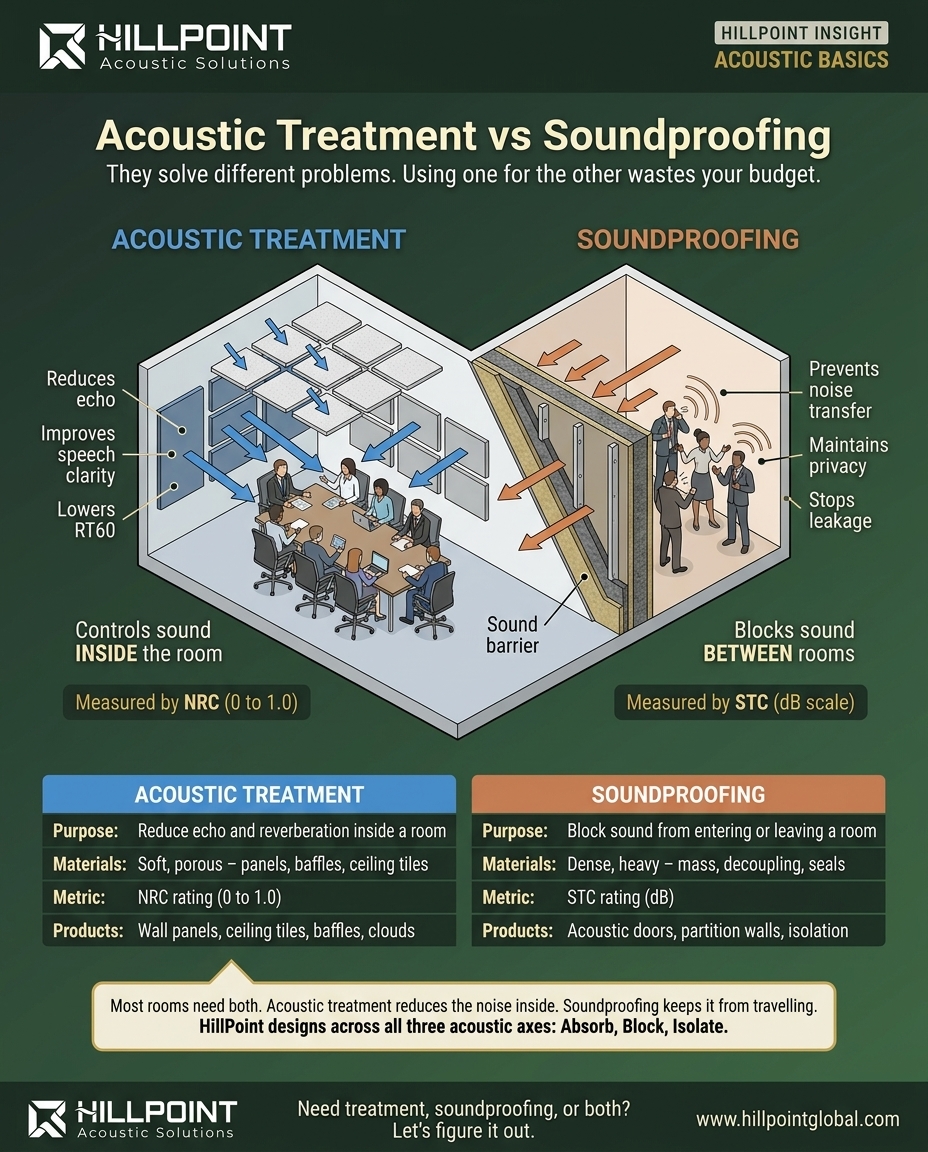
Acoustic treatment controls how sound behaves inside a room. Soundproofing controls how sound travels between rooms. One absorbs. The other blocks. Using the wrong one for your problem is a waste of money. If you want the full block-and-isolate version of this argument, the soundproofing solutions India guide maps STC, doors, walls, floors, and leakage paths in one place.
Acoustic treatment: fixing the room from the inside
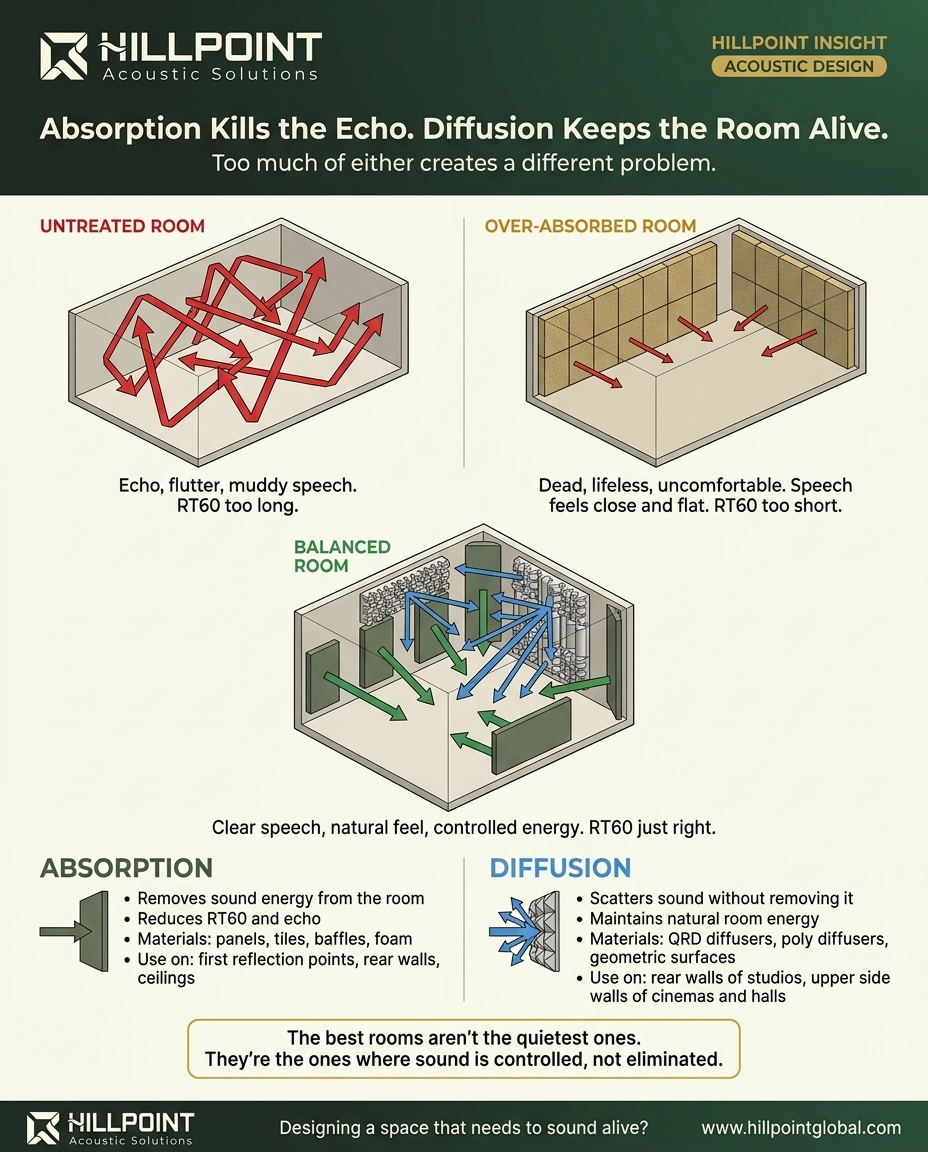
If the problem is echo, reverberation, muddy speech, or a space that "feels loud" even with just a few people talking, that's a treatment problem. Sound energy is bouncing off hard surfaces, walls, ceiling, floor, glass, and lingering in the room longer than it should. The overlapping reflections stack on top of each other and create a noise floor that makes conversation difficult.
Acoustic treatment uses soft, porous materials to absorb sound energy. NRC (Noise Reduction Coefficient) is the metric. A material with NRC 0.90 absorbs 90 percent of the sound energy that hits it. The result is a shorter reverberation time (RT60), clearer speech, and a room that feels noticeably quieter and less fatiguing.
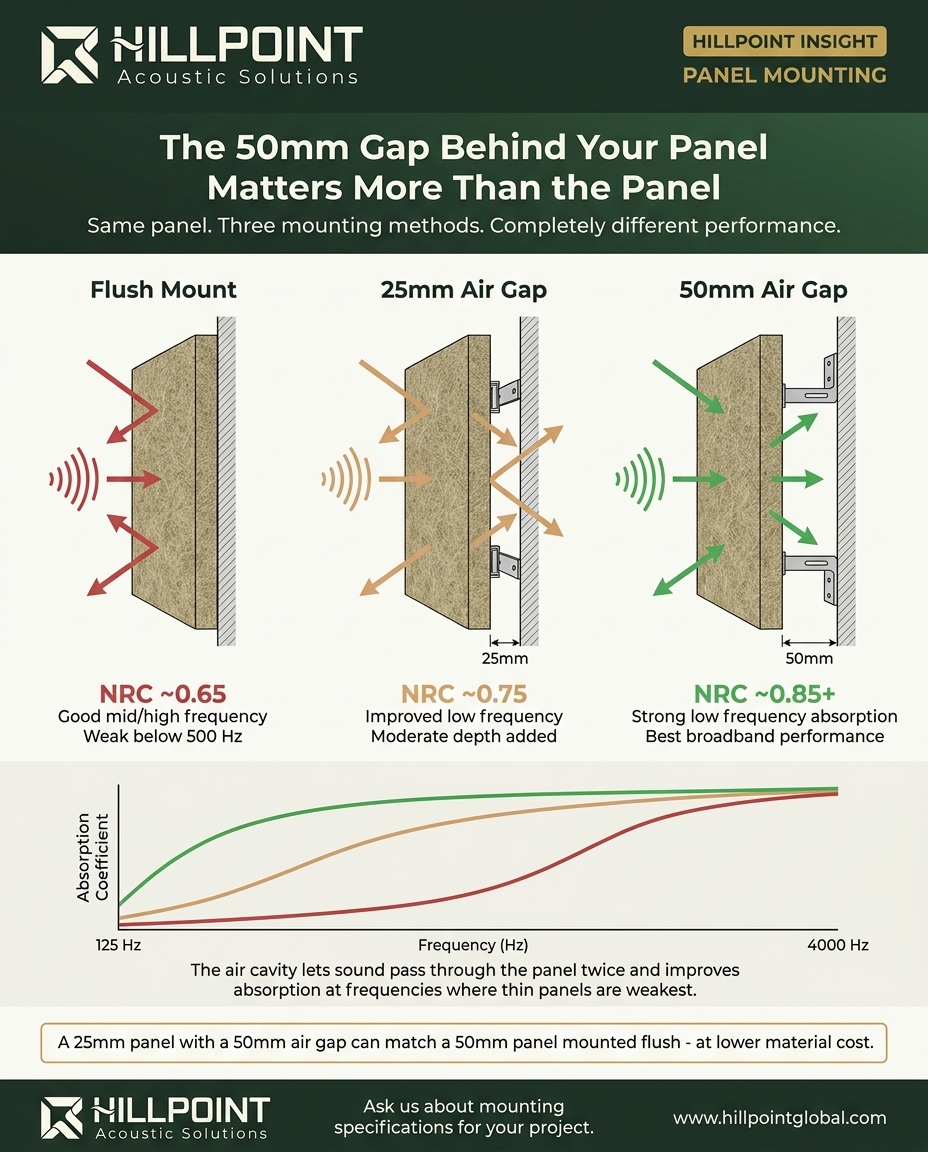
Treatment products include wall-mounted acoustic panels (wooden, PET, or fabric-wrapped), ceiling tiles and baffles, suspended cloud panels, and bass traps for low-frequency control. HillPoint manufactures all of these at our Tamil Nadu facility: Acousstop wooden panels in multiple profiles (Niche, Perf, Grille), SOF PET panels and baffles from recycled polyester, Comfy fabric-wrapped panels, and MAC Tile ceiling panels reaching NRC 0.95.
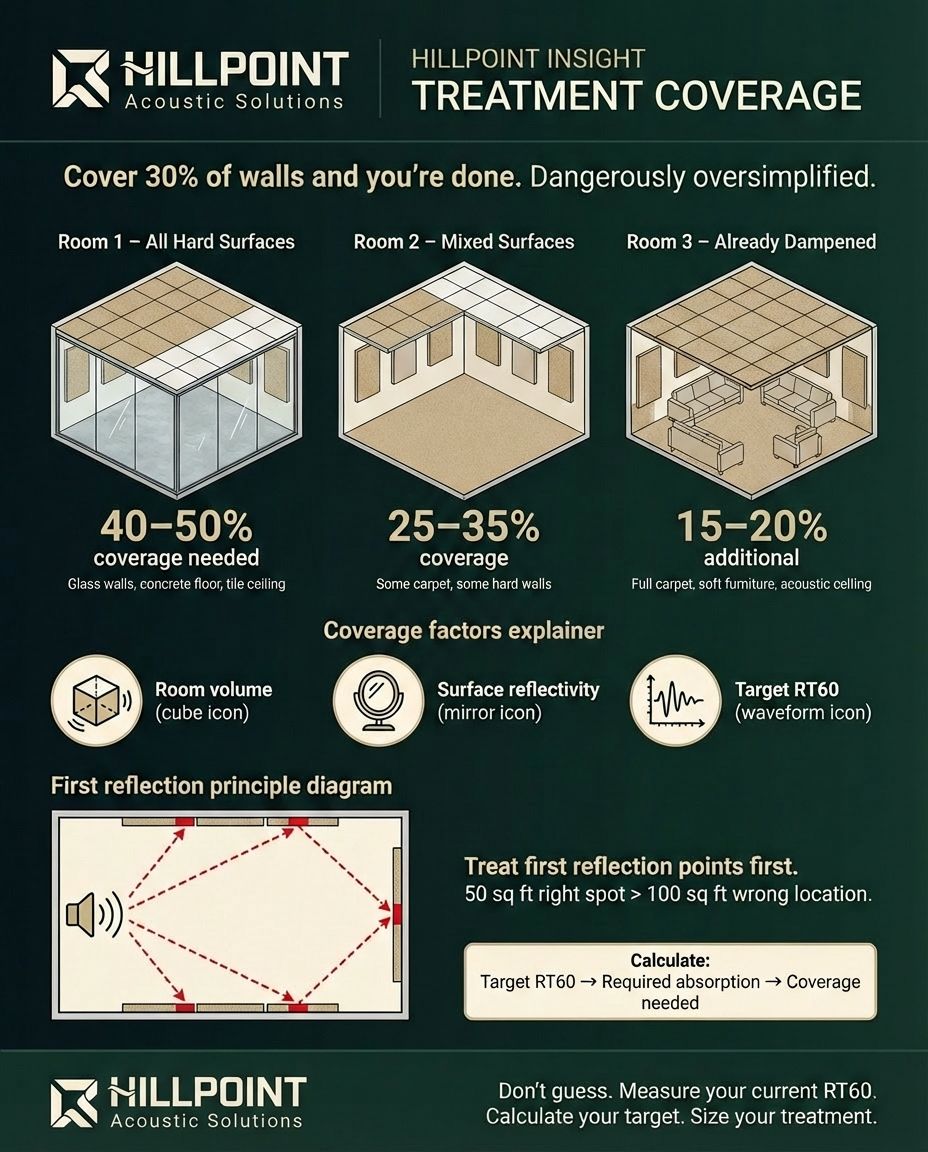
Treatment products are relatively lightweight, mount on existing surfaces, and can often be installed without major construction work. They're the right answer for offices with echo problems, conference rooms where speech is unclear, restaurants with noise build-up, and any space where the problem is inside the room itself.
Soundproofing: keeping sound where it belongs
If the problem is hearing the meeting next door, corridor noise entering a patient room, or music from a gym leaking into an adjacent office, that's a soundproofing problem. Sound is transmitting through the wall, door, ceiling, or floor assembly from one space to another.
Soundproofing uses dense, heavy materials and construction techniques to block airborne sound transmission. STC (Sound Transmission Class) is the metric. An STC 50 wall reduces the sound passing through it by 50 dB, making normal speech completely inaudible on the other side.
Soundproofing solutions include acoustic doors with multi-layered cores and perimeter seals (HillPoint manufactures doors rated STC 38 to 50), partition walls built with added mass and decoupled construction, sealed window assemblies, and duct treatments that prevent sound from flanking through mechanical systems.
Soundproofing typically involves heavier construction, is harder to retrofit, and costs more than acoustic treatment. It's the right answer for hotel rooms needing guest privacy, boardrooms handling confidential discussions, recording studios that can't tolerate external noise, and any space where sound needs to stay on one side of a barrier.
Why most rooms need both
Here's where it gets practical. A boardroom might need acoustic panels on the ceiling to improve speech clarity inside the room (treatment) and an STC 45 acoustic door to prevent conversations from being overheard in the corridor (soundproofing). If you only do the treatment, the room sounds great inside but leaks. If you only do the soundproofing, the room is private but still echoey.
HillPoint's three-axes framework maps directly onto this: ABSORB is acoustic treatment. Control what happens inside the room with panels, tiles, and baffles. BLOCK is soundproofing. Control what passes between rooms with doors, walls, and seals. ISOLATE is the third axis that people often forget: stopping structure-borne noise (vibration through floors, slabs, and mechanical systems) from transmitting through the building itself.
Most acoustic failures happen because the design addresses one axis and ignores the other two. A well-treated room with a bad door leaks. A well-sealed room with no ceiling treatment sounds terrible inside. HillPoint designs, manufactures, and installs across all three axes because covering one isn't enough.
How to tell which you need
The diagnostic is simple. If you're standing inside the problem room and the issue is how that room sounds, you need treatment. If you're standing outside the problem room and the issue is that you can hear what's happening inside, you need soundproofing. If both are true, you need both.
For projects across India and the GCC, HillPoint provides the full product range: panels, tiles, baffles, and ceiling systems for the treatment side, plus acoustic doors and partition systems for the soundproofing side. The advantage of working with a single manufacturer across both categories is that the treatment and soundproofing specs are coordinated, so you don't end up with a great wall and a bad door, or a great ceiling and untreated flanking paths.
Technical Guides
Need the full acoustic treatment and soundproofing guides?
The long-form acoustic panels India guide covers panel types, NRC logic, standards, and room treatment. The soundproofing solutions India guide covers STC logic, doors, walls, floors, and the block-and-isolate side of the same design problem.