Sound Flanking Paths: Why Walls Alone Don't Stop Sound
Partition walls rated STC 50 often deliver STC 25 to 30 in practice because sound flanks over, under, and around them. Here are the paths and fixes.
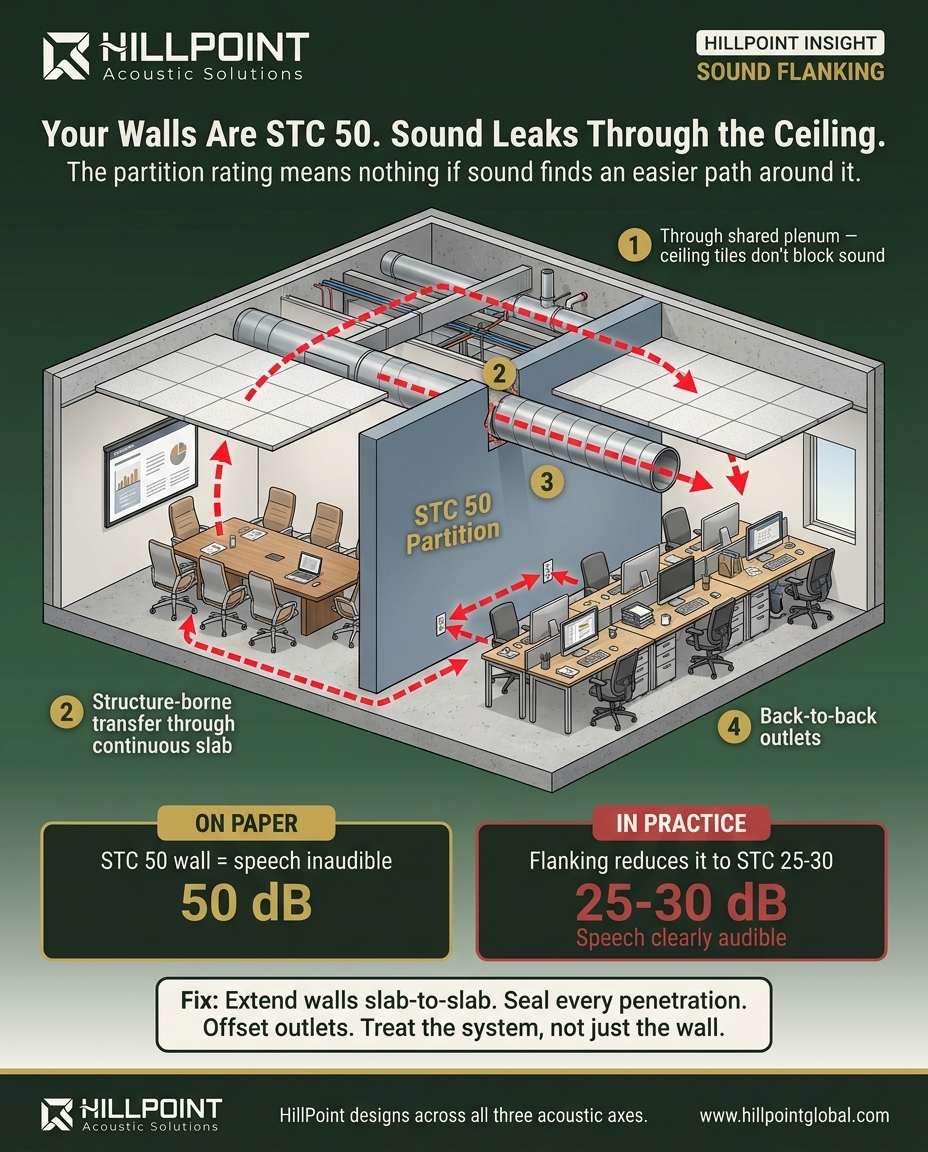
An STC 50 partition wall should make normal conversation completely inaudible between two rooms. That's the lab result. On a real project site, the same wall assembly often delivers STC 25 to 30, which means you can hear speech clearly enough to follow the content.
The wall rating isn't wrong. The assumption that sound only travels through the wall is. The soundproofing solutions India guide puts this flanking problem into the wider wall-door-floor-ceiling assembly that project teams have to control.
The plenum path
This is the most common flanking route in commercial interiors. The partition wall runs from the floor to the underside of the suspended ceiling. Above the ceiling line, the wall stops. The plenum space, that open cavity between the ceiling tiles and the structural slab, connects both rooms.
Sound passes up through the ceiling tile on one side, ceiling tiles are absorptive, not sound-blocking, so they barely resist airborne sound transmission, travels across the open plenum, and drops back through the ceiling tile into the adjacent room. The STC 50 wall is doing its job. The problem is that sound found a path that bypasses it entirely.
The fix is to extend the partition from the structural floor to the structural slab above, sealing the gap at the top with acoustic sealant. This is sometimes called a full-height or slab-to-slab partition. It's standard practice in rooms that need genuine privacy, like boardrooms, HR offices, and healthcare consultation rooms, but it's skipped surprisingly often in general office fit-outs where the cost and coordination of extending walls through the ceiling zone isn't budgeted.
Duct and service penetrations
Every penetration through a partition wall creates a potential flanking path. HVAC ducts, cable trays, plumbing risers, and fire sprinkler pipes all pass through walls, and if the gap around the penetration isn't properly sealed with acoustic material, sound transmits through the opening.
A 25mm unsealed gap around a duct penetration can reduce effective wall isolation by 10 dB or more. That's the difference between "can't hear speech" and "can follow the conversation." Acoustic sealant or fire-rated acoustic wrapping around every penetration is the standard approach, but it requires coordination between the acoustic consultant, the mechanical engineer, and the contractor. If nobody owns the spec, it doesn't happen.
Electrical back-boxes
Back-to-back electrical outlets on a shared partition wall create a direct acoustic bridge. The plasterboard is recessed on both sides at the same point, leaving a thin cavity between the two outlet boxes that transmits sound with almost no resistance.
Offsetting outlets horizontally by at least 400 mm eliminates this path. Some specifications call for fire-rated putty pads behind each outlet box as an additional measure. It's a small detail, but acoustically it's one of the most common sources of privacy complaints after occupancy, because it's invisible and easily missed during construction.
The floor path
Low-frequency sound transmits through the floor slab under a partition wall, especially in concrete structures. The slab acts as a continuous acoustic bridge between adjacent spaces. Impact noise, such as dropped objects or footfall, travels particularly well through this route.
For rooms that need high isolation, an acoustic break at the slab edge (a resilient layer or gap-fill material where the wall meets the floor) reduces structure-borne flanking. This is more common in studio, healthcare, and high-end hospitality applications than in typical office fit-outs.
How this connects to the three axes
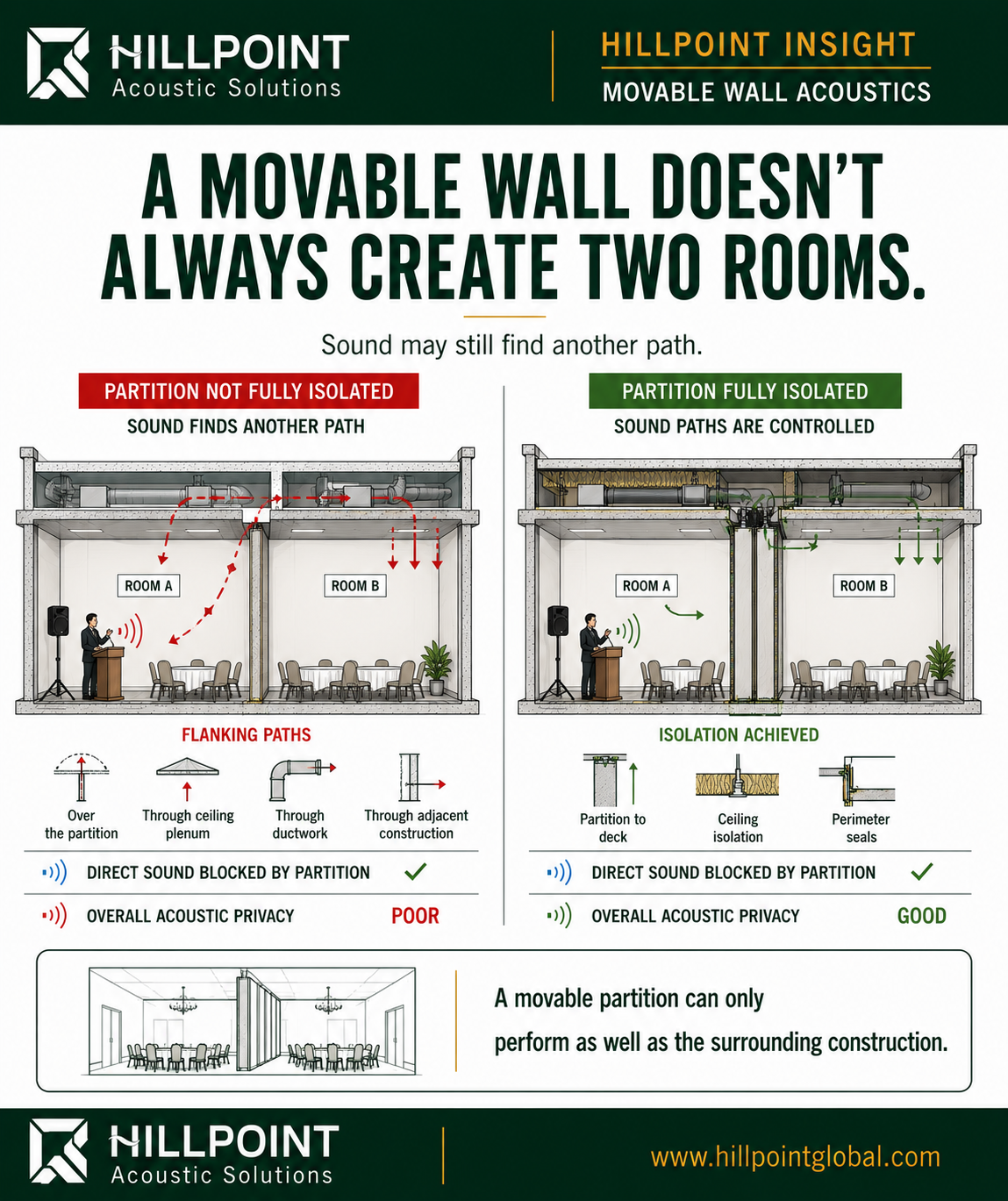
HillPoint's three axes framework addresses this directly. Most flanking problems happen when the design treats one axis (BLOCK, through the wall) while ignoring the other two (ABSORB within the room, ISOLATE through the structure). Flanking is what happens when the weakest path determines the result, regardless of how strong the main barrier is.
Designing for all three axes means specifying slab-to-slab partitions (BLOCK), treating the ceiling zone above for absorption (ABSORB), and isolating service penetrations and structural connections (ISOLATE). HillPoint works across all three because we manufacture the panels, doors, and partition systems and handle installation, which means we can coordinate the details that usually fall between trades.
For office projects where speech privacy is a design requirement, a flanking audit during the design phase costs a fraction of the retrofit needed to fix it after occupants move in.
Technical Guides
Need the full acoustic treatment and soundproofing guides?
The long-form acoustic panels India guide covers panel types, NRC logic, standards, and room treatment. The soundproofing solutions India guide covers STC logic, doors, walls, floors, and the block-and-isolate side of the same design problem.