STC ratings explained: what your acoustic door actually blocks
STC ratings turn door privacy into a measurable specification, but the rating only matters when the core, seals, frame, and installation all work together.
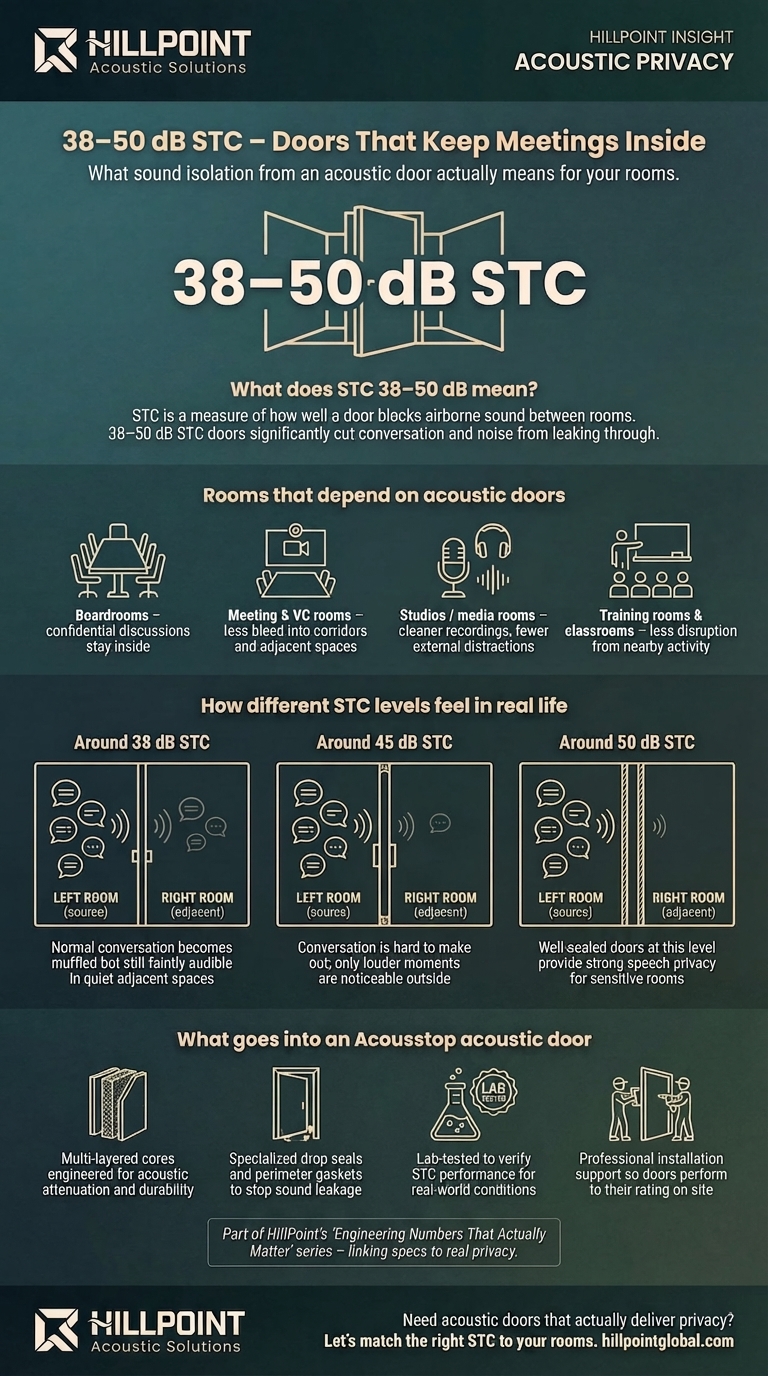
STC stands for Sound Transmission Class. It measures how well a door, wall, or window blocks airborne sound from passing through to the other side. The higher the number, the more sound gets stopped.
Most people see "STC 45" on a spec sheet and have no idea what that actually means for their room. So here is what different levels feel like in practice. For the wider context around walls, floors, ceilings, and flanking paths, the soundproofing solutions India guide connects the door rating to the rest of the assembly.
At STC 38, normal conversation in one room becomes muffled in the adjacent room, but it is still faintly audible if the other room is quiet. You can tell someone is talking. You might catch a few words. For a general office corridor, that's often acceptable.
At STC 45, conversation is hard to make out. You'd hear louder moments, a laugh or a raised voice, but you could not follow the discussion. For most meeting rooms and conference spaces, this is the practical minimum.
At STC 50, a well-sealed door provides strong speech privacy. You might know someone is in the room, but you can't hear what they're saying. Boardrooms with confidential discussions, HR rooms, and medical consultation spaces all sit closer to this target.
STC rating chart for acoustic doors
As a working chart, STC 38 is suitable where conversation can be muffled but not fully private, STC 45 is the practical minimum for meeting rooms and conference spaces, and STC 50 is the stronger target for boardrooms, HR rooms, medical consultations, studios, and other speech-privacy spaces.
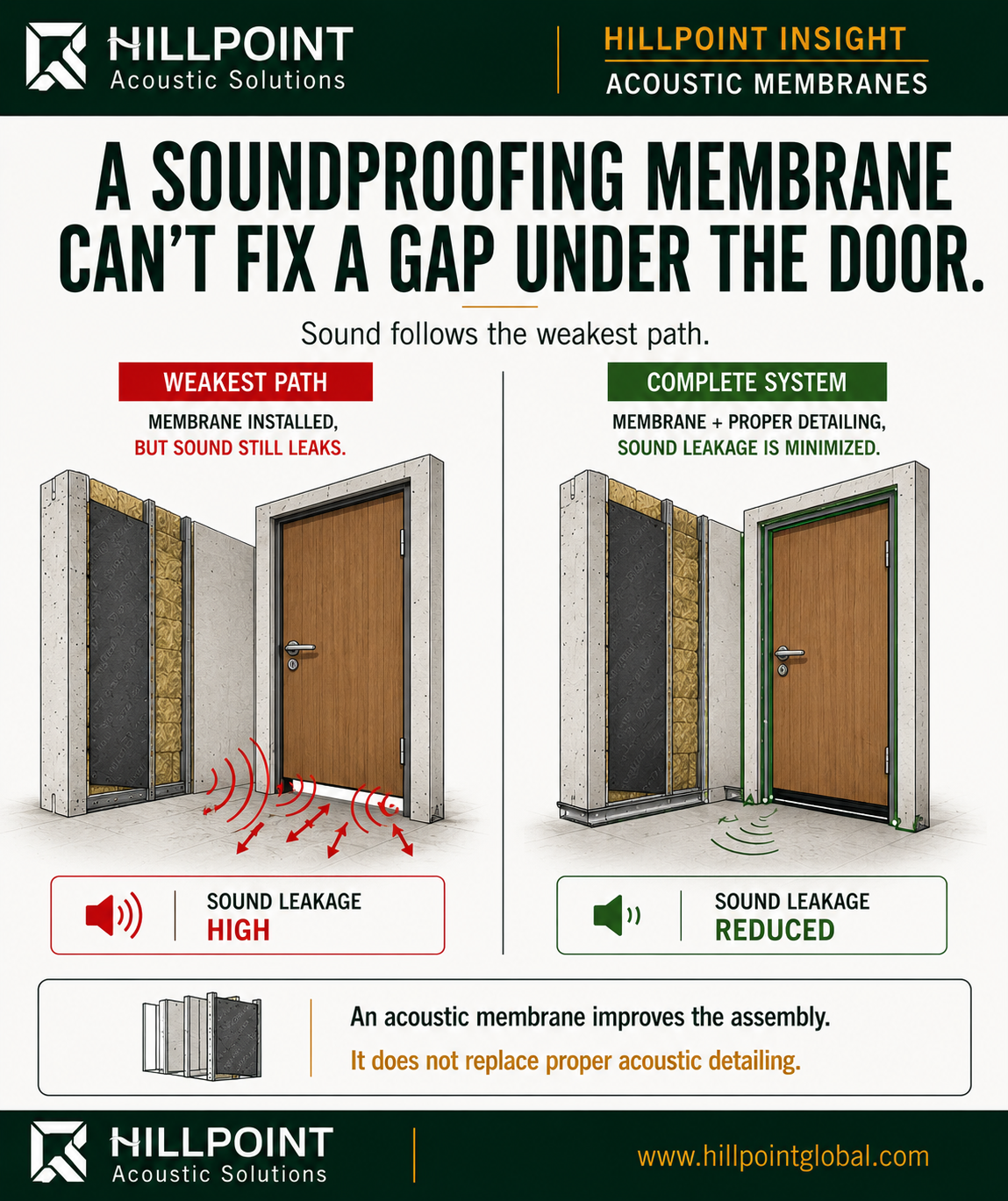
The rating only holds when the full door assembly is specified together: acoustic core, perimeter gasket, automatic drop seal, frame, threshold, and installation tolerance. A strong leaf with weak seals performs like the gaps around it, not like the lab certificate.
The door is usually the weak point
Architects spec STC 53 partition walls between conference rooms and adjacent offices all the time. That's standard for WELL certification. But then a hollow-core interior door goes into the opening, and that door might have an STC of 22 to 25. Sound doesn't care how good the wall is if it can leak through the door.
This is probably the most common acoustic mistake in commercial interiors. The weakest element in the partition assembly sets the effective sound isolation of the entire wall. A $30,000 partition wall with a $200 door is a $200 door, acoustically speaking.
The fix isn't complicated. An acoustic door with the right STC rating, proper drop seals at the bottom edge, and perimeter gaskets around the frame closes the gap. The door becomes part of the sound barrier instead of the hole in it.
What goes into an acoustic door
Our Acousstop acoustic doors achieve STC ratings from 38 to 50 through a few specific design choices. The core is multi-layered, engineered for acoustic attenuation rather than just structural integrity. The seals matter as much as the core: specialised drop seals at the bottom automatically engage when the door closes, and perimeter gaskets around the frame eliminate the air gaps where sound would otherwise leak through.
Every door is lab-tested to verify the STC rating under controlled conditions. That matters because a door that's rated STC 45 in a lab can underperform on site if the installation is sloppy. Frame alignment, seal compression, threshold gaps, all of it affects the real-world performance. That's why we handle installation ourselves, because on-site performance needs to match the spec.
Where acoustic doors actually get specified
Boardrooms and executive meeting rooms where confidential conversations need to stay inside. Video conference rooms where corridor noise from outside bleeds into the microphone. Recording studios and media rooms where any external noise is unacceptable. Training rooms and classrooms where activity in adjacent spaces disrupts the session. Hospital consultation rooms where patient privacy is a regulatory requirement, not just a preference.
In every case, the door is the component most likely to be under-specified. The walls get attention. The ceiling gets attention. The door gets whatever the fitout contractor had in stock.
If you're working on a project where sound isolation matters between rooms, check the door STC before you spec anything else. It is the bottleneck, and it is the most fixable one.
Technical Guides
Need the full acoustic treatment and soundproofing guides?
The long-form acoustic panels India guide covers panel types, NRC logic, standards, and room treatment. The soundproofing solutions India guide covers STC logic, doors, walls, floors, and the block-and-isolate side of the same design problem.