Server Room Soundproofing: How to Block 85 dB Without Blocking Airflow
Server rooms run at 85 dB. The office next door needs 45 dB. Here is how acoustic wall assemblies, louvres, and doors deliver that 40 dB gap without blocking airflow.
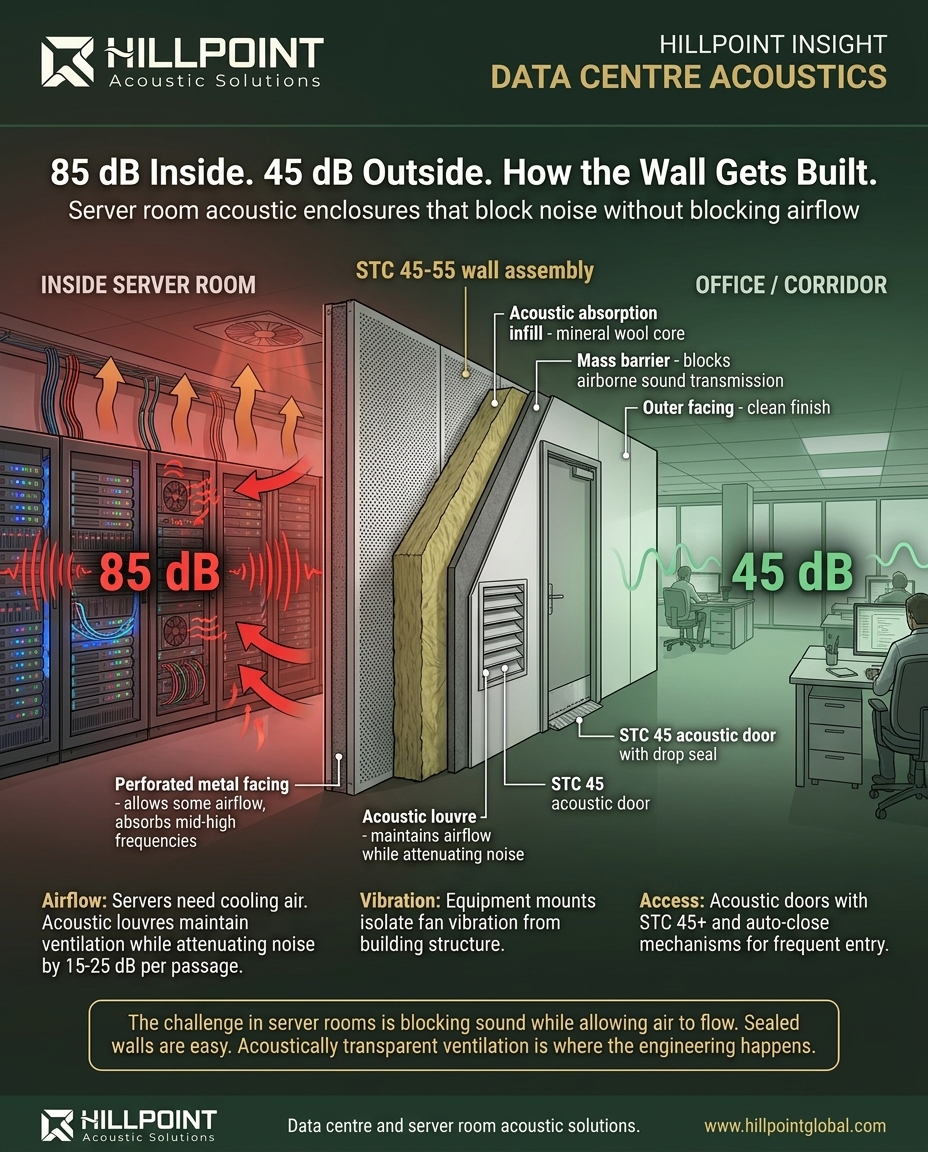
A server room full of rack-mounted equipment runs continuously at 80 to 90 dB. That's the aggregate noise from hundreds of cooling fans, power supply units, and HVAC systems keeping everything at operating temperature. The people working in the office 5 metres away need background noise below 45 dB to concentrate, hold conversations, and take phone calls without raising their voices.
The 35 to 40 dB gap between those two numbers is what the acoustic enclosure has to deliver. In a sealed room, that's straightforward: add enough mass and you block the sound. Server rooms aren't sealed. They need continuous airflow for cooling, frequent door access for maintenance, and cable penetrations through walls and floors. Every one of those functional requirements creates a potential acoustic weakness.
The wall assembly
A typical server room acoustic wall assembly has four layers, each serving a different function.
The inner facing, on the server room side, is a perforated metal panel. HillPoint's MetPan perforated metal panels serve this role. The perforations allow sound energy to pass through the metal surface and into the absorptive layer behind. The perforation pattern (hole diameter, spacing, and open area percentage) is tuned to the frequency range of server fan noise, which is predominantly in the 500 Hz to 4000 Hz range.
Behind the perforated facing sits an acoustic infill layer, typically mineral wool at 48 to 80 kg/m3 density. This layer absorbs the sound energy that passes through the perforations, converting it to heat. The thickness of the infill determines how much low-frequency absorption the assembly achieves: 50mm handles mid and high frequencies well, while 100mm extends the absorption meaningfully below 500 Hz.
The mass barrier layer sits behind the infill. This can be a dense plasterboard, cement board, or mass-loaded vinyl sheet. Its job is to block whatever airborne sound energy makes it through the absorption layer. Mass blocks sound, and the denser this layer, the higher the STC rating of the overall assembly.
The outer facing, on the office side, is a standard finish panel (painted plasterboard or metal cladding) that provides the clean visual finish and seals the assembly.
Together, a well-designed four-layer wall assembly achieves STC 45 to 55, which translates to a 45 to 55 dB reduction in sound transmission. For a server room running at 85 dB, an STC 50 wall delivers roughly 35 dB on the office side, which is well within the comfortable range.
The ventilation challenge
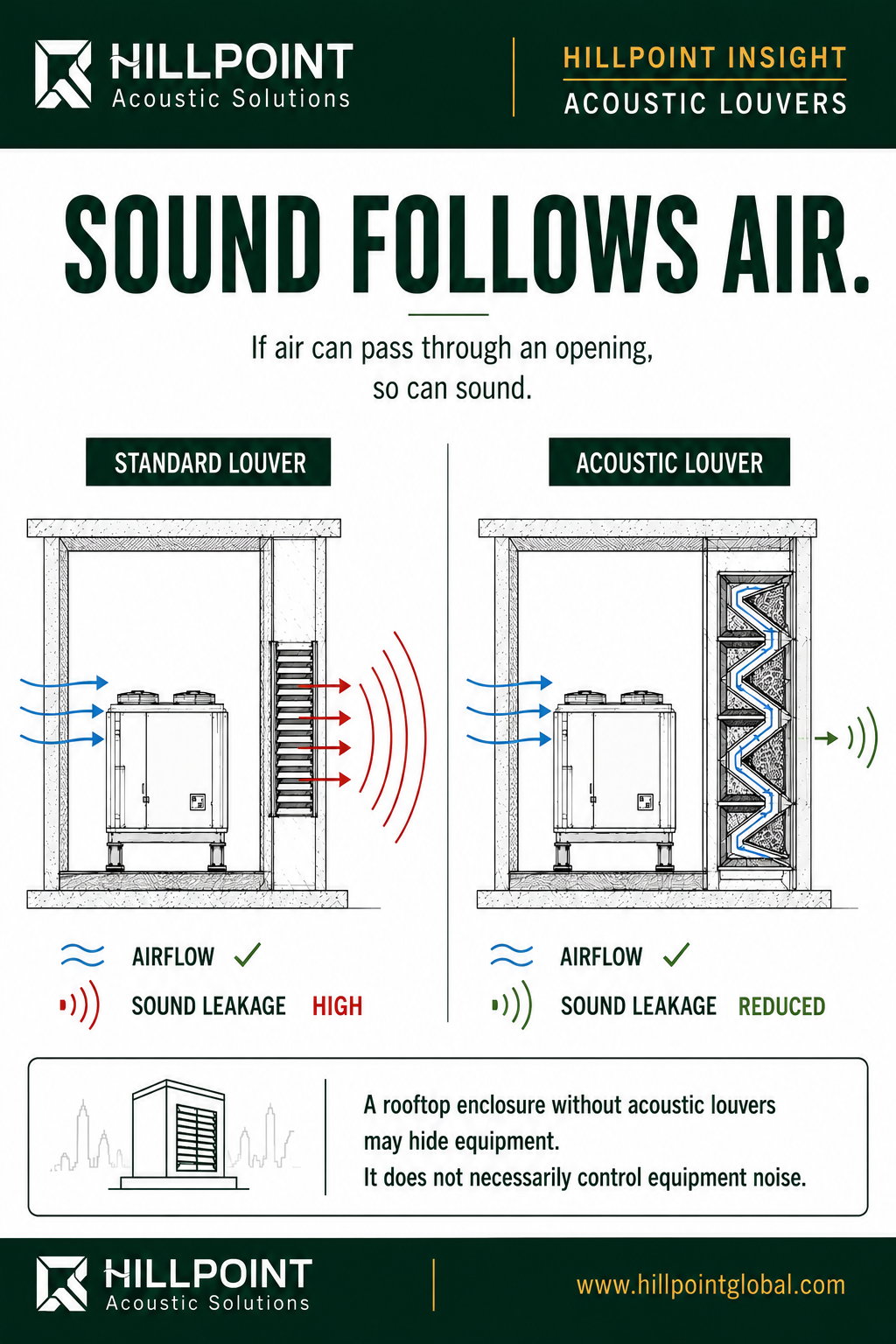
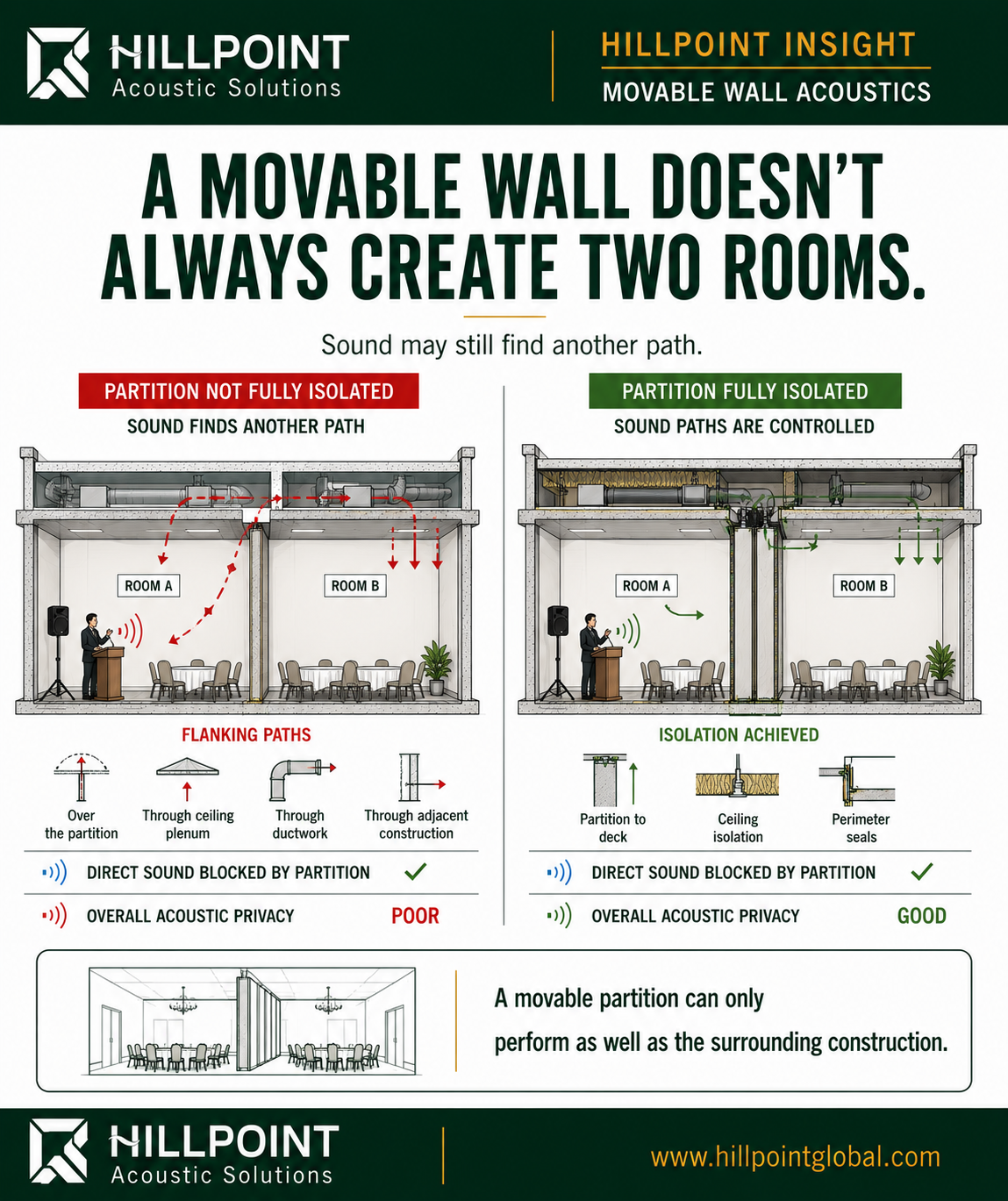
Servers generate heat. The cooling system has to remove that heat, and that means air has to move through the enclosure walls. Every ventilation opening is a potential sound leak that bypasses the wall assembly entirely, just as flanking paths bypass partition walls in offices.
Acoustic louvres are the standard solution. A louvre consists of angled blades with absorptive faces that allow air to pass through while forcing sound waves to bounce between the blades and lose energy with each reflection. A well-designed acoustic louvre attenuates 15 to 25 dB per passage while maintaining the airflow volume the cooling system requires.
The trade-off is pressure drop. More aggressive acoustic attenuation (more blades, tighter spacing, thicker absorption) means more resistance to airflow, which means the HVAC fans have to work harder. The louvre specification has to balance acoustic performance against the mechanical engineer's air volume and pressure requirements. Getting this balance wrong in either direction creates problems: too little attenuation and the office is noisy, too much restriction and the servers overheat.
Doors and penetrations
IT staff access server rooms frequently, sometimes dozens of times a day. Every time the door opens, the enclosure's acoustic integrity drops to zero for those seconds. An acoustic door with STC 45 and an automatic closing mechanism minimises the open time and restores the seal immediately. HillPoint manufactures acoustic doors with multi-layered cores and automatic drop seals that engage on closure.
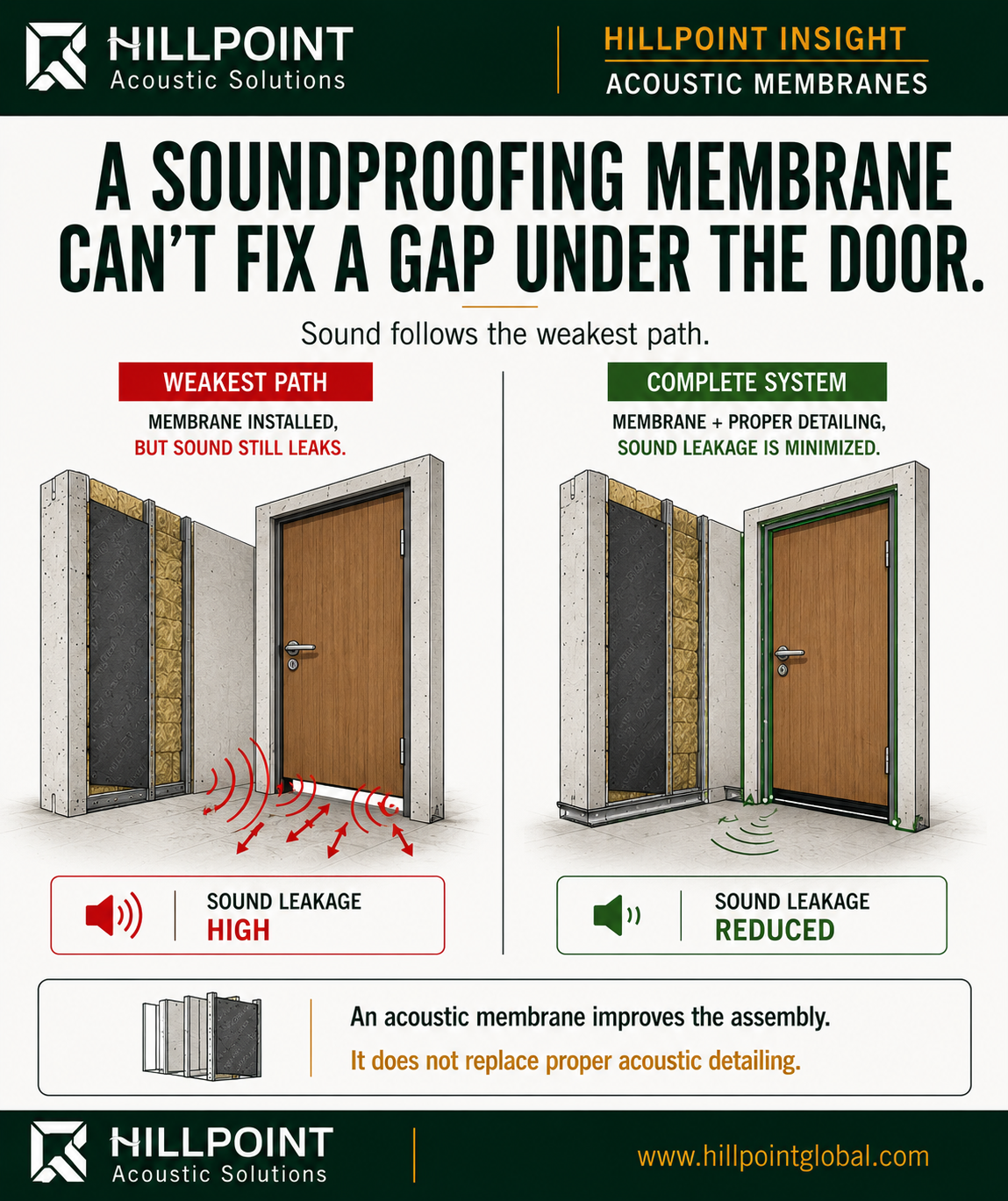
Cable penetrations through walls and floors are the other common weak point. Data cables, power feeds, and cooling pipes pass through the enclosure wall, and if the gaps around them aren't sealed with fire-rated acoustic sealant, sound transmits through the opening. This is the same flanking principle that affects office partitions, applied to a higher-noise-level environment.
India's growing data centre market
India's data centre construction pipeline is expanding rapidly. New facilities in Mumbai, Chennai, Hyderabad, and Bangalore are bringing server rooms into mixed-use commercial buildings where the adjacent spaces are offices, retail, or residential. The acoustic requirements are more demanding in these mixed-use contexts than in standalone data centre campuses, because the sensitive receivers are immediately adjacent rather than hundreds of metres away.
For data centre projects where HillPoint is involved early, we coordinate the MetPan wall panels, acoustic doors, and louvre specifications as one integrated acoustic enclosure. The wall assembly, ventilation treatment, and door performance all need to hit their respective targets for the enclosure to work as a system.
The acoustic spec for the server room enclosure should be set before the HVAC layout is finalised, because the louvre position, size, and attenuation requirement directly affect the duct routing and fan sizing. Getting this sequence right at design stage prevents the costly retrofits that follow when the office neighbour starts complaining about the hum from the server room after move-in.
Technical Guides
Need the full acoustic treatment and soundproofing guides?
The long-form acoustic panels India guide covers panel types, NRC logic, standards, and room treatment. The soundproofing solutions India guide covers STC logic, doors, walls, floors, and the block-and-isolate side of the same design problem.