Acoustic Panel Air Gap: Why 50mm of Empty Space Outperforms a Thicker Panel
A 50mm air gap behind an acoustic panel can improve low-frequency absorption as much as doubling the panel thickness. Here is how mounting method changes NRC.
The panel everyone worries about. The air gap nobody thinks about. That gap probably does more for your room's acoustics than choosing between two panels with similar NRC ratings.
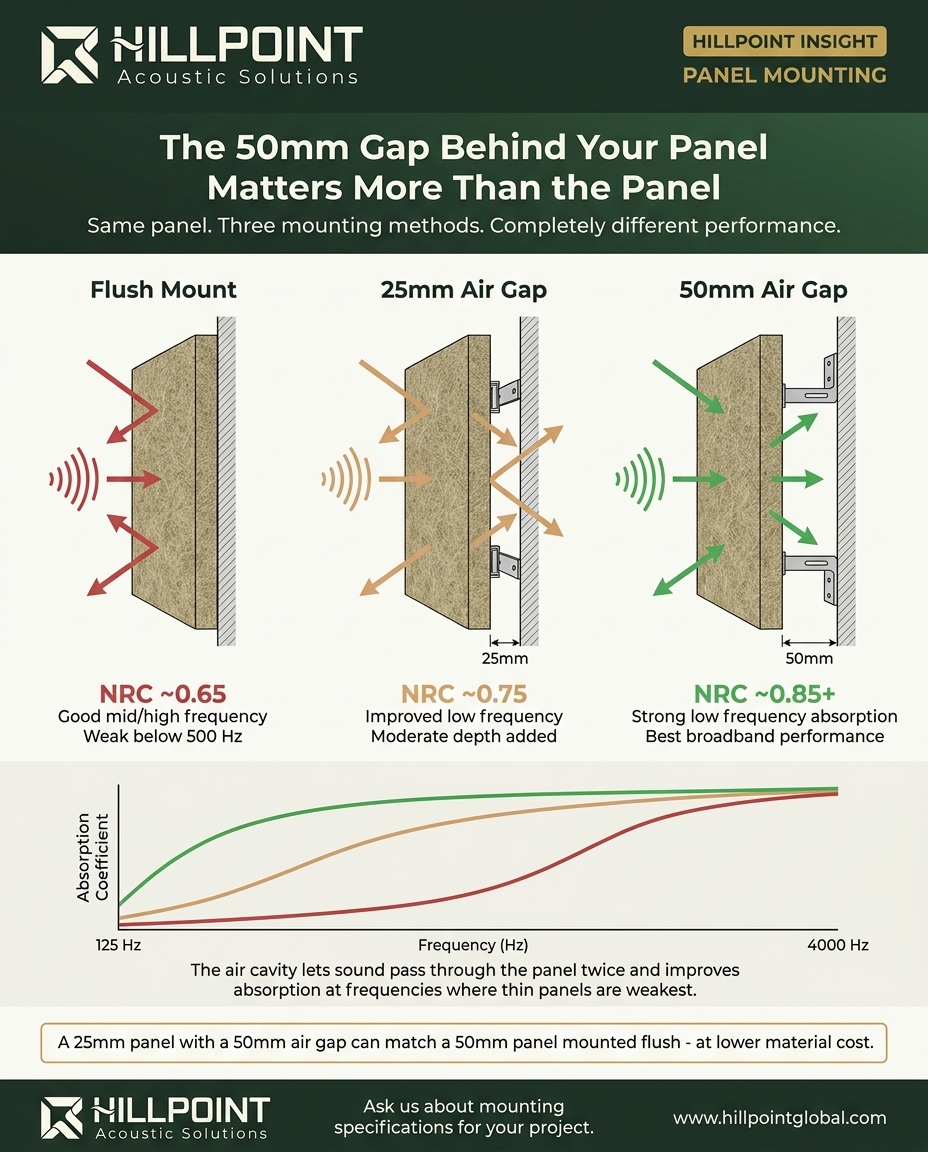
A 25mm PET acoustic panel mounted flush against a wall absorbs sound reasonably well at mid and high frequencies. That same panel with a 50mm air gap behind it absorbs meaningfully more at low frequencies, sometimes performing on par with a panel twice as thick mounted directly on the wall. The panel didn't change. The space behind it did.
How the air gap works
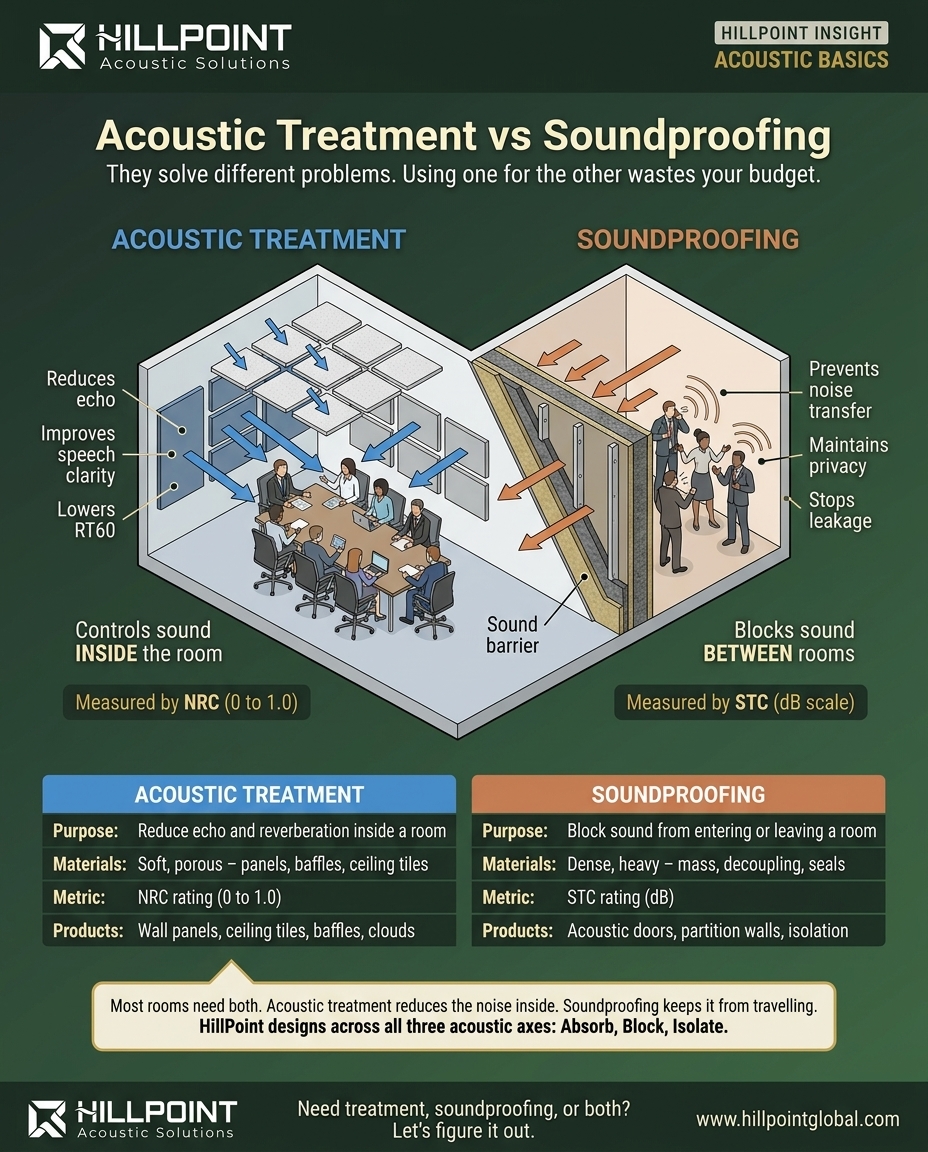
Sound waves hit the panel surface and penetrate the absorptive material. Some of that energy converts to heat through friction within the fibres, that's absorption. The remaining energy passes through the panel, hits the hard wall behind it, and reflects back through the absorptive material a second time, losing more energy on the return pass.
The air cavity itself acts as an additional absorption mechanism. At the wall surface, air particle velocity is zero and pressure is maximum. As you move away from the wall into the cavity, velocity increases. Porous absorbers work by converting air movement into heat through friction, so positioning the absorptive material away from the wall, where particle velocity is higher, makes it more effective at converting sound energy, particularly at lower frequencies where wavelengths are longer.
A 50mm cavity shifts the panel's absorption peak downward in frequency. A 100mm cavity shifts it further. The practical implication is that a 25mm PET panel with a 50mm air gap can handle a broader frequency range than a 50mm panel mounted flush, at lower material cost. Research across multiple testing labs following ISO 354 standards confirms that mounting type has a significant impact on measured NRC values. The same product can test at NRC 0.65 in Type A mounting (flush against backing) and NRC 0.85 or higher in Type E mounting (with a plenum behind it).
Three mounting methods compared
Flush mount (Type A equivalent): Panel adhered or mechanically fixed directly to the wall surface. Minimal depth added. Good mid and high frequency absorption. Weakest at low frequencies. Simplest installation. Lowest cost.
Air gap mount (25 to 50mm standoff): Panel held away from the wall using timber battens, Z-clips, or standoff brackets. Moderate depth added. Improved low-frequency absorption. The sweet spot for most commercial applications where some bass control matters but space isn't unlimited.
Deep cavity mount (100mm+): Panel suspended with a large air gap behind it. Maximum broadband absorption including meaningful low-frequency control. Used in recording studios, broadcast facilities, and auditoriums where bass management is critical. Requires more depth, which limits use in corridors and compact rooms.
HillPoint manufactures wooden panels, SOF PET panels, and fabric-wrapped panels at our Tamil Nadu facility, and we recommend air gap mounting for most projects where low-frequency control matters. The cost of battens or Z-clips is minor compared to the acoustic improvement.
When flush mount is actually the right choice
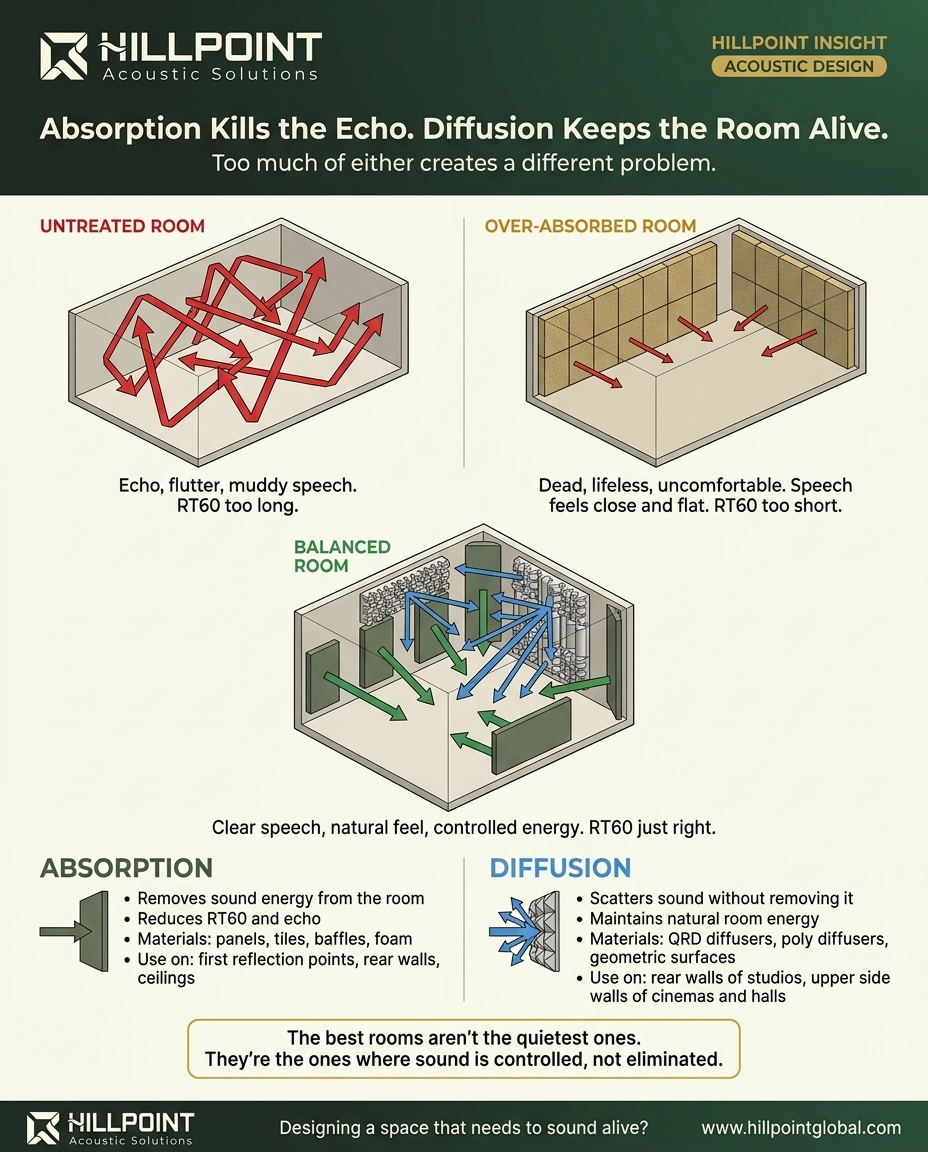
Not every room needs low-frequency absorption. In corridors, reception lobbies, and circulation areas where the primary problem is speech echo and reverberation at conversational frequencies (250 Hz to 4000 Hz), flush-mounted panels do the job well. The low-frequency benefit of an air gap isn't needed because the noise sources in those spaces don't generate significant bass energy.
Space constraints also force the decision. In narrow corridors or rooms where every millimetre of floor area matters, adding 50 to 75mm of depth (panel plus air gap) per wall can feel like too much. That's a fair trade-off to make, as long as it's a conscious decision during design rather than a discovery during installation.
The spec sheet problem
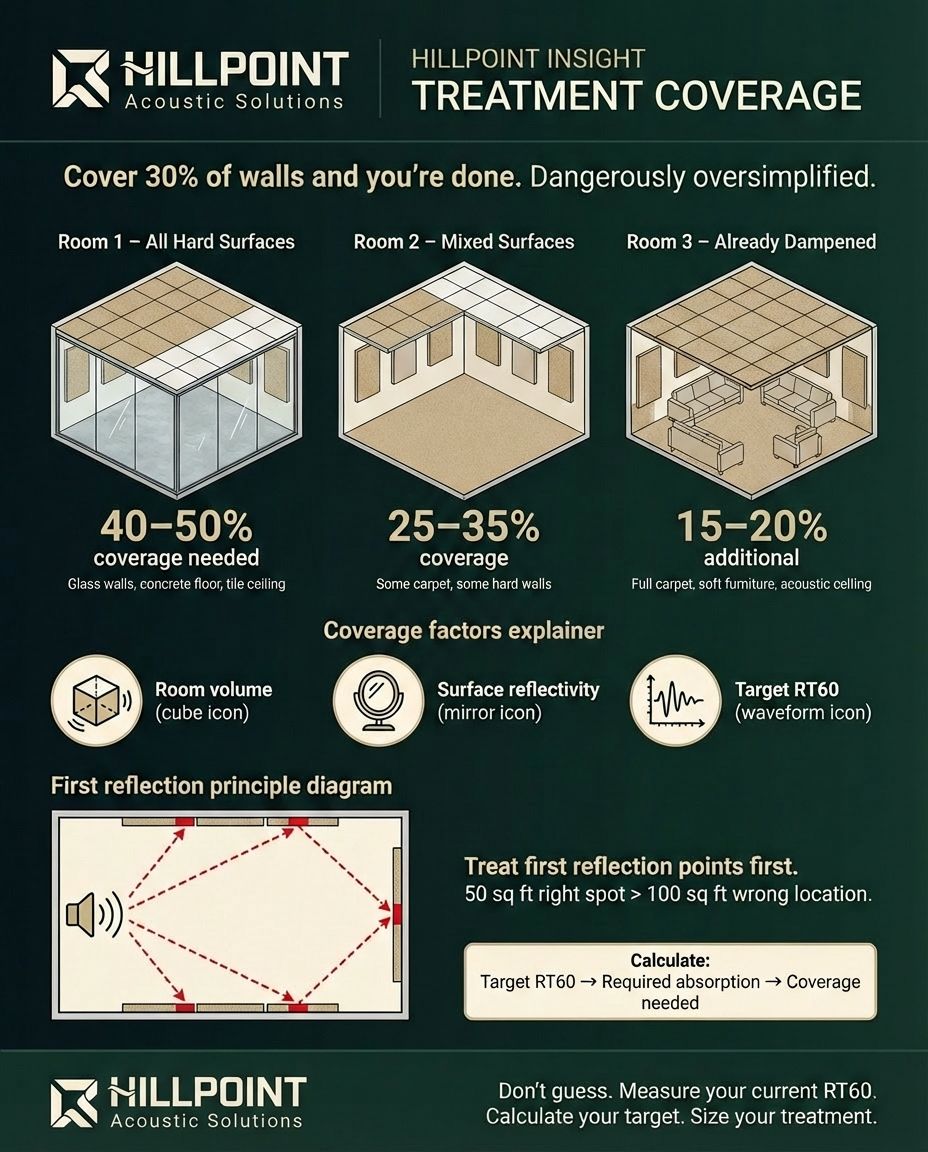
Here's the caveat. Acoustic panel NRC ratings on spec sheets often report the best-case testing result, which usually means a mounting condition with an air gap or fiberglass backing. If you're specifying a panel based on its published NRC 0.90 but installing it flush against a wall, the actual performance will be lower. Ask the manufacturer which mounting type the NRC was tested in.
At HillPoint, we publish test results with the mounting method specified. If a panel was tested with an air gap, we say so. If the flush-mount result is different, we report that too. It's the only way to make an honest specification.
Practical takeaway
If your project has rooms with low-frequency problems (HVAC rumble, bass from adjacent spaces, music venues, auditoriums) and you have 50 to 100mm of depth available behind the panels, use it. The air gap costs almost nothing in materials and can shift the panel's effective performance by half a NRC grade or more at the frequencies that matter most.
Technical Guides
Need the full acoustic treatment and soundproofing guides?
The long-form acoustic panels India guide covers panel types, NRC logic, standards, and room treatment. The soundproofing solutions India guide covers STC logic, doors, walls, floors, and the block-and-isolate side of the same design problem.