Reverberation time (RT60): the number that defines how your room sounds
RT60 measures how long sound lingers in a room, and it explains why a boardroom, classroom, office, and concert hall need very different acoustic targets.
Most people don't think about how long sound lingers in a room until they're stuck in a conference call where every word has a tail on it. That lingering is reverberation, and it has a number: RT60. It measures how long sound takes to decay by 60 decibels after the source stops.
The number matters more than most people in construction realize. It's the difference between a meeting room where speech is clear and one where every sentence piles up on the last.
What the targets look like
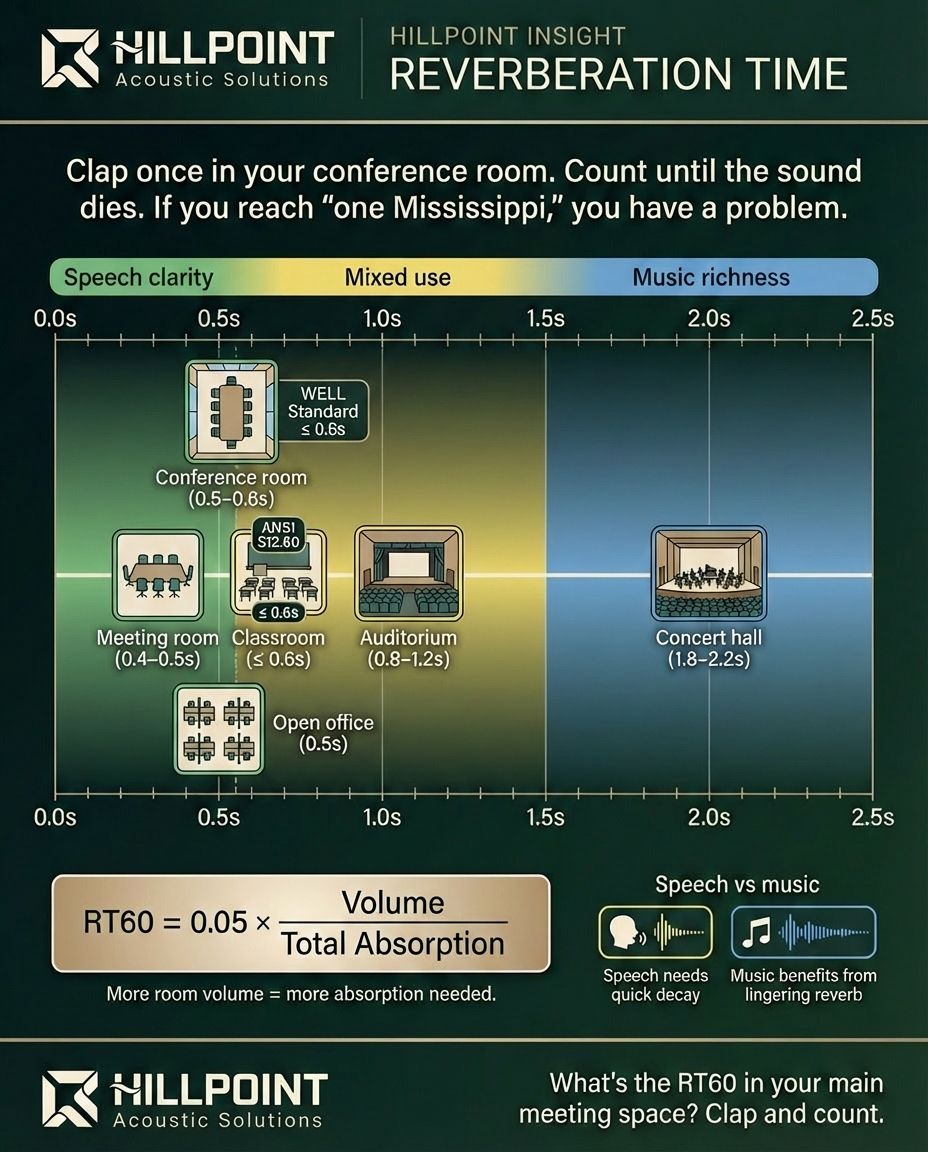
For a small meeting room you want RT60 somewhere around 0.4 to 0.5 seconds. Conference rooms can handle 0.5 to 0.6. Classrooms should stay under 0.6, and that's actually an ANSI S12.60 requirement, not just a preference. Schools that don't meet it are making it harder for students to understand the teacher, which is a measurable learning outcome issue.
Open offices need about 0.5 seconds, which is harder to hit than it sounds because there's so much volume and so few absorptive surfaces. All that air means more reverberation, and the lack of walls means fewer places to put absorption.
Auditoriums sit higher at 0.8 to 1.2 seconds, and concert halls go all the way up to 2.2 because you actually want reverb blending the music together. A concert hall that sounds like a boardroom would be terrible, but most people don't realize the reverse is equally true. A boardroom that sounds like a concert hall is just as bad for its purpose.
The Sabine formula
The math is the Sabine formula: RT60 equals 0.161 times Volume divided by Total Absorption. Bigger room, more absorption needed. It's one of the oldest equations in acoustics and it still holds up for most standard room shapes.
It explains why that double-height lobby sounds fine when it is empty but turns into a mess during all-hands meetings. The volume stayed the same, the number of voices went up, and nobody added absorption to match. It also explains why small rooms with hard surfaces can have surprisingly long reverberation: a 3x4 meter glass conference room can hit RT60 of 1.2 seconds, which is auditorium territory.
For anyone speccing acoustic treatment, the formula tells you how much absorption you need. Measure the room volume, decide your target RT60, and calculate the total absorption area required. Then figure out which products at which NRC ratings get you there. A Comfy panel at NRC 0.9 provides 0.9 sabins per square meter. A Niche wooden panel at NRC 0.8 provides 0.8. You add up the surfaces until you hit the total the formula demands.
WELL Building Standard and RT60
The WELL Building Standard has picked up on this. Offices going for WELL certification now need to prove RT60 under 0.6 for conference rooms and 0.5 for open workspaces. That's caught a lot of project teams off guard because nobody was measuring reverberation until certification audits started asking for it.
If you're on a project targeting WELL certification, or any green building standard that includes acoustic performance, the RT60 requirement is something to plan for during design. Retrofitting absorption into a finished space to pass an audit is more expensive and more disruptive than getting it right the first time.
ANSI S12.60 does the same thing for educational spaces. The standard caps RT60 at 0.6 seconds for classrooms under 283 cubic meters. Larger lecture halls have different targets. If you're working on a school or university project in India or the GCC, this standard is probably in the consultant's specification already.
When simple estimates aren't enough
The Sabine formula works well for rooms that are roughly rectangular with reasonably even distribution of absorption. For spaces with unusual geometries, very high ceilings, or mixed-use areas where the acoustic conditions change, like a hotel lobby that doubles as an event space, you might need more detailed analysis. That's where working with an acoustic consultant during the design phase saves money later.
That said, for most conference rooms, classrooms, and office spaces, the formula gives you a good starting point. You can get surprisingly close to the right answer with a tape measure, a calculator, and the NRC ratings from the product spec sheets.
The clap test
If you've never measured RT60 in your main meeting room, even a simple clap test tells you something. Clap once, loud, and count the tail. Past one second and you probably have a problem worth looking at. Below half a second and you're in decent shape for speech.
For proper measurement, a calibrated microphone and analysis software gives you the real number. But the clap test is free and it's enough to tell you whether the room needs attention or not.
The product pages for Comfy Panels, Niche Panels, Wood Baffles, SOF Baffles, and Comfy Tile panels all include NRC ratings you can use in Sabine calculations. For project-specific acoustic consulting, get in touch through the contact page.
Technical Guides
Need the full acoustic treatment and soundproofing guides?
The long-form acoustic panels India guide covers panel types, NRC logic, standards, and room treatment. The soundproofing solutions India guide covers STC logic, doors, walls, floors, and the block-and-isolate side of the same design problem.