Auditorium acoustics: from echo chamber to every seat crystal clear
Auditorium acoustics are judged from the back row: speech must stay clear, reverberation must stay controlled, and the room still needs enough life for events.
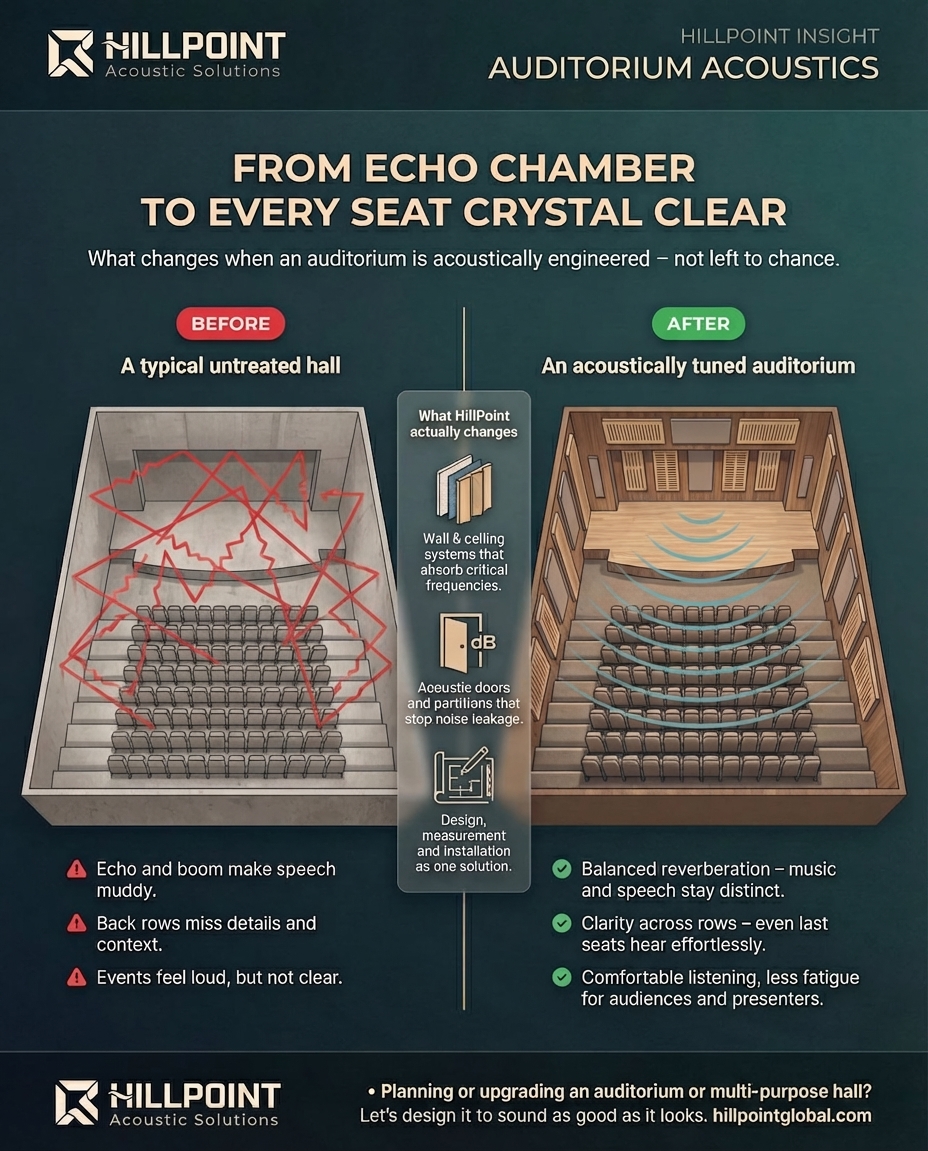
If your back rows are missing words and your events feel loud but unclear, you're dealing with the most common auditorium problem there is. The sound is reaching everyone, but so are its reflections. The direct voice from the stage and the reflected copies from the walls and ceiling arrive at different times, and the result is a muddiness that gets worse the further back you sit.
It is worth being specific about what "muddy" actually means here. In an untreated auditorium, the reverberation time might sit at 2.5 to 3.0 seconds. That means sound bouncing off hard walls and ceilings takes nearly three seconds to decay. For music, a long reverberation can actually be desirable, because it adds warmth and fullness. For speech, it is destructive. Syllables pile up on each other. The beginning of one word is still bouncing around the room when the next word arrives. The person in row 20 gets a smeared version of what the person in row 3 hears clearly.
What changes in a treated auditorium
The difference between an untreated hall and one that's been acoustically engineered is not subtle. The reverberation drops to something between 0.8 and 1.2 seconds depending on the primary use. Speech stays distinct from front row to back. The overall volume level can actually come down because the PA system doesn't need to fight its own reflections. And the audience experiences less listening fatigue, which matters when events run two or three hours.
The treatment itself involves three things working together. Wall panels on side walls and the back wall absorb the lateral reflections that cause the worst intelligibility problems. Ceiling treatment, usually a mix of absorption and controlled reflection, handles the overhead energy and can be tuned to help project sound from the stage toward the audience. And acoustic doors at the entrances keep corridor noise, HVAC rumble, and lobby chatter from bleeding in during performances.
The wall panel choice depends on the look the architect wants. Wooden grooved panels or perforated wooden panels give the warm timber aesthetic that most auditoriums go for. Fabric-wrapped panels or stretch systems work when the design calls for a smoother finish. The choice is visual first, because the acoustic performance can be matched across panel types by adjusting thickness and backing material.
The multipurpose hall problem
The hardest auditoriums to get right are the ones that host both speech and music. A lecture wants short reverberation for clarity. A concert wants longer reverberation for fullness. A school assembly hall that does both every week needs to land somewhere in the middle.
The usual approach is to design for speech clarity, around 0.8 to 1.0 seconds RT60, and accept that music performances will be slightly drier than ideal. The reverse, designing for music and accepting muddy speech, is worse because assemblies and presentations happen more often than concerts in most auditoriums.
Some larger venues solve this with variable acoustics, where heavy curtains or movable panels can be deployed or retracted to change the room's absorption characteristics between events. That's a more expensive approach and only makes sense for venues with frequent musical programming.
Why the back rows matter most
The acoustic design of an auditorium is really about the last row. The front rows will sound acceptable in almost any room because they're close enough to the source that direct sound dominates reflections. The back rows are where the problem lives, because by the time the direct sound reaches them, it's weaker relative to all the reflected copies bouncing off the walls and ceiling.
If the person in the last row can follow every word without straining, the room works. If they're leaning forward, asking their neighbour what was said, or giving up and checking their phone, the room has an acoustic problem that no amount of PA system can fully solve.
We've done auditorium and hall projects across the GCC and India, including school auditoriums, university lecture halls, and convention spaces. The product mix varies by project, but the principle is the same: measure the room, set the RT60 target, specify the treatment to hit it, and make sure the installation quality matches the spec. If you're planning or upgrading an auditorium or multipurpose hall, getting the acoustics right from the design stage is what separates a space that looks good from one that sounds good too.
Technical Guides
Need the full acoustic treatment and soundproofing guides?
The long-form acoustic panels India guide covers panel types, NRC logic, standards, and room treatment. The soundproofing solutions India guide covers STC logic, doors, walls, floors, and the block-and-isolate side of the same design problem.