Cinema Acoustics: What Makes a Cinema Sound Like a Cinema
Cinema acoustic design targets RT60 of 0.6 to 0.7 seconds and NC-25 to NC-30 background noise. Here is how treatment and isolation work together.
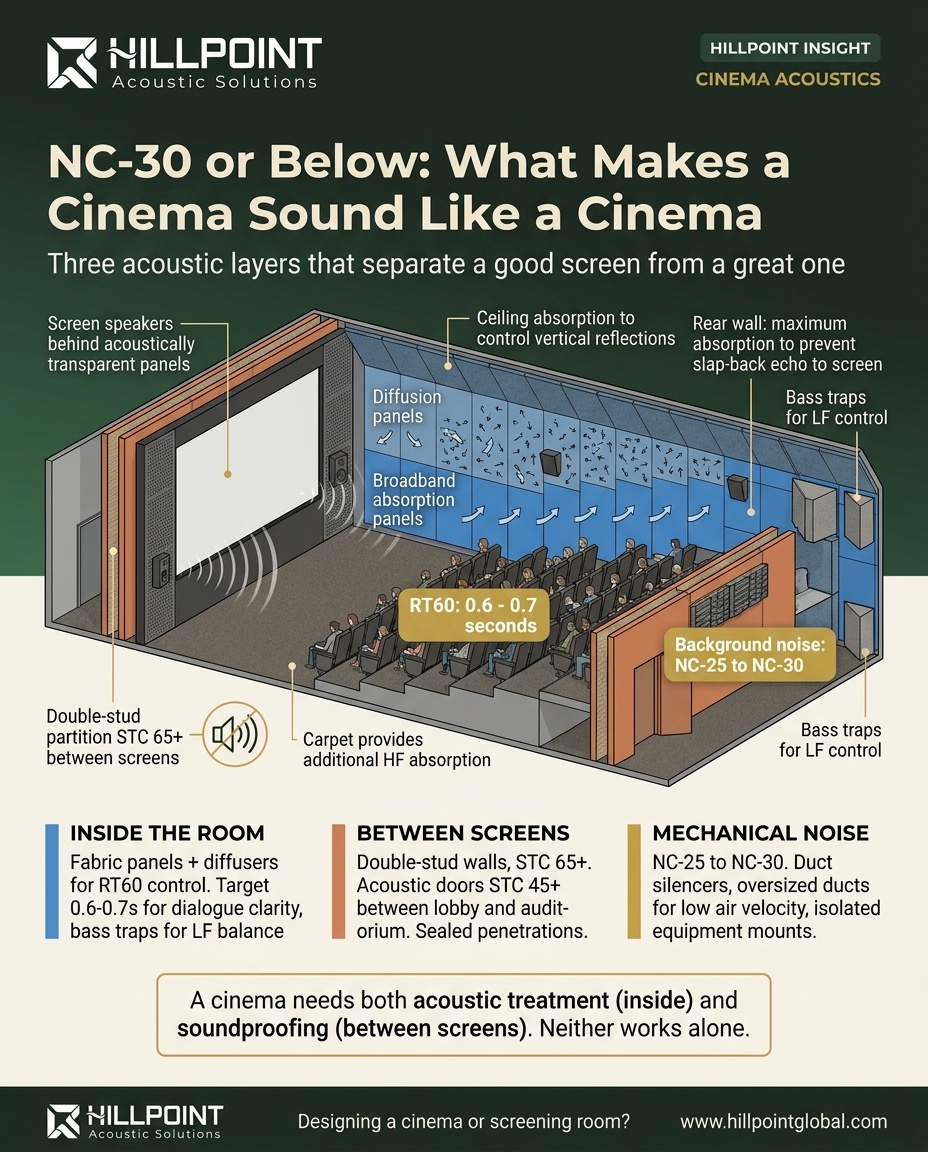
A cinema auditorium has tighter acoustic targets than most people realise. The RT60 needs to sit between 0.6 and 0.7 seconds for clear dialogue reproduction, which is shorter than most conference rooms but longer than a recording studio control room. The background noise needs to stay at or below NC-25 to NC-30, which means the HVAC system essentially has to be inaudible.
Getting both of these right while keeping the room from sounding dead or lifeless is the challenge. Cinemas need enough acoustic energy for the soundtrack to feel alive and immersive, but enough control for spoken dialogue to remain distinct in every seat.
Treatment inside the auditorium
The interior treatment is a mix of absorption and diffusion, and the balance between them matters more than in most other room types.
Side walls at seated ear height (roughly 1.0 to 1.5 metres above the floor) need broadband absorption to control first reflections from the screen speakers. These early reflections arrive within 10 to 20 milliseconds of the direct sound and cause comb-filtering that reduces dialogue clarity and blurs the stereo image. HillPoint's Comfy fabric-wrapped panels and wooden acoustic panels work well in this zone because they provide broadband absorption while matching the aesthetic that cinema interiors require.
Upper side walls benefit from diffusion rather than pure absorption. Diffusion scatters sound energy without removing it from the room, which preserves the sense of spaciousness and envelopment that immersive audio formats depend on. Overabsorbing the upper walls makes the room feel flat and lifeless, which defeats the purpose of premium cinema sound.
The rear wall takes maximum absorption. Any sound reflecting from the rear wall back toward the screen arrives at the audience seats with enough delay to be perceived as a distinct echo, which directly competes with the current dialogue or effect. Heavy absorption on the rear wall, typically covering 80 percent or more of the surface area, eliminates this slap-back reflection.
Corner bass traps at the rear of the auditorium control low-frequency build-up. Cinema subwoofers generate significant energy below 80 Hz, and room modes in the corners can make bass response uneven across the seating area. Trapping at the rear corners smooths out the low-frequency response without reducing the overall bass impact.
The ceiling requires absorption to control vertical reflections between the tiered seating and the ceiling surface. A sloped or stepped ceiling geometry helps distribute reflections, but absorption treatment is usually still needed. The target RT60 of 0.6 to 0.7 seconds can't be achieved from wall treatment alone in a room with a large, untreated ceiling.
Carpet on the floor provides high-frequency absorption that contributes to the overall RT60 control. It also reduces footstep noise from audience movement during the film.
Isolation between screens
A multiplex running six or eight screens simultaneously needs strong isolation between adjacent auditoriums. The dynamic range of modern cinema soundtracks is extreme, with peak levels exceeding 105 dB during action sequences. If the wall between two screens only achieves STC 50, the audience in the quiet drama next door will hear bass rumble and impact effects from the action film.
The standard approach is double-stud partition walls with no rigid connections between the two sides. STC 65 or above is typical for screen-to-screen isolation. Each stud frame carries independent layers of plasterboard with damping compounds, and the cavity between them is filled with mineral wool insulation. The key is that the two wall leaves don't touch, because any rigid connection creates a structure-borne sound bridge that short-circuits the air gap.
Acoustic doors between the lobby and each auditorium need STC 45 at minimum. HillPoint manufactures acoustic doors rated STC 38 to 50 with multi-layered cores and perimeter seals. Cinema doors also need to be heavy enough to self-close quietly and seal properly at the threshold.
Background noise control
NC-25 to NC-30 is the background noise target for cinema auditoriums. IMAX theatres target even lower than NC-35 for standard cinemas, often pushing toward NC-20 for the premium listening environment.
Achieving these levels requires oversized ductwork (larger cross-section means lower air velocity, which means less turbulence noise), acoustically lined ducts, silencers at the AHU outlet, and vibration-isolated mechanical equipment. The HVAC noise path from AHU to auditorium needs the same attention as the partition wall between screens.
If the HVAC system delivers NC-40 inside the auditorium, the quiet passages of any film will be masked by the air conditioning hum. That's the kind of detail that distinguishes a premium cinema experience from a generic one.
Coordinating treatment and isolation
Cinema acoustics require both acoustic treatment and soundproofing working together. The treatment controls how the room sounds inside. The isolation controls what gets in and out. Specifying one without the other produces either a well-isolated room that sounds terrible (too reverberant or too dead) or a beautifully treated room where the film next door bleeds through.
HillPoint provides the interior treatment products (wooden panels, fabric panels, ceiling systems) and the acoustic doors for lobby-to-auditorium barriers. For cinema and multiplex projects, the earlier the acoustic specification enters the design programme, the more options exist for partition wall construction, duct routing, and equipment placement, all of which become harder to change once structural work begins. The soundproofing solutions India guide expands that isolation side across walls, doors, floors, and plant paths.
Technical Guides
Need the full acoustic treatment and soundproofing guides?
The long-form acoustic panels India guide covers panel types, NRC logic, standards, and room treatment. The soundproofing solutions India guide covers STC logic, doors, walls, floors, and the block-and-isolate side of the same design problem.