HVAC Noise in Offices: What NC Curves Mean and Why Your Office Probably Exceeds Them
HVAC systems are the biggest source of background noise in offices. NC curves define acceptable levels. Here is what the ratings mean and how to hit them.
Most office acoustic complaints aren't about the people. They're about the air conditioning.
HVAC systems are the single largest source of sustained background noise in commercial offices. The air handling unit, ductwork, VAV boxes, dampers, and ceiling diffusers all generate and transmit noise along the air path, and by the time it reaches the occupied space, it sits at whatever level the mechanical design delivered. If nobody specified acoustic targets along that path, the background noise in the office is whatever it happens to be.
NC (Noise Criteria) curves are the tool that defines what it should be.
What NC curves actually measure
A single dBA number tells you the overall sound pressure level in a room, but it doesn't tell you what frequencies that noise contains. HVAC noise is rarely flat across the spectrum. A system might produce acceptable levels at speech frequencies (500 to 4000 Hz) but push excessive low-frequency rumble below 250 Hz, which creates a constant, fatiguing hum that a single dBA reading might not flag as a problem.
NC curves address this by setting maximum allowable sound pressure levels at each octave band from 63 Hz to 8000 Hz. An NC-35 rating means the measured noise at every frequency band must fall below the NC-35 curve. If the noise exceeds the curve at any single frequency band, the room fails that NC target regardless of how quiet it is at other frequencies.
This matters because HVAC systems tend to produce their highest noise levels at low frequencies, exactly where the NC curves are most restrictive. A room can measure 38 dBA overall and still fail NC-35 if the low-frequency content from the ductwork pushes above the curve at 63 Hz or 125 Hz.
NC targets for different office spaces
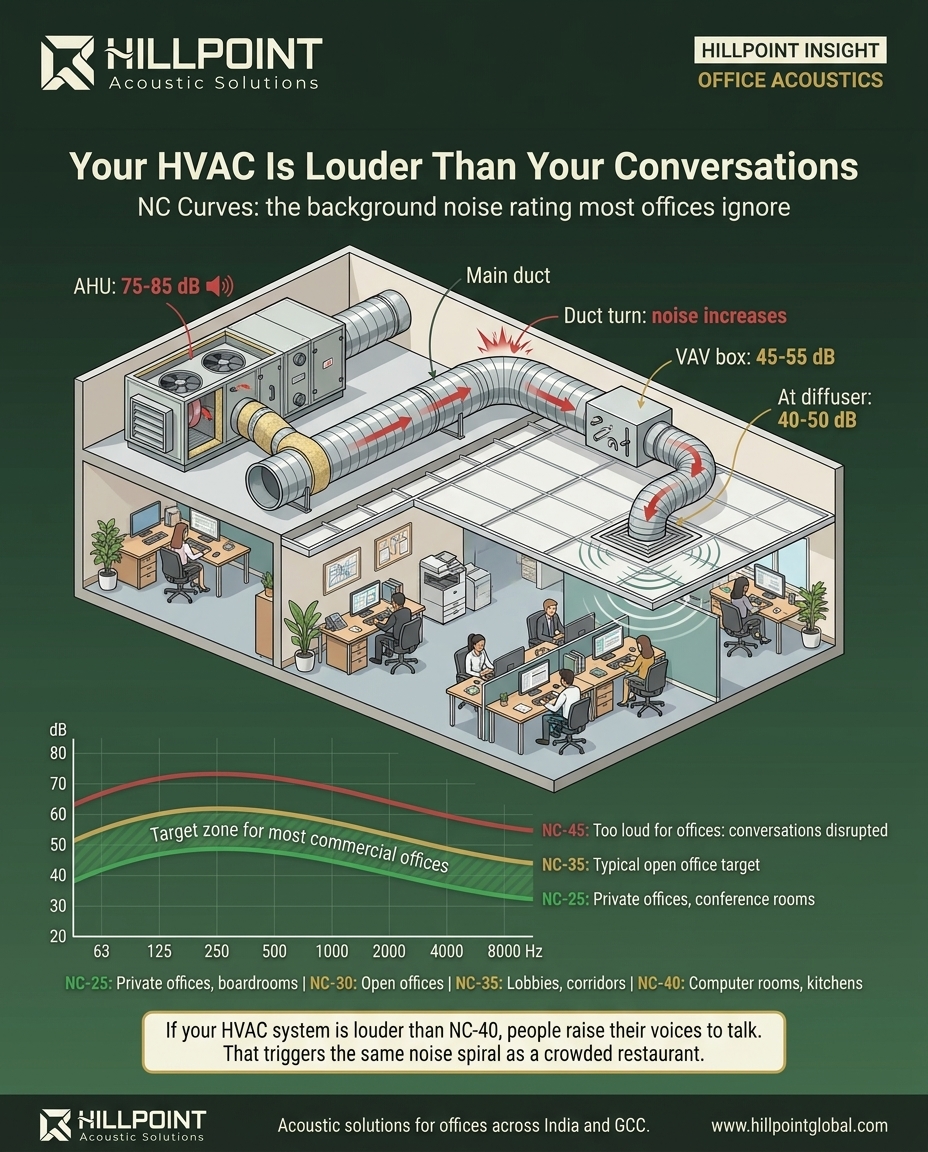
The standard targets used across most commercial acoustic specifications are NC-25 to NC-30 for private offices, boardrooms, and executive suites where speech privacy and concentration are critical; NC-30 to NC-35 for open plan offices where a moderate background noise level actually helps mask conversations and maintain some speech privacy; NC-35 for lobbies, reception areas, and circulation spaces where slightly higher background levels are acceptable; and NC-40 for computer rooms, server rooms, and kitchen areas.
Above NC-40, background noise begins competing with normal conversational speech, and the same Lombard Effect that makes restaurants louder over time starts happening in offices.
One nuance worth understanding: in open offices, a moderate background noise level (NC-30 to NC-35) is actually desirable because it helps mask speech from adjacent workstations. An office that's too quiet (below NC-25) can feel uncomfortably exposed, where every keyboard click and phone call carries across the floor. The NC target isn't about minimising noise to zero. It's about controlling it to the right level for the room's function.
Where HVAC noise enters the office
The noise path from the air handling unit to the occupied desk picks up and loses energy at every component along the way.
The AHU itself generates 75 to 85 dB at the fan discharge. Duct silencers at the AHU outlet reduce this by 15 to 25 dB depending on type and length. Main ducts attenuate some noise naturally through distance, but duct elbows and turns generate turbulence noise that adds back to the sound level. VAV boxes and dampers regulate airflow but produce their own noise, typically 45 to 55 dB at rated airflow. Flexible duct connections between the rigid ductwork and the ceiling diffuser attenuate high-frequency noise but do little for low frequencies. The ceiling diffuser grille is the final point where noise enters the room, typically at 40 to 50 dB if no silencing has been added along the path.
The ceiling itself plays a role. HVAC noise radiates from the diffuser downward and also enters the ceiling plenum, where it reflects off the structural slab above and passes through ceiling tiles into the room. High-NRC ceiling tiles absorb some of this reflected energy, reducing the contribution of the ceiling zone to the overall noise floor. Low-NRC tiles let it pass through with minimal reduction.
What HillPoint provides for HVAC noise control
HillPoint's primary role in HVAC noise control is on the room side: ceiling treatment that absorbs reflected HVAC noise, wall panels that reduce reverberation build-up from background noise sources, and MetPan perforated metal panels for plant room enclosures and duct-adjacent applications where fire-rated, washable, durable panels are needed.
The ductwork silencing itself is typically the mechanical engineer's domain, not the acoustic panel manufacturer's. HillPoint's involvement is most effective when we coordinate with the mechanical consultant during design to ensure the room-side acoustic targets are aligned with the duct-side noise attenuation. If the HVAC delivers NC-42 at the diffuser and the room needs NC-30, no amount of ceiling panels will close that gap. The noise source has to be addressed first, and then the room treatment handles the residual.
For office projects across India and the GCC, the earlier this coordination happens in the design programme, the more options exist for routing ducts, sizing silencers, and selecting ceiling systems that work together to hit the NC target at the desk.
Technical Guides
Need the full acoustic treatment and soundproofing guides?
The long-form acoustic panels India guide covers panel types, NRC logic, standards, and room treatment. The soundproofing solutions India guide covers STC logic, doors, walls, floors, and the block-and-isolate side of the same design problem.