Restaurant Acoustics: Why Restaurants Get Louder Every 15 Minutes
Restaurant noise levels can climb from 55 dB to 78 dB in two hours. The Lombard Effect creates a feedback loop that acoustic treatment breaks. Here is what works.
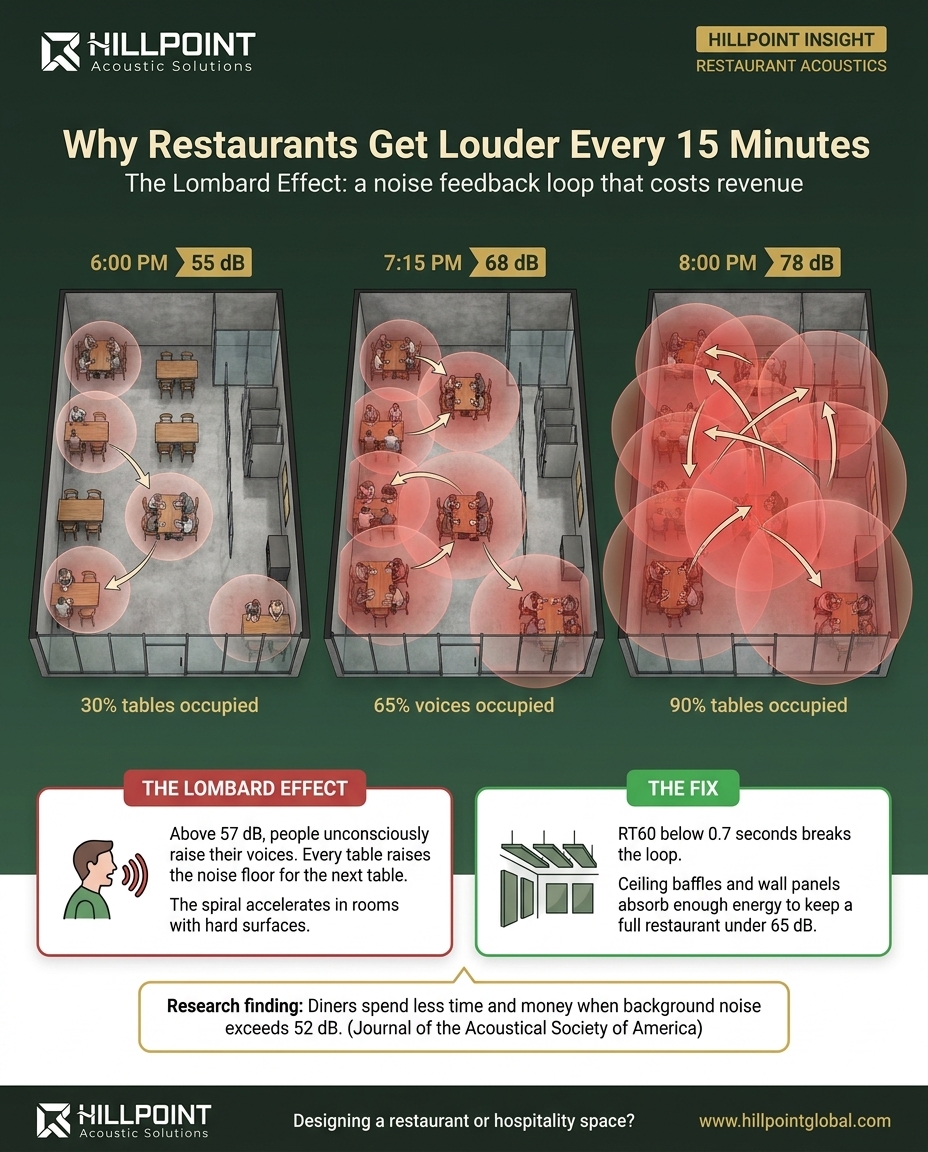
A half-empty restaurant at 6 PM sits at around 55 dB. Comfortable. Two hours later, the same room with full tables pushes 75 to 78 dB. Nobody touched the music volume. Nobody decided to start shouting. The room did it to itself.
This is the Lombard Effect, and it's been measured extensively in restaurant settings. Research published in the Journal of the Acoustical Society of America found that diners begin raising their voices involuntarily when background noise crosses roughly 57 dB. Once one table raises its volume, the background level increases for everyone else, triggering the same response at surrounding tables. The slope is measurable: for every 1 dB increase in background noise above 50 dB, speakers raise their own voice by 0.3 to 0.6 dB. Multiply that across 30 or 40 occupied tables and the feedback loop accelerates quickly.
Why restaurants are acoustically the worst room type
Most restaurant interiors are designed around materials that look great and reflect almost everything. Polished concrete floors, exposed brick walls, metal ceiling ducts, glass partitions. A typical restaurant might have an NRC (Noise Reduction Coefficient) of 0.05 to 0.10 across its main surfaces, meaning 90 to 95 percent of sound energy bounces back into the room.
That would be manageable with low occupancy. The problem is that restaurants are the one room type where the primary noise source, the occupants themselves, increases throughout the evening. An office has a roughly stable headcount. A classroom fills up once and stays put. A restaurant transitions from 20 percent occupancy to 95 percent occupancy over the course of service, and the noise floor rises with it.
Research from Ghent University measured noise levels in several eating establishments and found that sound pressure levels increased by more than 3 dB per doubling of occupants in rooms with limited acoustic absorption. In one student canteen, the level stopped rising altogether at about 150 occupants, not because people stopped talking, but because they actually gave up trying to communicate. The background level had reached roughly 69 dB, which requires unsustainable vocal effort to talk over.
The business cost nobody calculates
The 2016 Zagat State of American Dining report found that 25 percent of restaurant customers considered noise the most irritating part of eating out. More recent research confirms the pattern: willingness to spend time and money in a restaurant drops measurably when background noise exceeds 52 dB.
That's a lower threshold than most restaurateurs would guess. 52 dB feels barely noticeable, but it's the point where communication starts requiring effort rather than happening naturally. For fine dining and business dining settings, where conversation is the actual product alongside the food, that threshold matters directly. Guests leave earlier. They don't return. The reviews mention "too loud" and nobody connects it to the missing ceiling treatment.
What actually fixes it
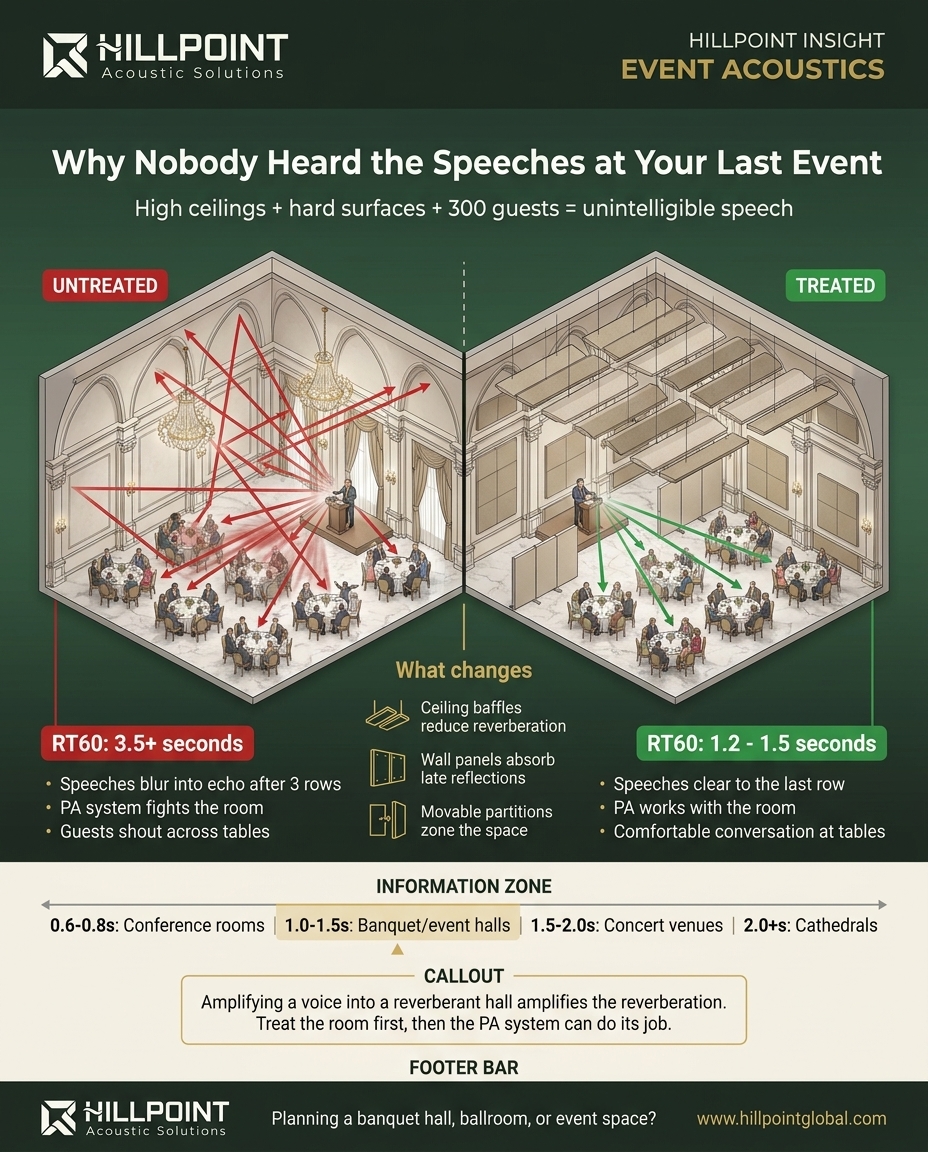
The acoustic goal in a restaurant is to bring the reverberation time (RT60) below 0.7 seconds. Research from Poncetti and Soares (2022) confirmed that spaces with RT60 under 0.7 seconds perform significantly better against the Lombard Effect than those above 1.0 seconds. The target average absorption coefficient for restaurant spaces should sit between 0.7 and 1.0 to allow comfortable speech at normal table spacing.
Ceiling treatment carries most of the load in restaurants. Tables, chairs, and diners themselves block the lower portions of walls, which limits how much wall-mounted panels can contribute. The ceiling, on the other hand, has clear exposure to the entire room. Suspended baffles or acoustic ceiling panels with NRC 0.85 or above make the biggest single difference.
Wall panels still help in specific zones, particularly in booths, banquette seating areas, and along hard perimeter walls where direct reflections between parallel surfaces create localised hot spots. The trick is to place absorption at the first reflection points between tables rather than covering every surface uniformly.
HillPoint manufactures SOF PET acoustic panels and wooden baffle systems at our Tamil Nadu facility that handle restaurant installations. PET panels are particularly practical in food service environments because they're moisture-resistant, washable, and carry no VOC emissions. Wooden baffles work well in exposed ceiling applications where the industrial aesthetic is part of the design intent.
One thing worth mentioning: the fix doesn't require covering the entire ceiling. Research consistently shows that treating 40 to 60 percent of the ceiling surface area drops RT60 enough to break the Lombard spiral. You keep the design intent of exposed services or decorative ceilings while actually making the room function for conversation.
For hospitality projects across India and the GCC, the earlier acoustic treatment enters the design conversation, the more options you have. Retrofitting a restaurant that's already open is possible but more disruptive and usually more expensive than getting it right during fit-out.
Quick reference for restaurant acoustic targets
RT60 below 0.7 seconds for speech-focused dining. Background noise level below 50 to 55 dB before service starts. Average room absorption coefficient between 0.7 and 1.0. Minimum table spacing depends on absorption levels, but treated spaces can seat tables as close as 1.5 metres apart while maintaining comfortable speech, compared to 3 metres or more in untreated rooms.
Technical Guides
Need the full acoustic treatment and soundproofing guides?
The long-form acoustic panels India guide covers panel types, NRC logic, standards, and room treatment. The soundproofing solutions India guide covers STC logic, doors, walls, floors, and the block-and-isolate side of the same design problem.