Banquet Hall Acoustics: Why Nobody Heard the Speeches at Your Last Event
Banquet halls with 6m ceilings and hard surfaces push RT60 past 3.5 seconds. Speeches blur after three rows. Here is what treatment fixes.
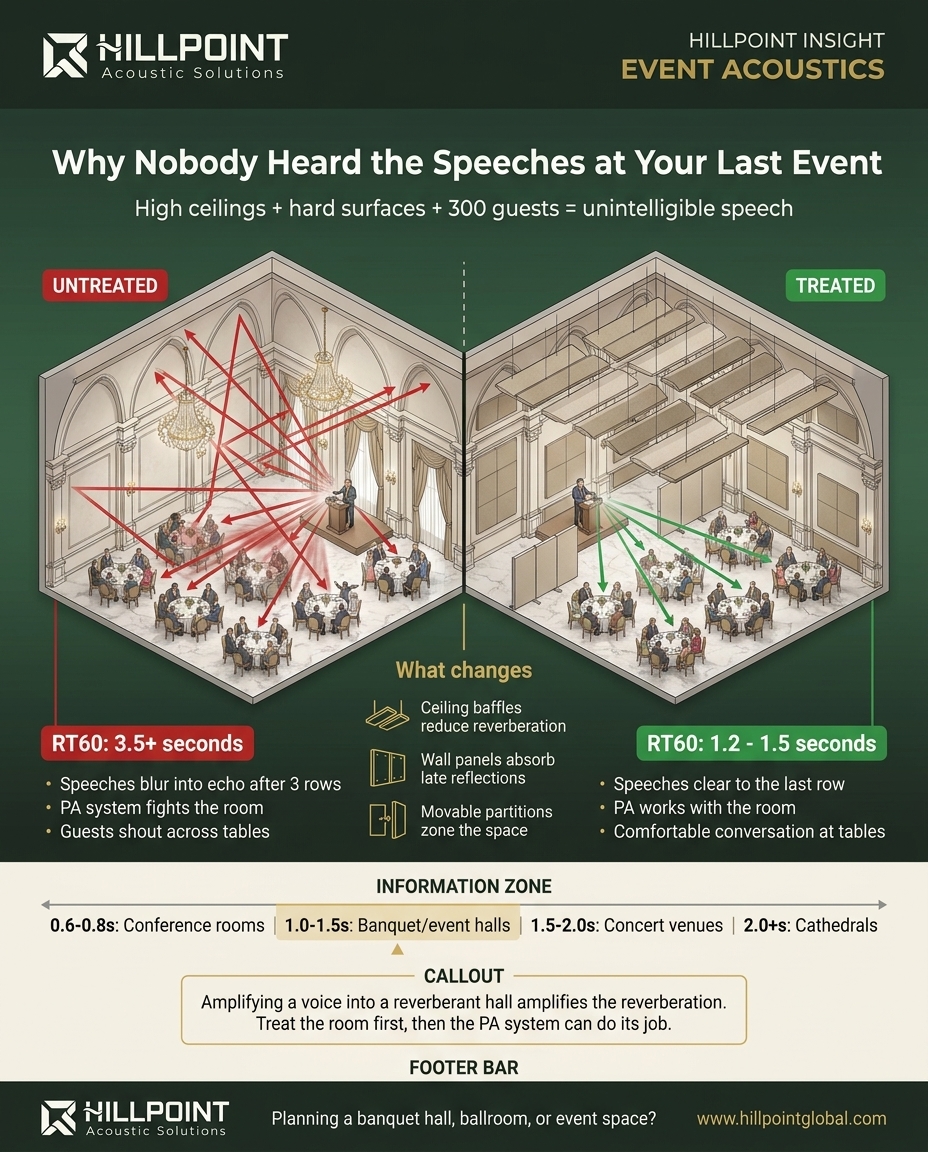
A banquet hall with 6-metre ceilings, marble floors, and plaster walls can produce an RT60 above 3.5 seconds. That means the speaker's voice is still bouncing around the room nearly four seconds after they've moved to the next sentence. The words overlap, consonants blur, and guests at the back tables catch fragments rather than sentences.
The instinct is to turn up the PA system. That makes things worse, because amplifying speech into a reverberant room amplifies the reverberation in proportion. The front tables get blasted. The back tables still can't make out the words. The signal-to-noise ratio hasn't changed, just the overall volume.
Why banquet halls are acoustically difficult
Three things combine to create the problem. The ceiling height is the biggest factor. A 6-metre ceiling means sound has to travel 12 metres (up and back down) before the first ceiling reflection arrives. That delay is long enough for the reflection to be perceived as a separate acoustic event rather than as reinforcement of the original speech. In a room with a 2.7-metre ceiling, the ceiling reflection arrives quickly enough to support speech intelligibility. At 6 metres, it fights against it.
The surfaces are the second factor. Banquet halls are designed to look grand: stone or marble floors, plaster or painted walls, large windows, chandeliers. Every one of these surfaces reflects sound with minimal absorption. The total room absorption is low relative to the volume, which is exactly what drives the Sabine equation toward long RT60 values.
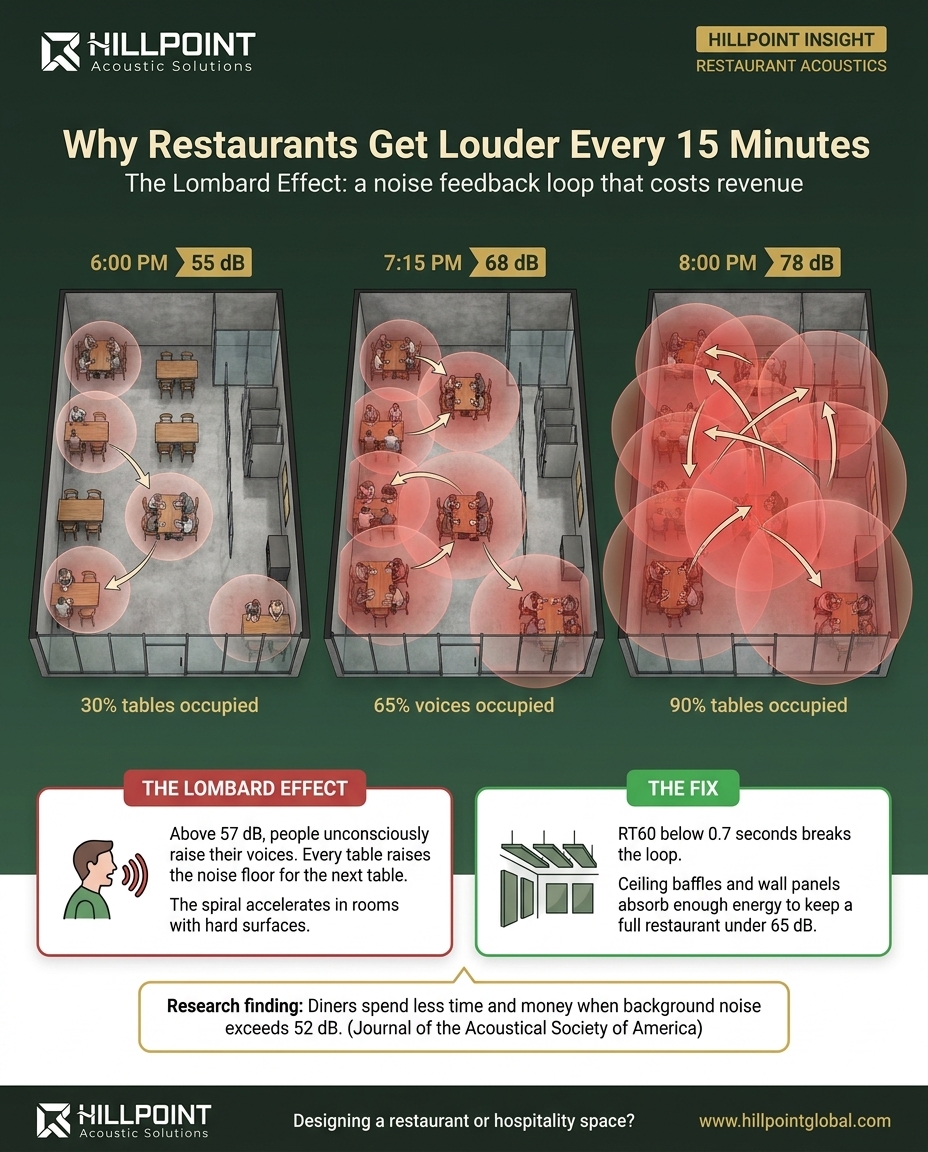
The occupancy and noise generation is the third factor. Three hundred guests at tables, eating, drinking, and talking, generate their own noise floor. The same Lombard Effect that escalates restaurant noise applies here at a larger scale. People raise their voices to be heard over the background, the background rises, and the cycle accelerates. A banquet hall with RT60 above 2.0 seconds makes this spiral worse because each voice reflection lingers and contributes to the noise floor for several seconds.
The treatment approach
The ceiling is the priority in any high-volume space. Suspended baffles or cloud panels are the most practical ceiling treatment for banquet halls because flat ceiling tiles can't be installed at 6 metres without looking odd, and the ceiling structure in these spaces is often architectural (exposed trusses, coffers, or decorative plasterwork) rather than a standard grid system.
HillPoint's wooden baffles and SOF PET ceiling panels can be suspended from the structure at various heights, bringing effective absorption closer to the occupied zone. Baffles absorb from both sides, which makes them efficient per unit area in a space where the ceiling treatment needs to handle a large volume of reverberant energy.
Rear wall absorption is the second priority. The rear wall (opposite the speaker position) is where the strongest late reflection originates, because the speaker's voice travels the full length of the room and returns as a distinct, delayed echo. Covering 50 to 70 percent of the rear wall with absorption panels catches this reflection and noticeably improves speech clarity in the middle rows.
Side wall treatment at ear height (1.0 to 1.5 metres above the floor) helps control lateral reflections that contribute to the noise build-up during dining. In a room where tables line the side walls, acoustic panels at seated head height catch the direct reflections between the hard wall and the dining area.
Movable partitions for flexible venues
Many banquet halls and hotel ballrooms need to function as both a large single event space and multiple smaller rooms for concurrent events. HillPoint manufactures Acousstop Wings, movable partition walls rated 25 to 55 dB acoustic value, that allow a ballroom to be divided into two or three zones.
The acoustic benefit goes beyond sound isolation between zones. Dividing the room reduces the effective volume of each zone, which automatically shortens the RT60 in each space. A 1,000 square metre ballroom with RT60 of 3.0 seconds might drop to 1.5 to 2.0 seconds in each half when divided, even without additional ceiling or wall treatment, simply because the volume-to-surface-area ratio improves.
The partition also prevents the Lombard spiral from feeding across the entire floor. Two events running simultaneously in separated zones each generate their own noise floor independently, rather than combining into one escalating noise environment.
Realistic targets
RT60 of 1.0 to 1.5 seconds is the target for banquet and event halls where speech intelligibility matters. This is longer than a conference room (0.4 to 0.6 seconds) because the space needs some acoustic warmth and atmosphere for events, music, and celebrations. Going below 1.0 seconds in a large hall risks making the space feel dead and lifeless, which is the wrong mood for a wedding or gala dinner.
Background noise before events start should sit below 40 to 45 dB, which requires HVAC systems designed for the room volume with adequate silencing. During events, the goal is to keep the ambient noise from the Lombard spiral below 75 dB through ceiling and wall treatment, which corresponds to the level where sustained vocal effort becomes uncomfortable.
For hospitality and event venue projects in India and the GCC, HillPoint provides ceiling treatment, wall panels, movable partitions, and acoustic doors as one coordinated package. The earlier acoustic treatment enters the design conversation, the more options exist for integrating baffles and panels into the architectural intent rather than adding them as a visible retrofit.
Technical Guides
Need the full acoustic treatment and soundproofing guides?
The long-form acoustic panels India guide covers panel types, NRC logic, standards, and room treatment. The soundproofing solutions India guide covers STC logic, doors, walls, floors, and the block-and-isolate side of the same design problem.