
Acoustic Baffles vs Clouds vs Ceiling Tiles: Three Ceiling Treatments for Three Different Jobs
Baffles, clouds, and ceiling tiles all absorb sound. They solve different problems. Here is when to spec each one and what happens when you pick wrong.
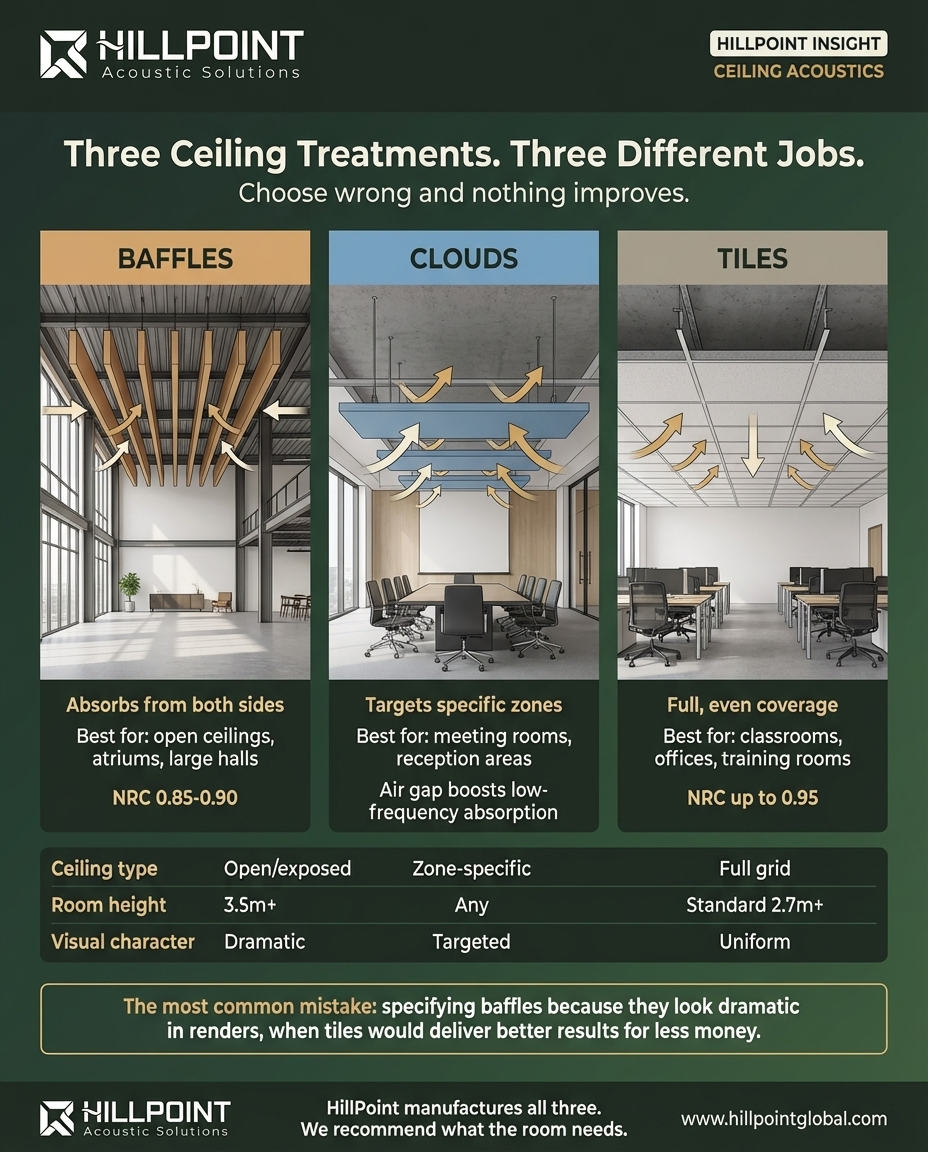
All three go on the ceiling. All three absorb sound. They don't do the same job, and the wrong choice wastes budget without fixing the acoustic problem.
This is a decision architects and interior designers face on almost every commercial project, and it usually comes down to aesthetics first and acoustics second. That's not always a bad approach, but it helps to understand what each option actually does to the sound in the room before picking the one that looks best in the render.
Vertical baffles
Baffles hang vertically from the ceiling structure, typically in rows or grids. They're most common in spaces with exposed ceilings where there's no suspended grid to work with: warehouses converted to offices, atriums, sports halls, large retail spaces, and open-plan factories.
The acoustic advantage of baffles is that they absorb from both sides. A 1 square metre baffle presents roughly 2 square metres of absorptive surface to the room. That makes them efficient per unit area, which matters when you're working with a limited budget or a ceiling that can't support heavy loads across its full area.
HillPoint manufactures two baffle types: SOF PET baffles made from recycled polyester, and wooden baffles in solid timber or MDF with various finishes. The PET baffles are lightweight, which helps in retrofit situations where the existing ceiling structure wasn't designed for suspended loads, and the published product data puts them up to NRC 0.65. The wooden baffles bring a warmer aesthetic with published performance up to NRC 0.85 depending on the core and backing.
Baffles work best in volumes above 3.5 to 4 metres of clear height. Below that, they start to feel visually heavy and their acoustic benefit over flat ceiling tiles diminishes because the room is small enough that tiles would cover the job adequately. I'll be direct: specifying baffles in a 2.7 metre ceiling meeting room because they look dramatic in the 3D visualisation is probably not the right call acoustically or financially.
Horizontal ceiling clouds
Clouds are horizontal panels suspended below the structural ceiling, usually with a visible air gap above. They differ from continuous ceiling tiles in that they cover specific zones rather than the entire ceiling.
Clouds target first reflection points. If you have a conference table in the centre of a room, hanging a cloud panel directly above it catches the reflections that would otherwise bounce off the hard ceiling back down to the table. This improves speech clarity at the table without treating the rest of the ceiling where HVAC diffusers, lighting tracks, and sprinkler heads might make continuous treatment impractical.
The air gap above a cloud panel adds acoustic value. Sound passes through the panel, hits the structural ceiling above, reflects back through the panel, and gets absorbed on the second pass. This air cavity improves low-frequency absorption compared to flush-mounted panels, something we discuss in more detail in our article on how panel coverage affects room performance.
Clouds also work well in spaces where the architect wants to maintain a visible ceiling height while still treating acoustics. Lobbies, reception areas, and circulation spaces often use clouds at 2.8 to 3.0 metres while the structural ceiling sits at 4.0 metres or above.
Lay-in ceiling tiles
Ceiling tiles in a T-grid system (T15 or T24) are the workhorse of commercial acoustic treatment. They cover the entire ceiling uniformly and provide consistent, predictable absorption across the room. No hot spots, no dead zones, just even coverage.
HillPoint's Acousstop MAC Tile panels are designed for T-grid systems and reach NRC 0.95, meaning the ceiling absorbs 95 percent of the sound energy hitting it. At that level, the ceiling does most of the room's acoustic heavy lifting, which often means less wall treatment is needed, reducing overall project cost.
Tiles are the right answer for classrooms, training rooms, standard offices, meeting rooms, and any space where consistent speech clarity matters more than architectural drama. They install quickly, they're easy to replace if damaged, and they integrate with standard lighting and HVAC grid layouts.
The trade-off is aesthetic. A grid ceiling looks like a grid ceiling. Some architects work around this with concealed grid systems or custom tile sizes, but the fundamental visual character is utilitarian rather than expressive.
Picking the right one
If the ceiling is exposed and the room volume is large, baffles. If you need targeted treatment in specific zones without covering the whole ceiling, clouds. If you want maximum acoustic performance with minimum design complexity, tiles.
The mistake to watch for is specifying the visually exciting option when the acoustically simple one would deliver better results for less money. Baffles in a small boardroom. Clouds scattered randomly rather than positioned at reflection points. Tiles with NRC 0.55 when the room needed 0.85 or above.
Match the product to the acoustic problem, then refine the aesthetics within that choice. All three work. They just work for different rooms. HillPoint manufactures all three product types, and our acoustic ceiling systems page groups them the way architects and project teams compare them in live projects.
Technical Guides
Need the full acoustic treatment and soundproofing guides?
The long-form acoustic panels India guide covers panel types, NRC logic, standards, and room treatment. The soundproofing solutions India guide covers STC logic, doors, walls, floors, and the block-and-isolate side of the same design problem.