Why ceiling acoustic treatment matters more than wall panels
In most offices, the ceiling spreads speech and background noise farther than the walls, which is why ceiling treatment often delivers the biggest acoustic improvement.
If conversations seem to travel farther than they should, look up before you look around. In many rooms, the ceiling is the surface doing most of the acoustic damage.
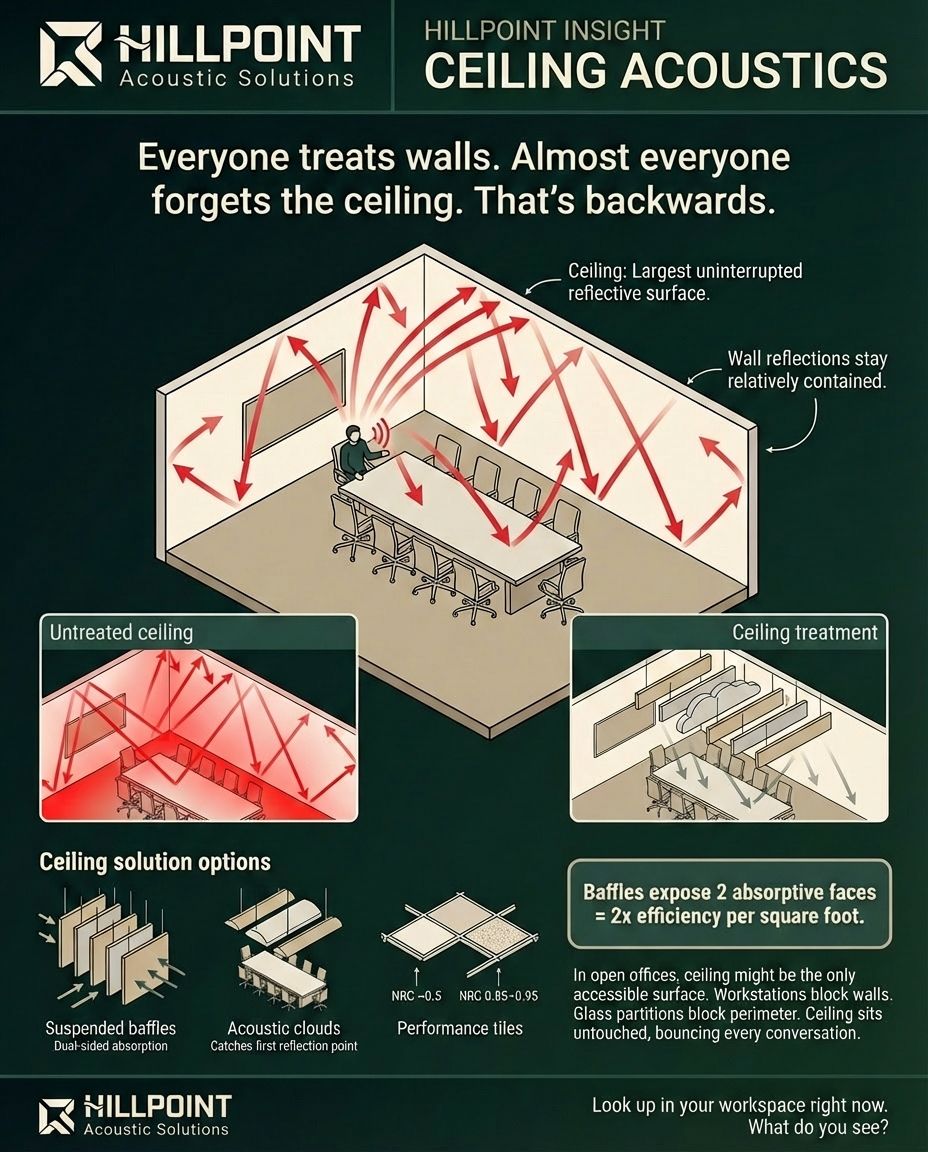
Makes sense though. Walls are right there at eye level. When a room sounds bad your first instinct is to stick panels on the walls. But in most rooms the ceiling is actually the bigger problem. It's the largest uninterrupted hard surface, and sound from a speaker's mouth hits it before anything else. From there it fans out in every direction across the full floor plate.
Wall reflections at least stay somewhat local. The ceiling is doing the real damage, and it does it quietly enough that most people don't realize the source.
Open offices make this worse
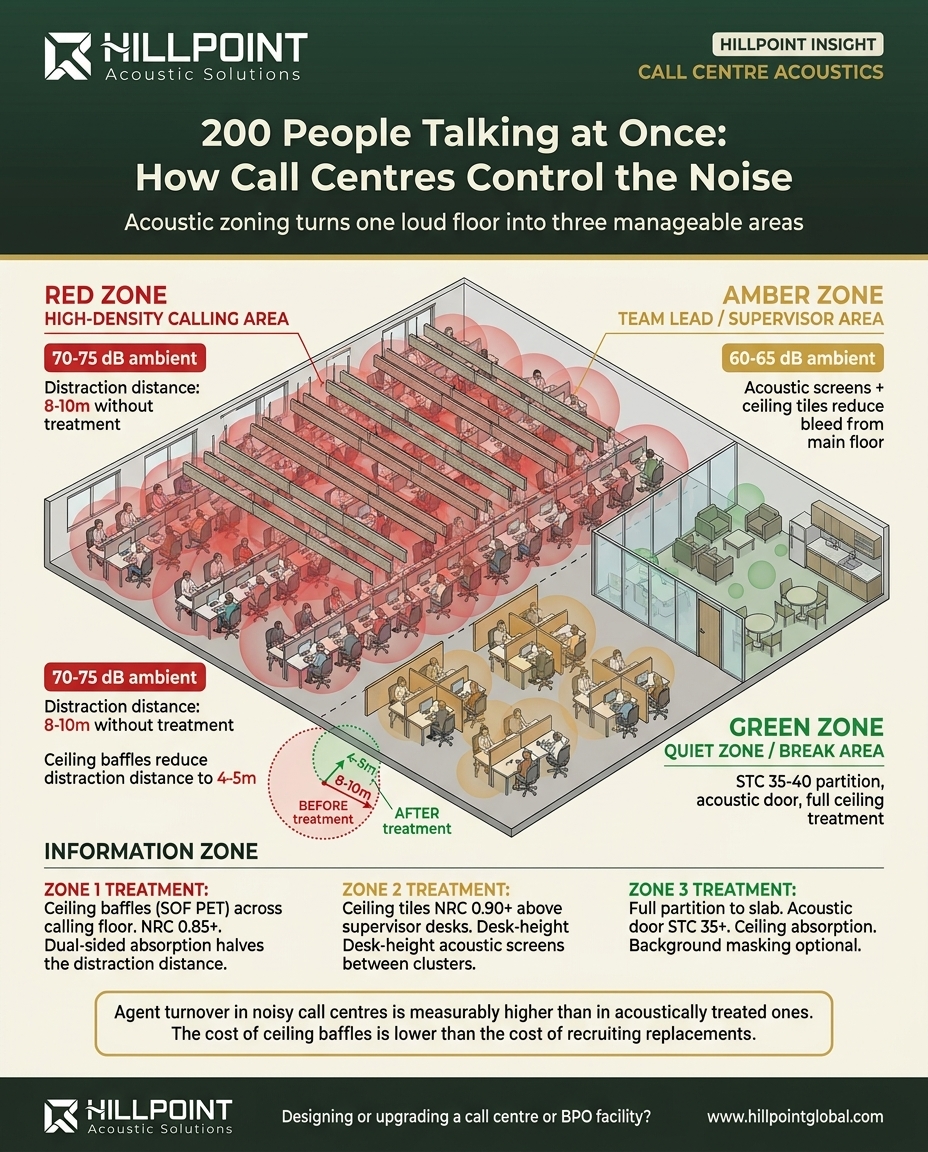
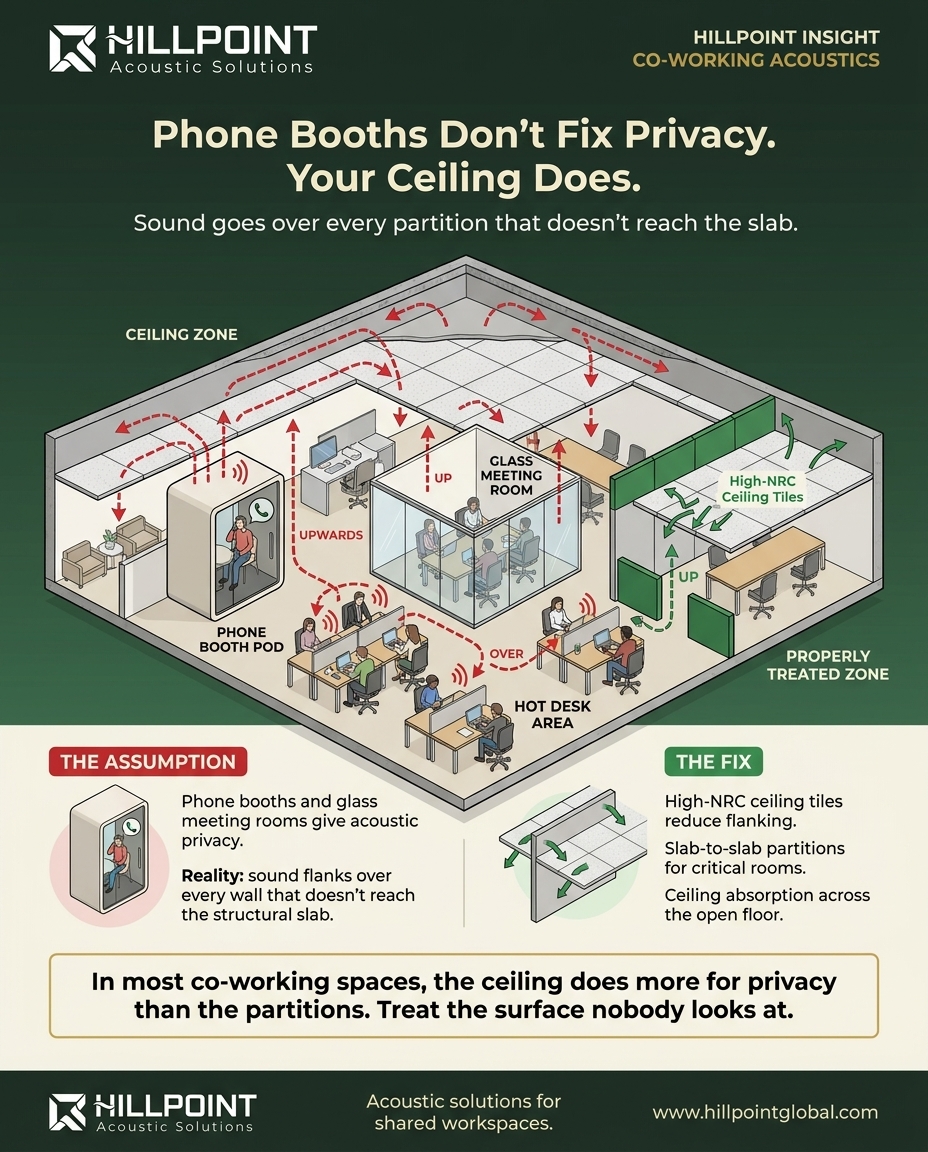
In most open offices you usually can't treat the walls even if you wanted to. Workstations are in the way. Glass partitions cover whatever's left. The ceiling is sitting there wide open, bouncing every conversation from one side of the floor to the other, and nobody's thought about it.
This is actually why a lot of acoustic treatment projects disappoint. Someone specs wall panels, covers 30 square meters of wall surface, and the room sounds about the same. Because the ceiling was always the bigger contributor, and it is still untreated.
If you've ever sat in an open office and heard a conversation clearly from 15 meters away, that's almost certainly a ceiling reflection problem. The direct sound from someone's mouth would have died off at that distance. What you're hearing is the bounce off the ceiling, which has a much wider spread pattern than any wall reflection.
Three ceiling treatment options that actually work
Baffles are the fix I wish more architects would spec early. They hang in the plenum so both faces absorb. You get twice the working surface from the same material, which is why we've seen them outperform wall panels that cover double the area. Our Wood Baffles and SOF Baffles (PET felt) are the two products we install most for this. The PET version is lighter and works well in spaces where weight on the ceiling grid is a concern.
Clouds work on the same idea but mount flat. Put one above a conference table and it catches the first ceiling bounce before speech gets muddy on the far side. Most of the speech clarity damage in a meeting room comes from that one reflection. Contour Panels are what we typically use for cloud installations, shaped fabric panels that hang on GI wire and catch sound before it spreads.
Then there's the simplest option. If your space has a standard drop ceiling, swapping tiles makes more difference than people expect. The NRC jump from a 0.5 basic tile to a 0.9 performance tile is significant. Our Comfy Tile panels fit standard ceiling grids and hit NRC 0.85 or higher. No structural changes needed, just pull out the old tiles and drop in the new ones.
A note about NRC and ceilings
NRC is a mid-band average across 250 to 2000 Hz, so it won't tell you everything about low-frequency problems. But for speech frequencies, which is what matters in offices and conference rooms, it's a reliable indicator. If you're comparing ceiling tile options, NRC is the right number to look at.
The gap between a standard 0.5 NRC tile and a 0.9 performance tile sounds like a small number. In practice it's the difference between a room where you can focus and one where you can't. That 0.4 improvement applied across an entire ceiling changes the character of the space.
How to tell if your ceiling is the problem
Next time you walk into your office, look up. That's probably where most of your noise problem actually is.
Here's a quick test. Stand in the middle of the room and clap once. If the echo sounds like it's coming from above rather than from the sides, your ceiling is the main reflective surface. In rooms with hard ceilings and carpeted floors, this is almost always the case.
If you want the project-planning version of this conversation, our acoustic ceiling systems page pulls the ceiling-specific products into one place. The product pages for Wood Baffles, SOF Baffles, Comfy Tile, and Contour Panels have the technical specs, and the contact page is there when you want to discuss a live project.
Technical Guides
Need the full acoustic treatment and soundproofing guides?
The long-form acoustic panels India guide covers panel types, NRC logic, standards, and room treatment. The soundproofing solutions India guide covers STC logic, doors, walls, floors, and the block-and-isolate side of the same design problem.