Open office acoustics: why one conversation costs you 66% of your focus
Open office speech is uniquely distracting because the brain is wired to process language, even when employees are trying not to listen.
Your open office runs at 65 decibels. Your employees just lost 66% of their focus.
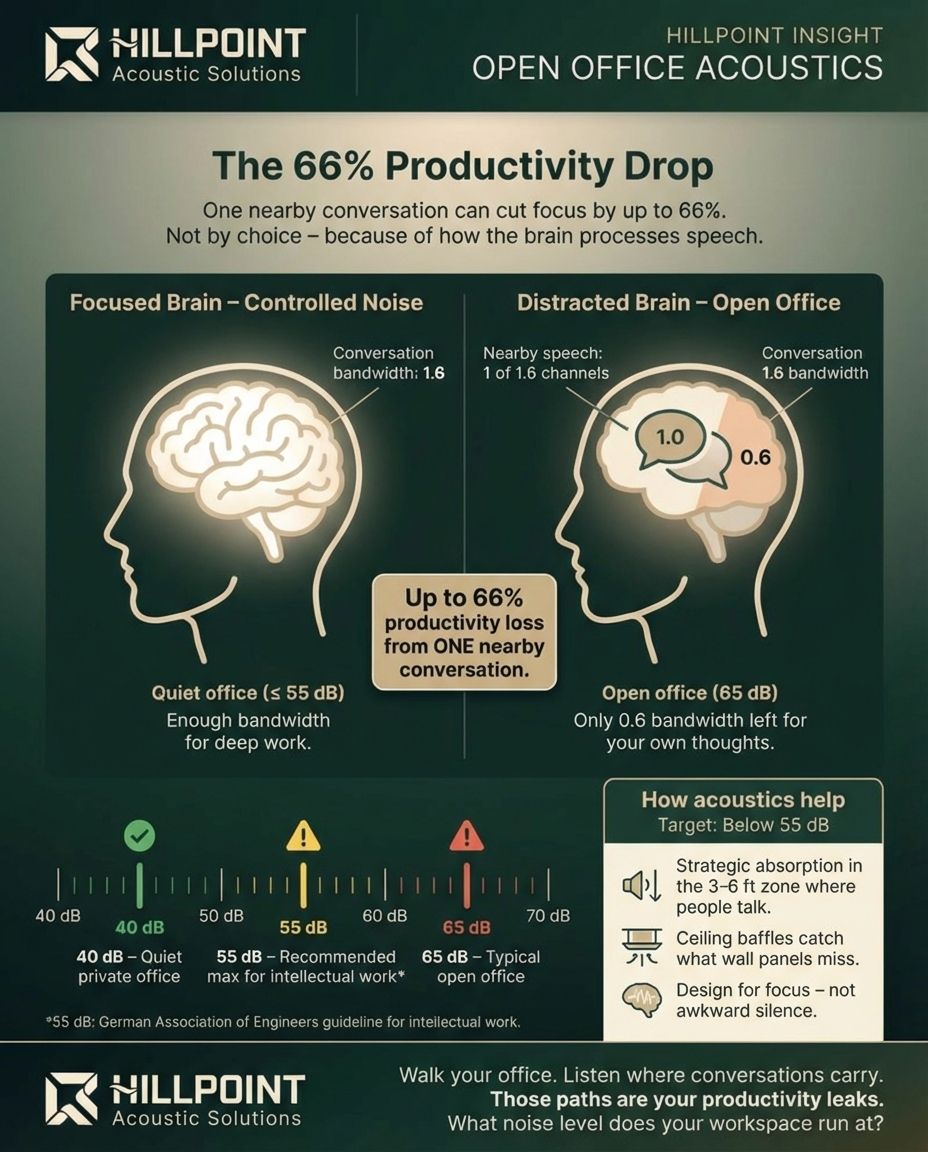
That's not a made-up number. Researchers strapped brain monitors on people working in open offices. One nearby conversation. That's all it took. Productivity crashed by two thirds. Not because people chose to eavesdrop. Because human brains physically cannot ignore overheard speech.
The biology behind it
Here's why. We have processing capacity for roughly 1.6 conversations. When someone talks near you, that eats up 1 of your 1.6 channels. You're left with 0.6 to hear your own thoughts. Willpower doesn't change biology. You cannot train yourself to ignore speech, because your brain is wired to process language whether you want it to or not.
This is different from other noise. Traffic, keyboard clicks, coffee machines - those are steady-state sounds that the brain learns to filter out fairly quickly. But speech is variable, it has meaning, and the auditory cortex treats it as high-priority input. That's the specific thing that kills focus in open offices, and it's the specific thing acoustic treatment needs to target.
The decibel problem
The German Association of Engineers (VDI) caps intellectual work environments at 55 dB. Most open offices hit 60 to 70 dB. That 10 decibel gap sounds small but it's actually a doubling of perceived loudness. It costs you clarity, creativity, and cognitive output every single day.
For context: 40 dB is a quiet private office. 55 dB is the recommended maximum for work that needs concentration. 65 dB is a typical open office during working hours. That 65 dB environment is roughly four times louder than the recommended maximum, and the people working in it just accept it as normal because they've never experienced anything else.
What actually works
The fix targets the 3 to 6 foot zone where mouths are and where speech travels horizontally. Strategic absorption in this band cuts reverberation dramatically.
Ceiling baffles catch what wall panels miss. In an open office, the ceiling is usually the only treatable surface anyway, because walls are covered by workstations, screens, and glass partitions. Our SOF Baffles (PET felt, made from recycled material) and Wood Baffles are what we install most in these environments. They hang in the plenum space and absorb from both sides, which means you get twice the absorption per square meter compared to a flat panel.
For areas where you can treat vertical surfaces, desk-mounted screens with acoustic cores work well in the 3-6 foot zone. They don't stop sound from travelling overhead, but they reduce direct path transmission between adjacent workstations, which is where the worst of the speech distraction comes from.
Drop ceiling tiles matter too. If the existing ceiling is a standard mineral fiber tile with NRC around 0.5, swapping to a performance tile at NRC 0.85-0.9 across the whole floor makes a measurable difference. Our Comfy Tile panels are designed for this; they fit standard grid systems and the swap is straightforward.
The goal isn't silence. An office that's too quiet has its own problems, mainly that every small sound becomes more noticeable. The target is ambient levels below 55 dB without creating an environment where someone dropping a pen sounds like an event. Some designers add background sound masking on top of the acoustic treatment to fill in the gaps. That's a separate system but it works well alongside absorption.
How to find your problem zones
Walk through your office tomorrow. Listen to where conversations carry furthest. Those paths are your productivity leaks. The spots where you can clearly hear a phone call from across the room, that is where the ceiling reflection is doing the most damage.
If you want to measure it properly, a sound level meter app on your phone will give you a rough dB reading during peak hours. It won't be laboratory-accurate, but if it's showing 60+ dB consistently, you have a problem worth addressing.
The product pages for SOF Baffles, Wood Baffles, and Comfy Tile panels have the technical specs and NRC data. If the project is in Bangalore, our acoustic panels Bangalore page is the faster commercial route. For a broader open-office assessment, the contact page is still the best way to start.
Technical Guides
Need the full acoustic treatment and soundproofing guides?
The long-form acoustic panels India guide covers panel types, NRC logic, standards, and room treatment. The soundproofing solutions India guide covers STC logic, doors, walls, floors, and the block-and-isolate side of the same design problem.