Co-Working Space Acoustics: Why Privacy Fails and What Actually Fixes It
Phone booths and glass meeting rooms look private. Sound flanks over their walls through the ceiling plenum. Here is what actually delivers acoustic privacy.
Co-working spaces sell privacy as a feature. Phone booths, glass meeting rooms, quiet zones. The marketing says the workspace is designed for focus. The acoustics usually say otherwise.
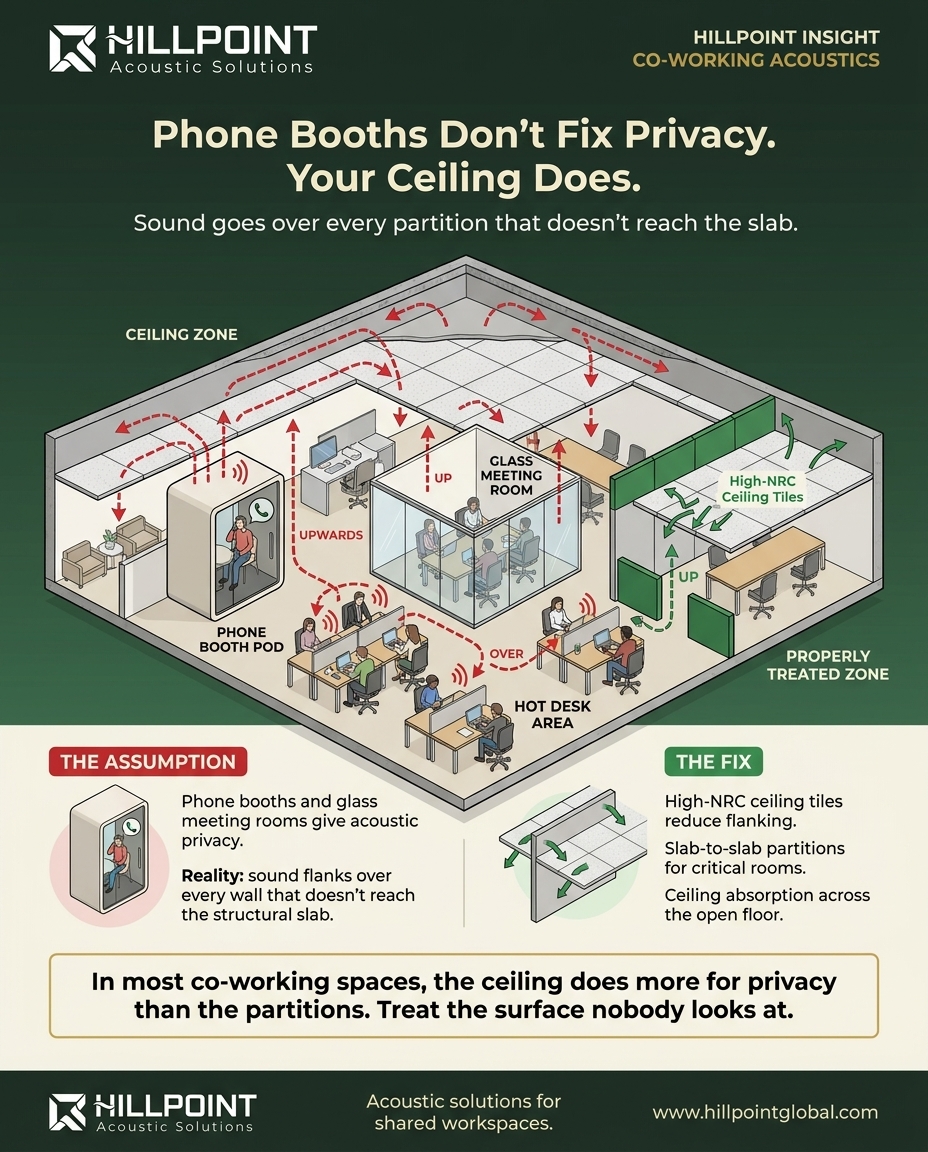
The fundamental problem is simple: most co-working fit-outs use partitions that stop at the suspended ceiling line. Above the ceiling tiles, the plenum space is open and continuous across the entire floor. Sound goes up, over, and down, and no amount of glass or pod construction changes that if the ceiling path is untreated.
Why phone booths fail acoustically
A phone booth with glass walls and a solid door looks enclosed. The person inside feels private. But the booth typically sits on the floor slab with walls extending to the ceiling grid, not the structural slab above. The ceiling tile sitting on top of the booth is an absorber with an NRC of maybe 0.55 to 0.70, which means it soaks up some sound inside the booth but does almost nothing to stop airborne sound from passing through it into the plenum.
From there, the sound is in the open ceiling void, and it radiates outward to every adjacent space on the floor. The person at the hot desk 3 metres away hears a muffled but clearly intelligible version of the phone call. The distraction distance hasn't been reduced as much as the visual enclosure suggests, because the sound path isn't through the booth walls. It's over them.
This is the same flanking principle that affects office partition walls: the barrier rating only applies to the direct path through the barrier. If an easier path exists around it, the barrier rating is irrelevant.
Glass meeting rooms have the same problem
Glass partitions rated STC 35 to 40 look impressive and feel solid. For the path directly through the glass, they work. But if the glass stops at the ceiling grid and the plenum is shared, sound travels over the glass through the ceiling void. The effective room-to-room isolation drops to whatever the ceiling tiles provide, which might be STC 15 to 20. Conversations in the meeting room are audible on the open floor, and the glass wall has become an expensive privacy illusion.
What actually delivers privacy in co-working spaces
The ceiling carries more weight than the partitions in shared workspaces. Three interventions make the biggest difference:
First, upgrade the ceiling tiles across the entire open floor to NRC 0.85 or above. This reduces the overall ambient noise level on the floor, which raises the background masking effect and makes speech from adjacent areas less intelligible. HillPoint's MAC Tile panels at NRC 0.95 handle this effectively in standard T-grid systems.
Second, for rooms that genuinely need speech privacy (legal consultations, HR discussions, client calls), the partition must extend from the structural floor slab to the structural ceiling slab. Full height, sealed at the top. This eliminates the plenum flanking path entirely. The door on that room needs to be an acoustic door with seals, not a standard interior door with a 10mm undercut.
Third, the open floor area between workstations benefits from ceiling-mounted absorption and desk-level screens. PET ceiling baffles or cloud panels above workstation clusters reduce the reflected noise energy that crosses the floor. Low-level acoustic screens between desks don't block sound (they're too short), but they attenuate direct-path speech between immediately adjacent seats.
HillPoint manufactures the ceiling tiles, PET baffles, and acoustic doors needed for all three layers. For office and co-working projects across India and the GCC, we find the most effective results come from treating the ceiling as the primary privacy tool and using partitions as a secondary barrier for the rooms that need genuine isolation.
The operator's perspective
Most co-working operators learn about acoustic privacy from tenant complaints, not from the design brief. The first complaint usually comes within weeks of opening: "I can hear everything from the meeting room." The retrofit is more expensive and more disruptive than getting the ceiling right during fit-out.
For co-working developers and operators, the practical advice is to specify ceiling tiles with NRC 0.85 or above across the entire floor from day one. It's a modest cost increase over standard tiles, and it's the single specification that does the most for acoustic privacy across the whole space.
Technical Guides
Need the full acoustic treatment and soundproofing guides?
The long-form acoustic panels India guide covers panel types, NRC logic, standards, and room treatment. The soundproofing solutions India guide covers STC logic, doors, walls, floors, and the block-and-isolate side of the same design problem.