Hotel Soundproofing: Why Guests Hear Everything Despite STC 50 Walls
STC 50 walls don't help if sound flanks through door gaps, ducts, and back-to-back outlets. Here are the noise paths in hotel rooms and how to treat each one.
A guest checks into a 4-star hotel in Dubai. The party wall between their room and the adjacent room is rated STC 50. On paper, that should make normal conversation inaudible from next door. In practice, they can hear the neighbour's television clearly enough to follow the dialogue.
The wall isn't the problem. Everything around it is.
Where sound actually travels in hotel rooms
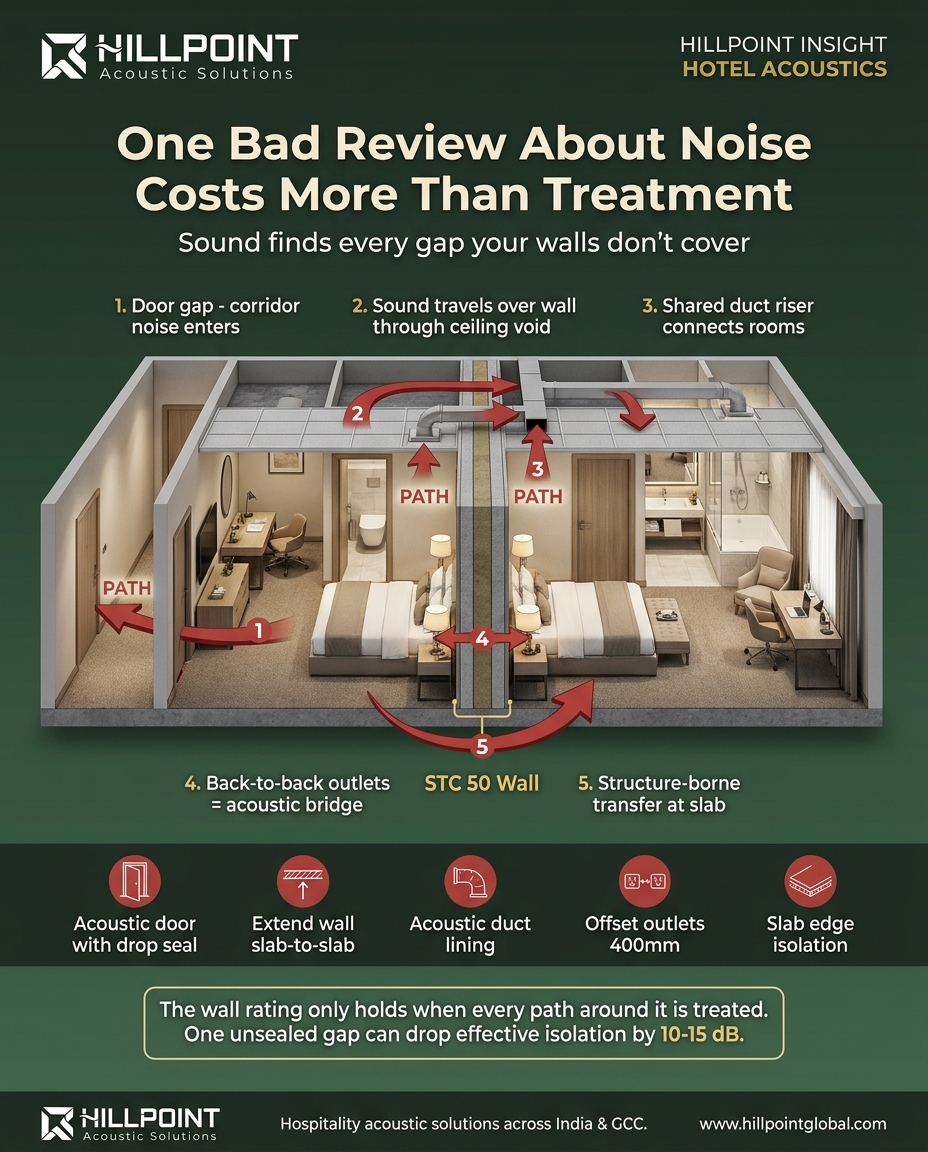
STC (Sound Transmission Class) is measured under laboratory conditions where the test wall is the only path between two rooms. In a real hotel, sound has five or six alternative routes, and it takes the easiest one.
The door undercut is probably the most common offender. Hotel room doors need a gap at the bottom for HVAC return air, and that gap, even at 10 to 12 mm, creates a direct acoustic path from the corridor into the room. Corridor noise from housekeeping carts, other guests, elevator lobbies, and ice machines travels straight under the door. A door rated STC 45 in the lab can perform at STC 30 or worse on site if the undercut isn't sealed with an automatic drop seal.
Bathroom exhaust ducts connect adjacent rooms through shared risers. Sound travels up the duct from one room, through the riser, and down into the next room's bathroom. This is a flanking path that no amount of wall treatment will fix because the sound bypasses the wall entirely.
Electrical back-boxes installed back-to-back on either side of a party wall punch holes straight through the acoustic barrier. Even small penetrations can reduce effective wall isolation by 5 to 10 dB. The fix is simple, offset the outlets by at least 400 mm horizontally, but it has to be specified before the electrician runs the cables.
The slab edge where the party wall meets the floor is another weak point. If the wall sits on a continuous slab without an acoustic break, low-frequency sound transmits through the concrete structure around the base of the wall. Impact noise from dropped objects or footsteps in the room above transfers through the same path.
The GCC hospitality context
The hotel construction boom across Dubai, Qatar, and Saudi Arabia puts acoustic quality under intense pressure. The market is building 4 and 5-star properties at scale, and guest expectations for room quietness are set by the best hotels in the world. A single "noisy room" review on Booking.com or TripAdvisor sits permanently visible to every future booking.
The acoustic specification for most 4 to 5-star properties calls for STC 50 to 55 between guest rooms, STC 45 for corridor-to-room barriers, and background noise levels below NC-30 (roughly 35 dB) at night. These numbers are achievable, but only if the specification covers the entire acoustic envelope, not just the wall rating.
What the spec should actually include
Walls rated STC 50 or above, built full height from slab to slab, not stopping at the ceiling line. Acoustic doors with STC 38 to 45 rating, including frame seals and automatic drop seals at the threshold. HillPoint manufactures acoustic doors that achieve these ratings through multi-layered cores and perimeter gasket systems, and we install them because the door rating only holds when the seals are adjusted on site.
Duct penetrations sealed with acoustic wrapping or fire-rated acoustic sealant. Electrical outlets offset between rooms, never back-to-back on shared walls. Window assemblies with proper acoustic glazing (STC 30 to 35 minimum for urban locations). Slab edge isolation at party wall junctions.
I'll be honest, most of these details are boring construction coordination items. They don't show up in renders or design presentations. But they're the difference between a hotel room that delivers STC 50 in practice and one that delivers STC 30 with a spec sheet claiming 50. The soundproofing solutions India guide lays out the broader wall-door-floor logic behind these hospitality details.
Testing after fit-out
Some hotel operators test room-to-room isolation after the fit-out is complete. Most don't. The ones who test consistently find gaps between the spec and reality, usually at doors and duct penetrations. Post-construction testing costs a fraction of what a negative noise review costs over the lifetime of the property. It's worth building into the handover process for any hospitality project where acoustic quality is a brand standard.
Technical Guides
Need the full acoustic treatment and soundproofing guides?
The long-form acoustic panels India guide covers panel types, NRC logic, standards, and room treatment. The soundproofing solutions India guide covers STC logic, doors, walls, floors, and the block-and-isolate side of the same design problem.