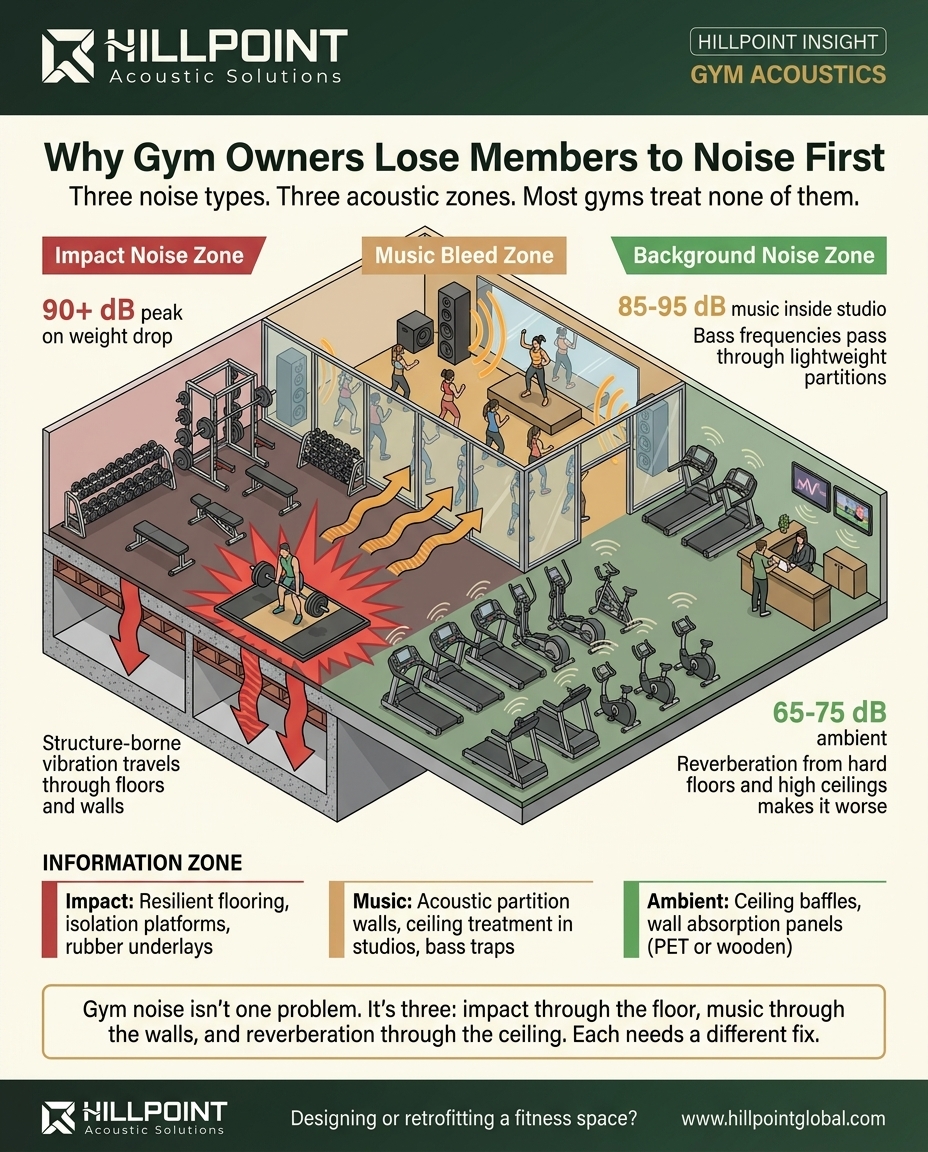
Why Acoustic Panels Won't Fix Gym Impact Noise
Gym below an office or apartments? Acoustic panels won't stop the thud of a dropped weight. Here is why impact noise needs floor isolation, not more panels.
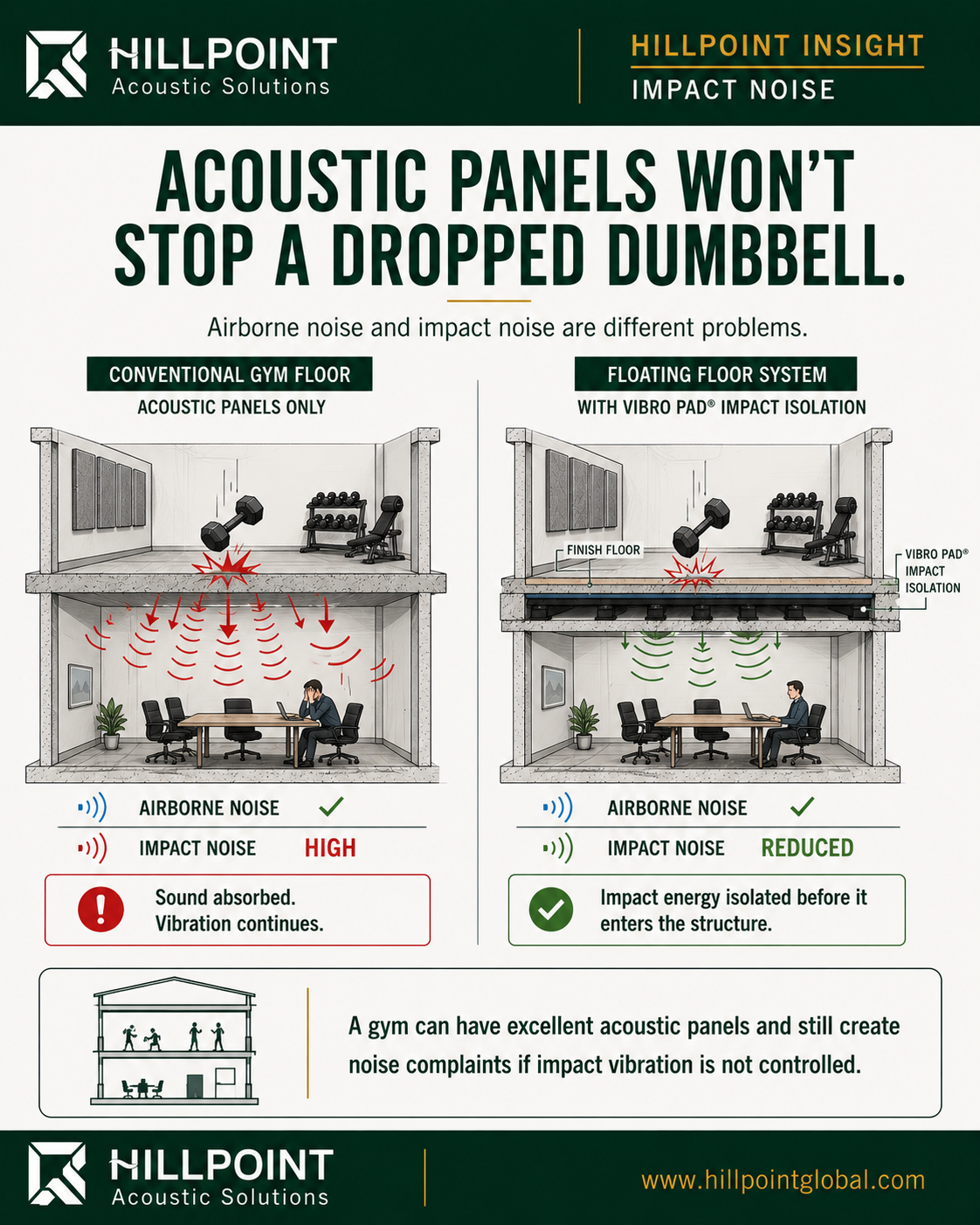
Picture a gym on the third floor of an office building. The walls are covered in acoustic panels, the ceiling has absorption, the room sounds clean and controlled. The tenant on the second floor still calls every evening to complain about the thudding.
The panels aren't broken. They're solving a problem that isn't the one generating the complaint.
This trips up a lot of gym operators, and honestly it's an easy mistake to make. Noise feels like one thing when you're standing in the room. Inside the building, it's at least two very different things, and they travel by completely separate routes.
Two noises that feel the same and aren't
Airborne noise is the stuff moving through the air. Voices, group-class instruction, the music, treadmill fans, general buzz. Acoustic wall panels, ceiling systems and baffles handle this well. They cut reflections, drop the reverberation, and make the room more comfortable to train and talk in. That's their job and they're good at it.
Impact noise is a different animal. It starts when something hits the building directly. A dropped dumbbell, a loaded barbell coming down, box jumps, heavy machine stacks slamming. The energy from that impact doesn't bother with the air. It goes straight into the floor slab as vibration.
Will acoustic panels stop gym noise to the floor below?
No. Acoustic panels absorb airborne sound inside the room, but a dropped weight sends its energy into the structure, not the air. That vibration travels through the slab to the spaces below and around, where panels can't reach it. Stopping it needs floor isolation, not wall or ceiling treatment.
That's the short version. The longer one is worth understanding, because it changes what you actually buy.
What impact noise does once it's in the structure
When a heavy object strikes the floor, the energy spreads outward through the building as structure-borne noise. This is the part people underestimate. Airborne sound fades fairly quickly as it moves through space. Vibration in rigid concrete and steel doesn't fade the same way. It can travel a long way through slabs, beams and columns and show up somewhere you wouldn't expect.
So an office directly under the lifting area gets repeated thumps. Hotel guests two floors down hear a low-frequency thud they can't place. Residents in an apartment beside the building's amenity gym feel it as much as hear it, even with treated walls between them. Low frequencies are the worst offenders here, and they're also the hardest to deal with after the fact.
The room itself is usually fine. The vibration path is the problem.
What is a floating floor?
A floating floor separates the finished gym floor from the structural slab using a resilient isolation layer, so impact energy is absorbed at the surface instead of passing straight into the building. The walking and lifting surface effectively sits on springs or resilient mats, which breaks the direct path that carries vibration to the spaces below.
Catch the energy before it reaches the slab
The principle behind every impact fix is the same. You have to interrupt the vibration before it enters the structure, because once it's in the slab, you've lost most of your chances to stop it.
In practice that means putting a resilient layer between the impact and the structural floor. For lighter duty, a resilient roll under the finished floor takes the edge off foot traffic and moderate equipment. Our Acousstop Vibro Roll is an 8 mm resilient layer made for that kind of light-to-medium use. For the heavy free-weights and functional zones where dumbbells actually get dropped, you want something tougher, like interlocking resilient rubber tiles built to take repeated impact, which is what the Acousstop Vibro Pad is designed for. The serious cases, a CrossFit-style box or a free-weights floor sitting directly over occupied space, often justify a full floating floor system.
How much isolation you need depends on the weights involved, the slab, and how sensitive the space below is. There's no single product that covers every gym, and anyone who tells you otherwise probably hasn't stood in the room downstairs.
Where this keeps coming up
Commercial fitness centres inside office towers are the classic case, protecting the tenants and retail below. Hotel gyms have to keep the thumps out of guest rooms and quiet public areas. Mixed-use developments stack residential over amenity gyms, which is about the least forgiving layout there is. Schools deal with sports halls sitting near classrooms. And multi-family residential amenity gyms have neighbours on every side, so comfort there is mostly an isolation question.
Design it in, don't retrofit it
Impact noise is one of the more painful things to fix after the building is finished. Retrofitting isolation usually means pulling up the finished floor, shutting the facility for a stretch, working around live construction, and paying for it twice. None of that is fun, and a chunk of it is avoidable.
When a fitness space is going in near anything noise-sensitive, the isolation belongs in the early drawings, coordinated between the architect, the structural engineer, the MEP team and the acoustic side. The slab build-up, the floor finish and the isolation all want to be decided together. Deciding them in sequence is how you end up with the second-floor phone calls.
You still need the panels
None of this means the panels were a waste. The room still needs absorption to control reverberation and keep speech and music intelligible, especially in a class environment. Drop the panels and the gym sounds like a swimming pool. The point is that absorption and isolation answer two separate questions, and a strong result usually needs both running at once. Treat only the air and the vibration keeps travelling. Treat only the floor and the room itself sounds harsh.
That's how we look at a gym brief at HillPoint Global. We manufacture both sides of it, the absorptive panels and ceiling systems for the airborne side, and the Acousstop Vibro Pad and Vibro Roll for the impact side, and we'd rather flag the floor question early than get the call about the floor below later. If you've got a gym going in over occupied space, the floor build-up is the first thing worth a hard look.
Related reading: the three axes of acoustic design breaks down why absorbing, blocking and isolating are not interchangeable. For the products, see the Acousstop Vibro Pad and Acousstop Vibro Roll, and the gym acoustic treatment page for the full picture. Impact performance between floors is measured as Impact Insulation Class under ASTM test methods if you want the standards detail (astm.org).
Technical Guides
Need the full acoustic treatment and soundproofing guides?
The long-form acoustic panels India guide covers panel types, NRC logic, standards, and room treatment. The soundproofing solutions India guide covers STC logic, doors, walls, floors, and the block-and-isolate side of the same design problem.