Gym Acoustics: Three Noise Problems That Need Three Different Fixes
Gyms face three noise problems: impact from weights, music bleed from studios, and reverberation from hard surfaces. Here is how to treat each zone.
A gym is acoustically one of the worst room types to get right, because the noise isn't one problem. It's at least three distinct problems happening in the same building, and each one requires a different fix.
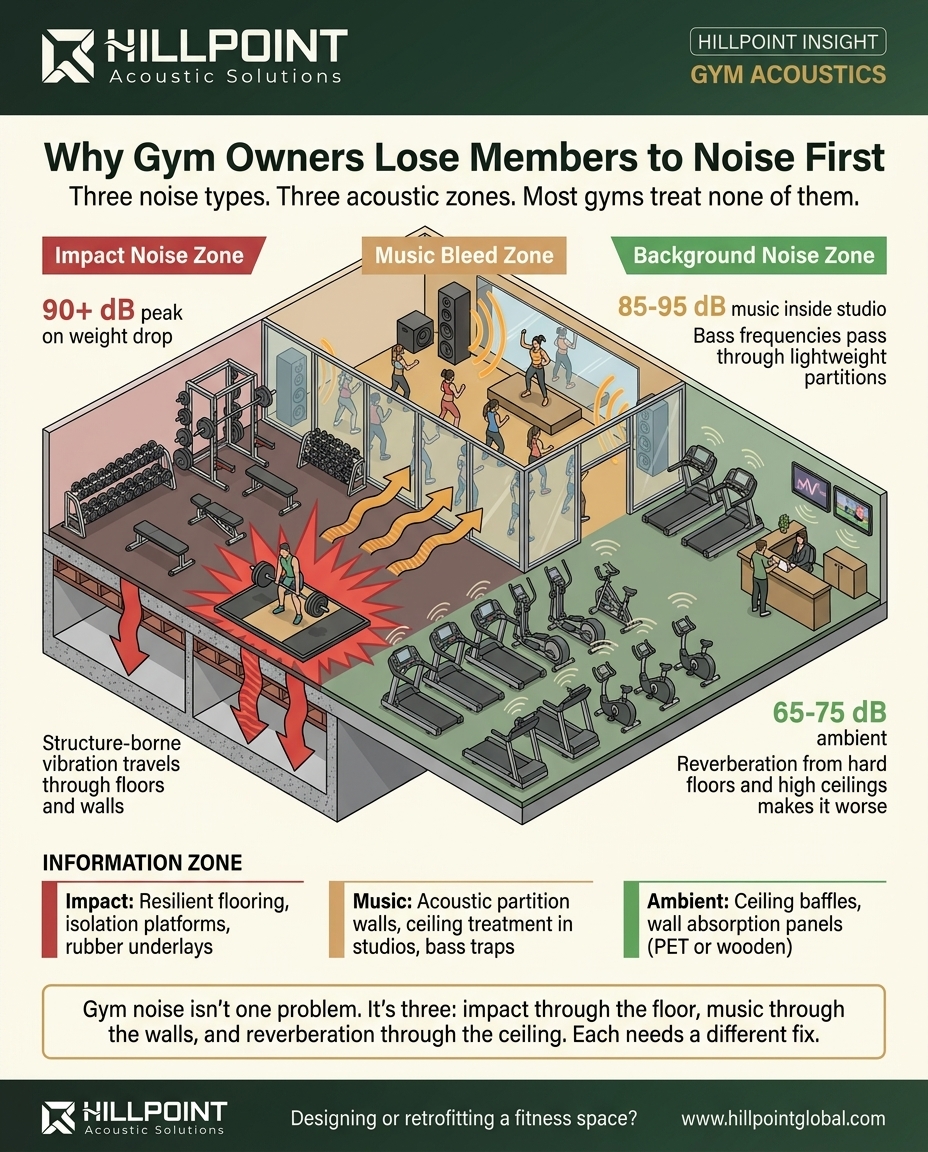
The free weights area generates impact noise that travels through the building structure. The group class studio produces music at levels that bleed through partition walls. The general floor creates a sustained ambient noise level amplified by reverberation from hard surfaces and high ceilings. Treating one without addressing the others leaves the space feeling just as loud.
Impact noise from weights
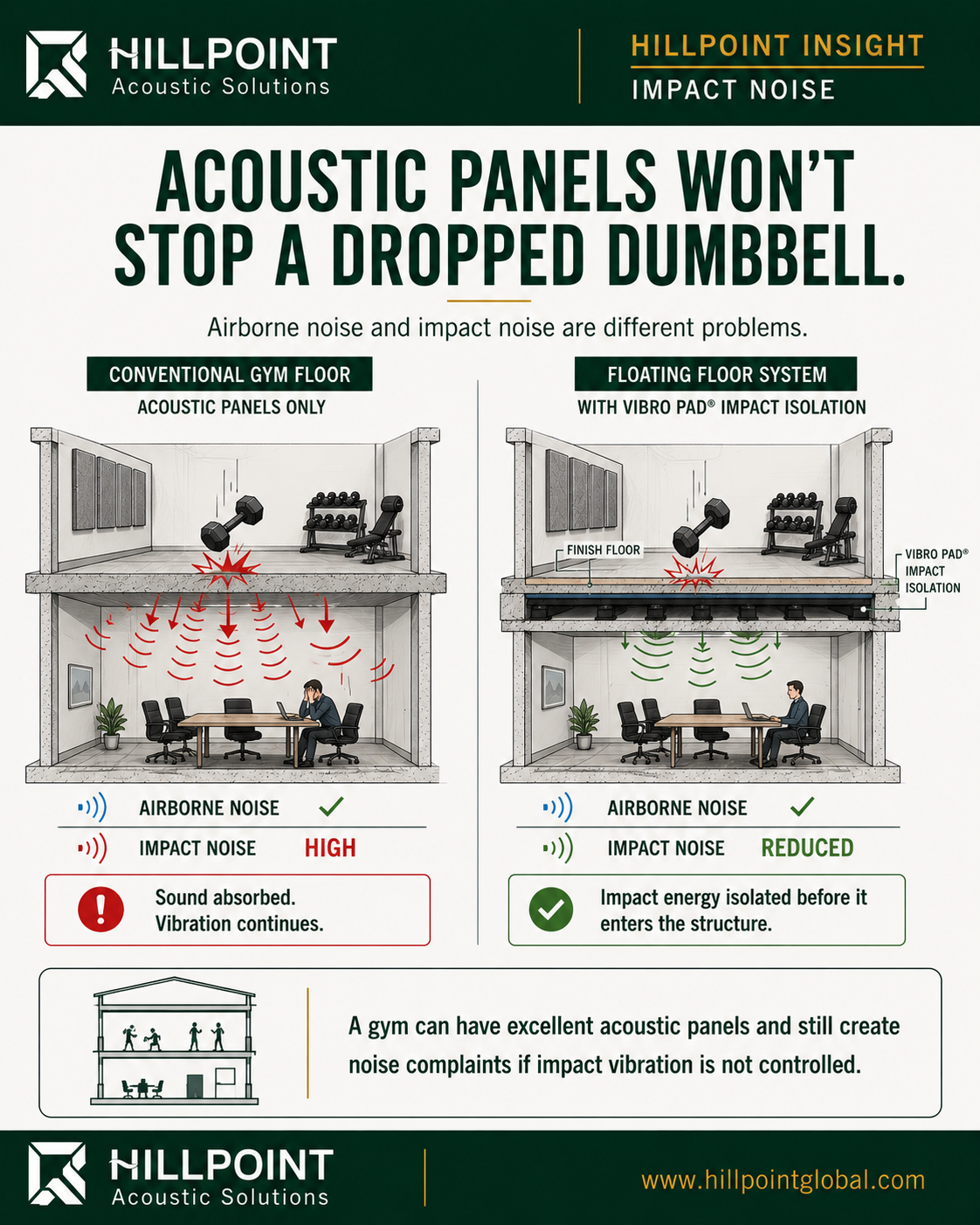
When a loaded barbell hits a platform from overhead height, the peak sound level can exceed 90 dB at 2 metres. That's the airborne component. The more damaging part is the vibration that transmits through the floor slab into the building structure, reaching spaces above, below, and adjacent to the gym, sometimes several floors away.
Standard rubber gym tiles (8 to 10mm) reduce the surface noise but do very little for structure-borne vibration. The difference between basic rubber tiles and a properly engineered isolation platform is substantial. Acoustic testing by Eleiko found a 25.7 dB reduction using their SVR vibration-reducing platform compared to an 8mm tile baseline, and 18.8 dB better than 30mm standard tiles. A 10 dB reduction is perceived as roughly half the loudness, so that difference is dramatic.
For weightlifting zones, the treatment sits in HillPoint's ISOLATE axis: resilient flooring systems, isolation platforms for Olympic lifting areas, and rubber underlays that decouple the gym floor from the structural slab. Ceiling panels and wall treatment do nothing for this problem, because the noise pathway is through the structure, not through the air.
Music bleed from group studios
Group fitness studios typically run music at 85 to 95 dB inside the room. Spin classes, HIIT sessions, and dance classes all push the system hard. Inside the studio, the level is intentional. Outside the studio, it's a complaint.
The problem is almost always bass frequencies. Below 125 Hz, standard glass partitions and lightweight stud walls offer minimal resistance. The bass energy passes through as if the wall is barely there. The mid and high frequencies get blocked adequately, but what you hear from outside is the thudding bass rhythm, which is often more annoying than broad-spectrum noise because it's rhythmic and persistent.
Fixing music bleed requires mass and decoupling. Heavier partition walls (double-layer plasterboard on each side with a resilient channel system), acoustic glazing instead of standard glass, and bass traps in the studio corners to reduce the energy hitting the walls in the first place. The studio ceiling also benefits from high-NRC treatment to absorb sound before it builds up and forces its way through every available path.
Reverberation on the main gym floor
Large open gym spaces with concrete or rubber floors, metal deck ceilings, and minimal soft surfaces create high reverberation times. Sound from treadmill motors, TV speakers, weight machine pulleys, and conversations bounces around the room, building up to a sustained ambient level of 65 to 75 dB that makes the space feel loud and exhausting even when it's not especially busy.
This is the noise problem that acoustic panels and ceiling treatment actually solves. Ceiling baffles are particularly effective in gyms because they work in exposed ceiling environments (no grid needed), absorb from both sides, and bring the reverberation down noticeably across the whole floor.
HillPoint's SOF PET baffles and wall panels are well-suited to gym environments. PET is moisture-resistant, which matters where humidity is higher than a typical office. It's lightweight, which matters when ceiling structures weren't designed for heavy suspended loads. And it's recyclable, which increasingly matters for fitness brands marketing their environmental credentials.
Wooden acoustic wall panels work well in reception areas, stretching zones, and premium fitness spaces where the aesthetic needs to feel more refined than standard foam or fibre panels.
Treating the gym as three zones
The mistake most gym fit-outs make is treating the entire space as one acoustic problem. Ceiling panels go up everywhere, rubber tiles go down everywhere, and nobody addresses the studio partitions or the platform isolation separately.
The right approach maps HillPoint's three acoustic axes to the three gym zones: ABSORB with ceiling baffles and wall panels on the main gym floor, BLOCK with acoustic partitions, doors, and glazing between the group studio and the main floor, and ISOLATE with resilient flooring, isolation platforms, and vibration-decoupled equipment mounting in the free weights zone.
This is the same problem that open offices face with meeting rooms, just at higher source levels.
HillPoint manufactures panels, baffles, and door systems covering the ABSORB and BLOCK axes. For the ISOLATE axis, we coordinate with flooring specialists to ensure the complete acoustic system works together rather than leaving gaps between trades.
For gym and fitness centre projects, getting these three zones right from the design stage avoids the costly retrofits that follow noise complaints after opening.
Technical Guides
Need the full acoustic treatment and soundproofing guides?
The long-form acoustic panels India guide covers panel types, NRC logic, standards, and room treatment. The soundproofing solutions India guide covers STC logic, doors, walls, floors, and the block-and-isolate side of the same design problem.