Acoustic Louvers: Cut Rooftop HVAC Noise, Keep the Airflow
Acoustic louvers cut rooftop HVAC noise while still passing the air chillers and cooling towers need. Here is how they work and how to spec one.
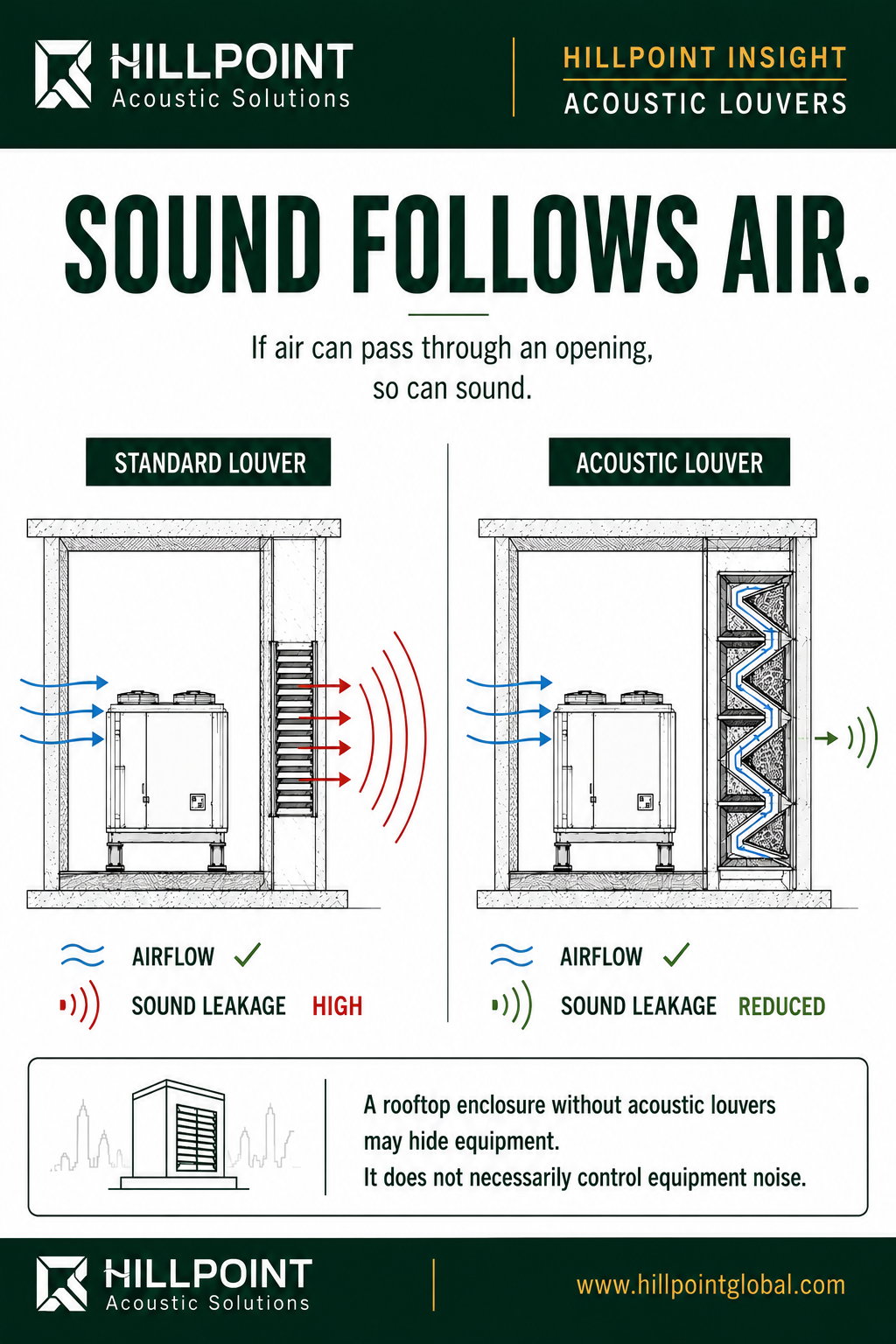
On a lot of rooftop plant decks, the loudest thing isn't the chiller. It's the louvered opening the chiller breathes through. The machine sits inside an enclosure, the enclosure needs air, so somebody cuts a big ventilation opening into the wall. Air goes in and out the way it should. The noise rides along with it.
That's the whole rooftop noise story in one line. Acoustic louvers exist because you can't just seal the opening shut, and a plain louver does almost nothing to the sound.
Why the opening is the leak, not the equipment
Chillers, cooling towers, air-handling units and exhaust fans all generate noise at the source, and manufacturers have gotten better at quieting them down. The problem is rarely the rated sound power on the data sheet. It's the path that sound takes once it's running.
Mechanical plant needs a steady supply of air to stay within its operating temperatures. So the enclosure gets ventilation openings. Sound energy treats those openings as an open door. It travels straight through and carries across the roof to whoever sits downwind, which is usually a hotel room, an upper office floor, a neighbouring building, or the project's own terrace and pool deck.
Cooling towers make this worse than most people expect, because they push a lot of air and produce broadband noise with real low-frequency content. Low frequencies are the hardest to deal with and the most likely to travel a long way and trigger complaints at the boundary.
What a standard louver actually does
A conventional louver does three jobs. It lets air pass, it keeps rain out, and it holds airflow resistance to a minimum. None of those jobs involve sound.
Look at a standard louver edge-on and you can see the issue. The blades are shallow and the line of sight straight through is mostly open. Sound waves don't meet anything that slows them down. You get good airflow and almost no attenuation, which is exactly what the louver was designed to do. It just wasn't designed for your noise problem.
What is an acoustic louver?
An acoustic louver is a deeper ventilation louver with sound-absorbing splitters built into the blade path, so it lets air through while soaking up a large share of the noise inside the louver depth before that noise reaches the boundary. It does the job of a normal louver and adds attenuation, which a standard louver can't offer.
The depth is the part that matters. A standard louver might be 50 to 75 mm deep. An acoustic louver runs much deeper, often 200 mm to 300 mm or more, because the sound needs distance and absorptive surface to lose energy as it passes through. More depth and more lining generally buys more attenuation, especially at the higher frequencies. Low-frequency control stays harder and usually leans on the enclosure and isolation, not the louver alone.
Do acoustic louvers reduce airflow?
Yes, and this is the part the marketing usually skips. An acoustic louver has a lower free area and a higher pressure drop than a plain louver of the same face size, because those splitters sitting in the airstream take up room and add resistance.
So you don't get attenuation for free. You design around it. You size the opening larger to recover the free area, and you check the added static pressure against the fan curve so the equipment still moves the air it needs. Get that sizing wrong and you've solved a noise complaint by creating a ventilation problem, which on a chiller or a generator can mean higher head pressure, hotter running, nuisance trips, and a shorter service life. The honest version of the brief is balance, not blockage.
Where they earn their place
Cooling tower enclosures are the classic case. High airflow, broadband noise, often sitting close to occupied space.
Chiller plant rooms need large volumes of ventilation air while staying under an environmental noise limit at the property line. Generator enclosures are another one. Emergency sets run loud, and the ventilation and radiator openings turn into the main leakage paths the moment the set fires up. Plant rooms and general rooftop service zones use acoustic louvers wherever airflow and a noise target have to live together.
How to actually spec one
Picking an acoustic louver off a catalogue line rarely ends well. A few things decide whether it works on site.
1. Airflow and free area. Start from the ventilation rate the equipment needs, then size the louver face so its reduced free area still delivers that flow.
2. The attenuation target. This comes from the gap between the equipment noise and the limit at the receiver or boundary, which is set by local regulation and how close the neighbours are.
3. The equipment spectrum. A cooling tower, a generator and an AHU do not sound alike. Match the louver to the frequencies that are actually causing the trouble, especially anything low.
4. Depth and available space. Deeper louvers attenuate more but eat into the plant deck. Geometry often sets the ceiling on what you can achieve.
5. Weather and access. Rooftops see rain, sun and wind. The louver has to handle exposure and stay maintainable for years.
Why this belongs in the early drawings
Rooftop noise is far cheaper to handle on the drawing board than after handover. Once the complaints start, you're retrofitting around live equipment, working in tight roof space, and often paying for it twice.
Bringing the acoustic side into the HVAC and architectural coordination early lets the team protect occupant comfort, hold the community noise limit, and keep the project compliant without expensive rework later. The louver opening, the equipment selection and the enclosure all want to be decided together, not in sequence.
The louver is one piece of the path
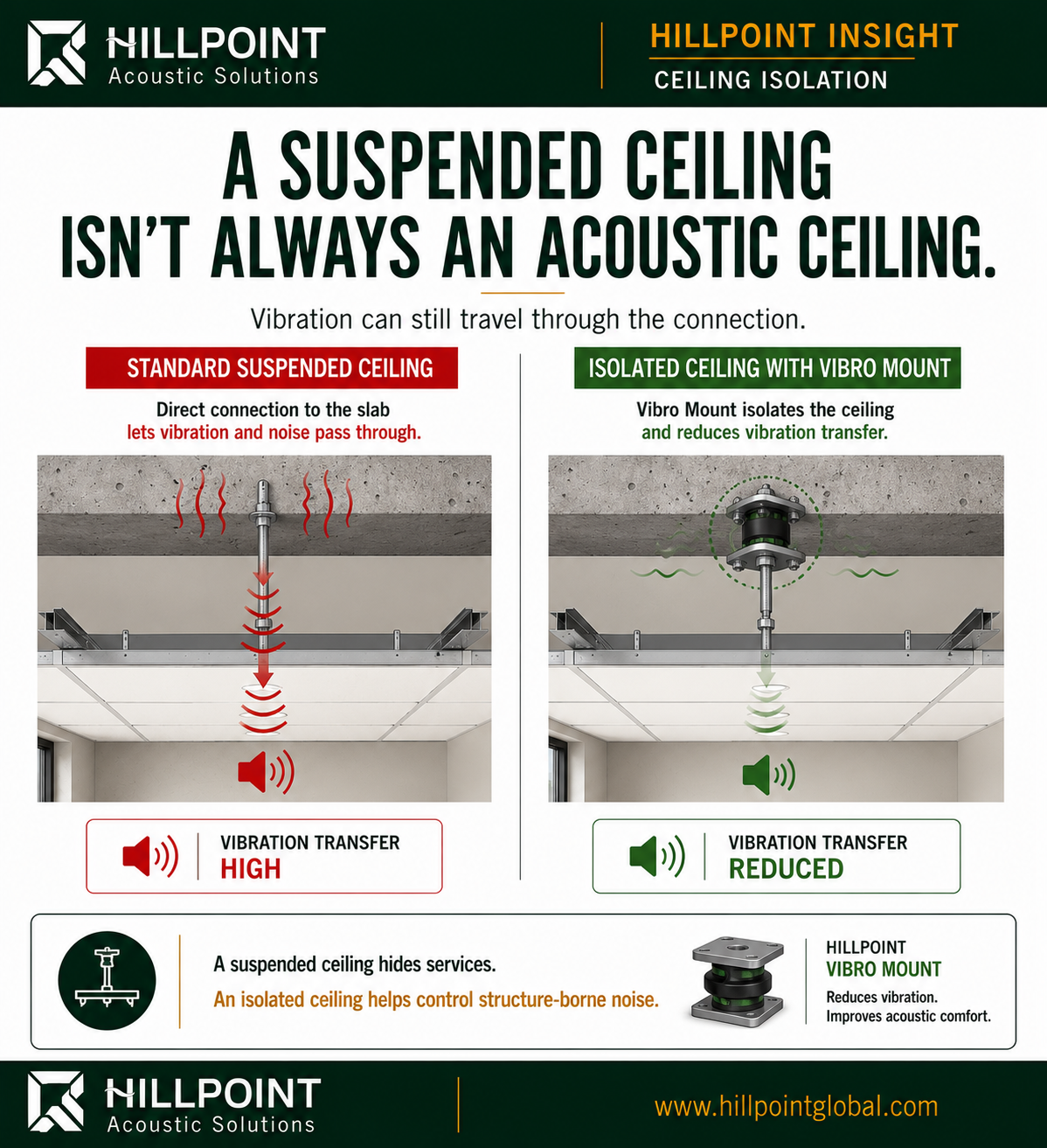
A louver on its own rarely fixes a rooftop. Sound from mechanical plant travels as airborne noise through the openings and as structure-borne vibration down through the slab, and a good result usually needs both routes handled. That means equipment selection, vibration isolation under the machines, the enclosure build, and the acoustic louvers all working as one system. Treating only the opening leaves the vibration path open, and the complaint comes back in a different form.
That system view is how we approach it at HillPoint Global. We manufacture the Acousstop acoustic louver range and size each opening against the real equipment and the site's noise target rather than a generic spec, and we work alongside the architects, MEP consultants and contractors who own the rest of the path. If you've got a rooftop plant deck near occupied space, the louver schedule is worth a second look before the drawings lock.
Related reading: the three axes of acoustic design covers why absorbing, blocking and isolating solve different problems. For the products themselves, see the Acousstop acoustic louver and Acousstop Vibro Mount for the isolation side. ASHRAE remains the standard reference for HVAC and mechanical noise control if you want to go deeper into the engineering (ashrae.org).
Technical Guides
Need the full acoustic treatment and soundproofing guides?
The long-form acoustic panels India guide covers panel types, NRC logic, standards, and room treatment. The soundproofing solutions India guide covers STC logic, doors, walls, floors, and the block-and-isolate side of the same design problem.