Why an Acoustic Membrane Alone Won't Soundproof a Room
An acoustic membrane improves a wall, but it can't beat a gap under the door. Here is the weakest-path principle and why soundproofing is a system, not a product.
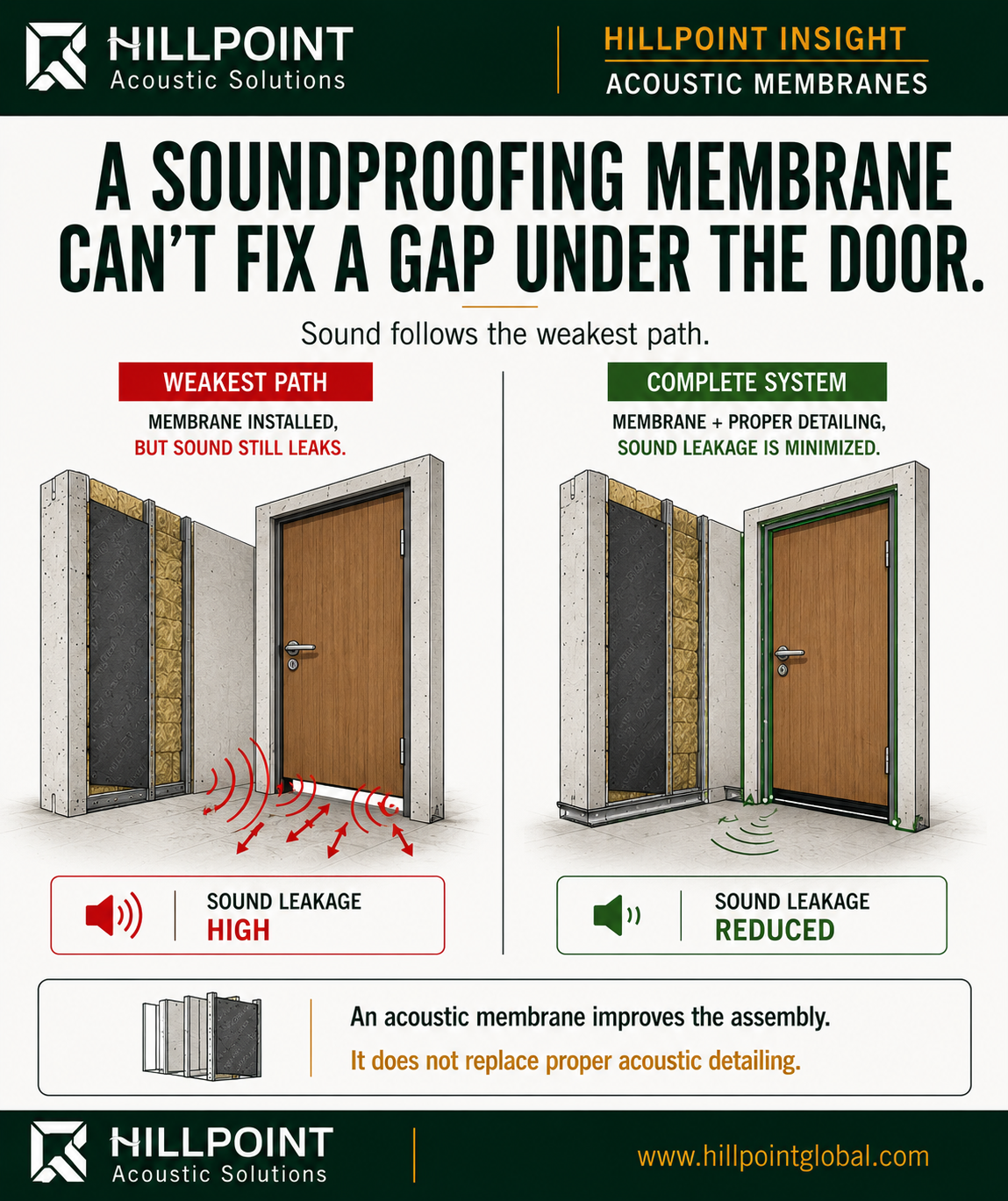
A wall gets built up properly. Insulation in the cavity, two layers of gypsum, a dense acoustic membrane in between. On paper it's a strong assembly. Then there's a 10 mm gap under the door, and the room next door hears every meeting anyway.
The membrane did its job. The door undercut quietly undid it. This is probably the most common way soundproofing disappoints, and it has almost nothing to do with the products chosen.
When a project hits a noise complaint, the reflex fix is usually to add material. More mass, another layer, a membrane. Sometimes that's the right move. A lot of the time, the wall was never the problem.
What an acoustic membrane actually does
A membrane is a thin, dense layer you build into a wall, floor or ceiling to add mass and improve how much sound the assembly stops. Mass matters in sound isolation, so a good membrane genuinely lifts the performance of the build-up it sits inside. They show up in offices, hotels, residential towers, studios, schools and healthcare spaces for exactly that reason.
The catch is in the phrase "the assembly it sits inside." A membrane improves the path it's part of. It does nothing for the paths it isn't part of, and those other paths are usually where the trouble is.
Does an acoustic membrane soundproof a room?
Not on its own. A membrane raises the performance of the wall or floor it's built into, but sound isolation depends on the whole assembly. If there's a gap under the door, an unsealed penetration, or a leaky perimeter, sound bypasses the membrane entirely. The membrane helps. It can't compensate for the weak points around it.
The weakest path wins, every time
Here's the principle that explains most of this. Sound takes the easiest route between two spaces, and the result is dominated by that easiest route, not the average of all of them. People picture sound pushing straight through the wall. Sometimes it does. More often it finds a gap and pours through there instead.
That's why a small opening punches so far above its size. A gap that's a tiny fraction of the wall's area can cap the performance of the entire assembly, because it's an open path while everything around it is closed. You can't average your way out of a leak. The expensive wall and the cheap gap don't split the difference. The gap wins.
Why does sound leak under a door?
A door undercut is a continuous open slot connecting two rooms, and air gaps carry sound very efficiently. Most internal doors are cut with a gap at the bottom for airflow or to clear flooring, and that gap becomes a direct acoustic path straight past an otherwise solid wall. It's often the single weakest point in the room.
The frame perimeter is the next offender. A door leaf can be heavy and well built, but if the frame isn't sealed cleanly against the wall, you get a continuous leakage line right around the opening. Threshold, head, jambs. All of them have to close.
The leaks that beat the wall
Beyond the door, the usual suspects are predictable once you know to look. Service penetrations are a big one, electrical conduit, cable trays and pipework punched through a wall and left unsealed around the edges. HVAC openings turn ventilation into a sound path when grilles and ducts connect two rooms without any attenuation. And construction joints, the interfaces where wall meets ceiling or floor, leak whenever the detailing skips a proper seal.
None of these are exotic. They're the boring, easy-to-miss details that get value-engineered or rushed near the end of a job, and any one of them can hold the whole room back.
Soundproofing is a system, not a product
A membrane can test beautifully in a lab. So can an acoustic door, and so can a wall build-up. Line them all up in a real building with sloppy interfaces between them and you can still get a leaky room. The lab measures one component under controlled conditions. The building gives you construction tolerances, penetrations, interface conditions and whatever happened on site that day.
So the data sheet is a starting point, not a guarantee. Real performance comes from how the pieces meet each other, which means the membrane, the door, the perimeter seals, the acoustic sealant at the joints and the sealed penetrations all have to be treated as one system. Miss the integration and the best products in the world still leak. Sound going around the separating element, rather than through it, is its own topic worth understanding too, and the three axes of acoustic design covers where blocking ends and isolation begins.
What moves the result more than mass
If a room is leaking, adding another layer of board is rarely the highest-value fix. Closing the door undercut with a proper drop seal, sealing the frame perimeter, and dealing with the penetrations usually buys more than another sheet of gypsum ever will. Honestly, the cheapest interventions on a job are often the ones that matter most, which is a hard thing to sell when a membrane feels like the more serious answer.
That's the lens we bring to it at HillPoint Global. We manufacture the Acousstop Silenz membrane for the mass side of the assembly and STC-rated acoustic doors with auto-close drop seals for the weak point most rooms share, but on most projects we'd point at the door, the perimeter and the penetrations before reaching for more material in the wall. If a space has to stay private, the detailing is worth checking before the product schedule grows.
For the products, see Acousstop Silenz and the Acousstop acoustic doors. The STC ratings explained piece covers why a door's rating only holds up when the seals and installation do. Lab versus field sound isolation is set out in ASTM test methods if you want the standards detail (astm.org).
Technical Guides
Need the full acoustic treatment and soundproofing guides?
The long-form acoustic panels India guide covers panel types, NRC logic, standards, and room treatment. The soundproofing solutions India guide covers STC logic, doors, walls, floors, and the block-and-isolate side of the same design problem.