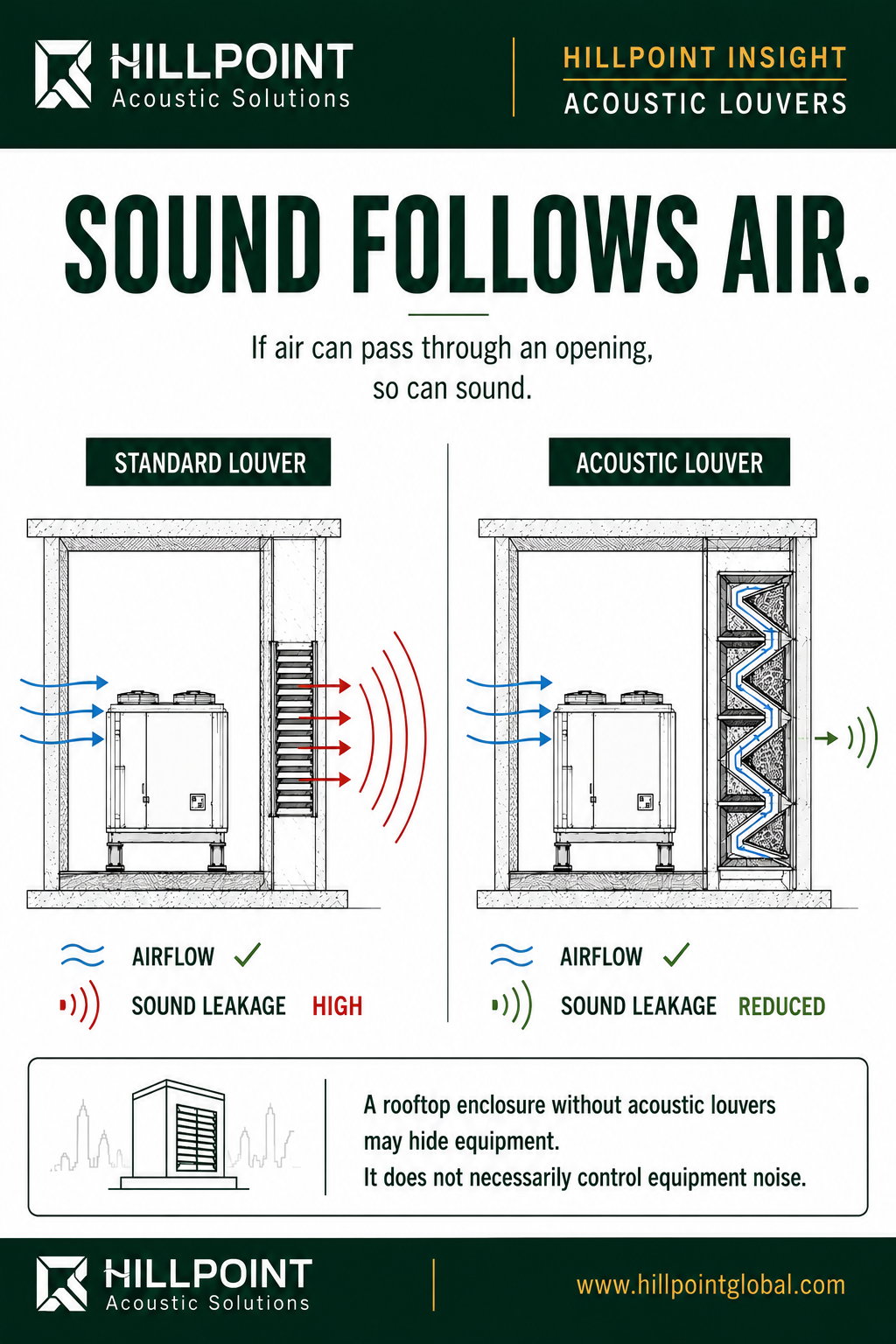
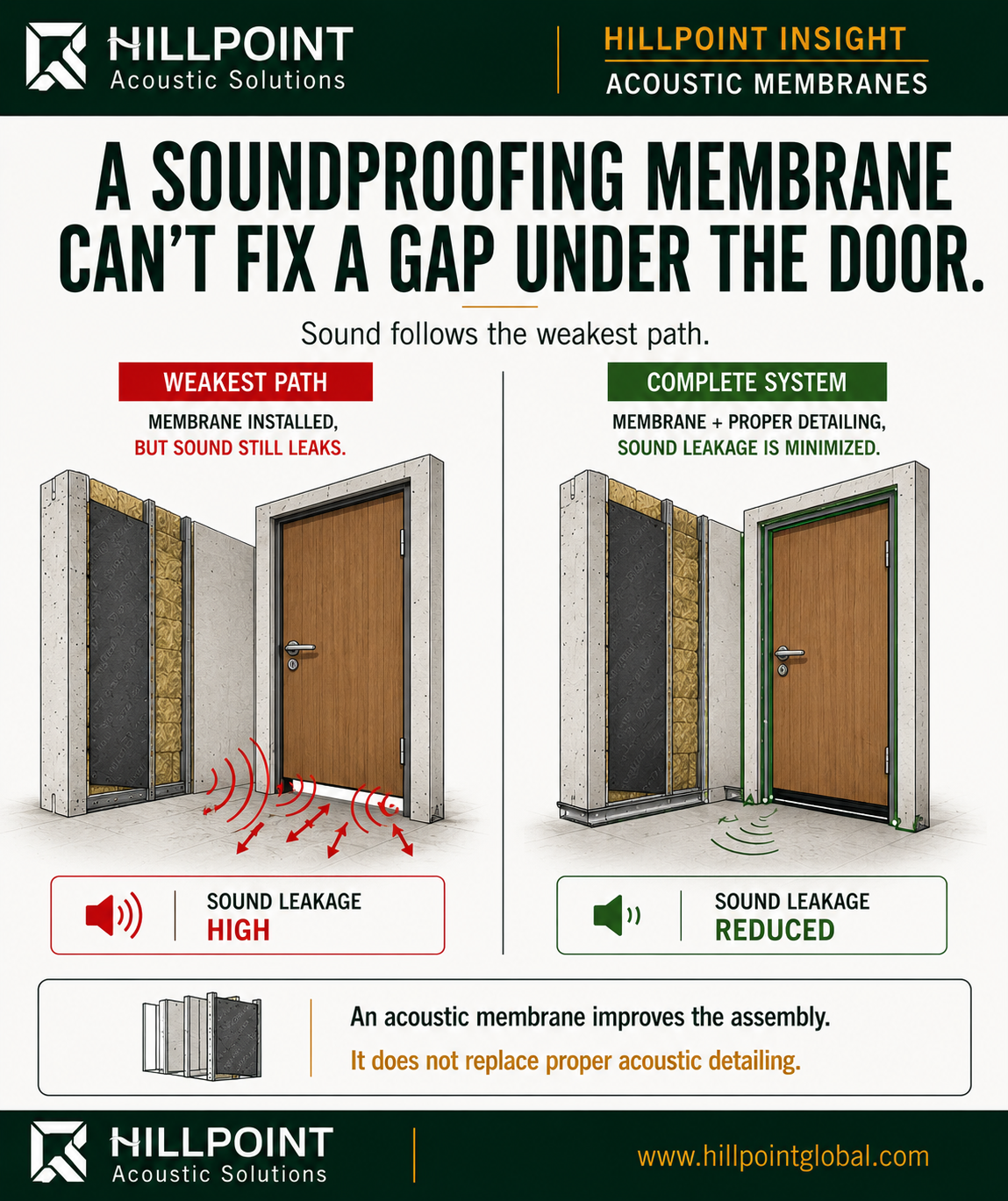
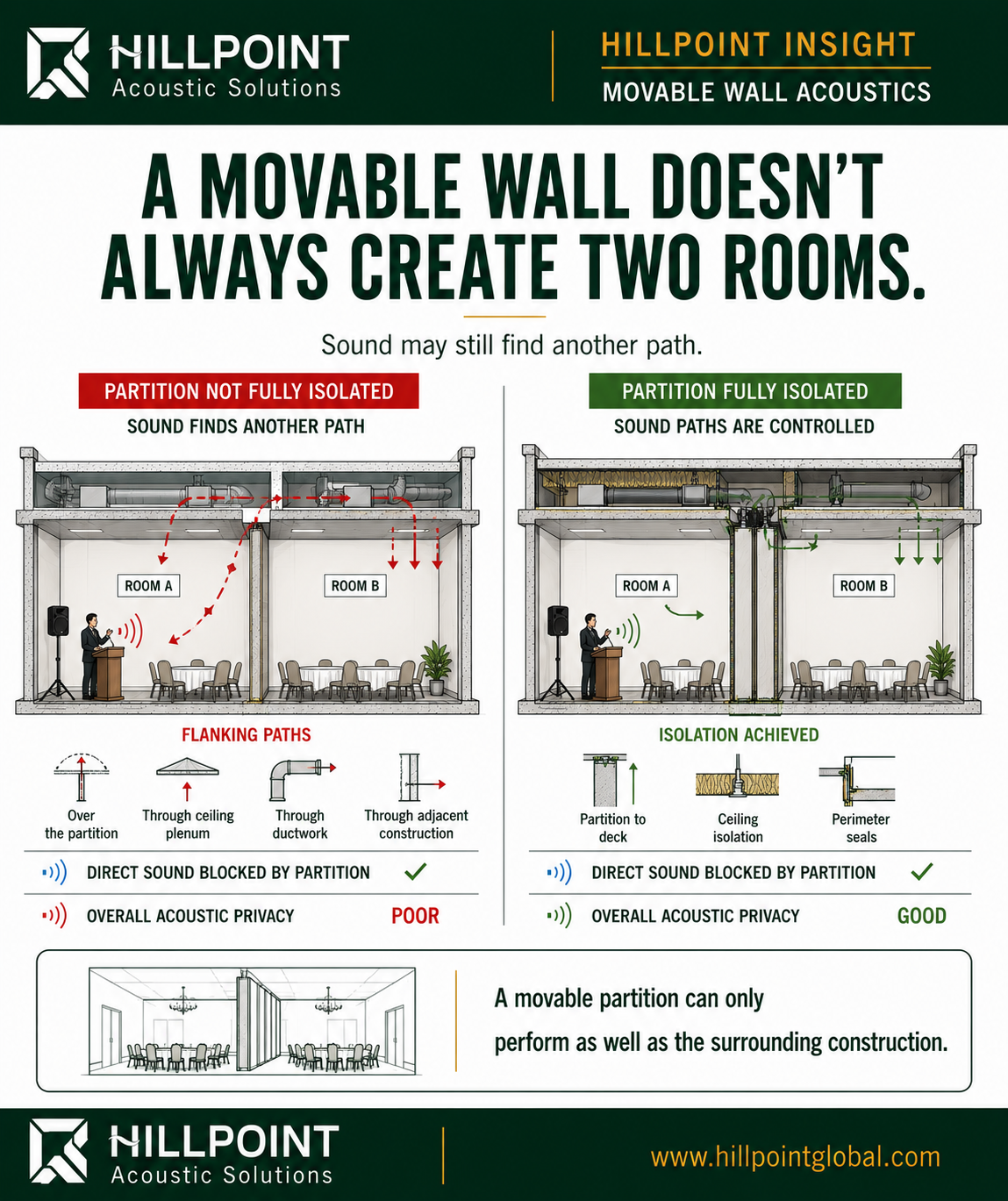
Suspended Ceiling vs Isolated Ceiling: Stopping Vibration
A suspended ceiling hides services. It usually won't stop vibration from the slab above. Here is the difference an isolated ceiling makes and when you need one.
A tenant on a commercial floor keeps reporting a low rumble in the late evening. There's a suspended ceiling overhead, services tucked away, clean finish, the lot. Someone reasonably assumes the ceiling already deals with noise. The plant room one floor up is still putting a hum into the room every night, and the ceiling isn't touching it.
A suspended ceiling and an isolated ceiling look the same from underneath. They're not the same system, and the difference only shows up when vibration enters the picture.
This mix-up is common because the two words get used interchangeably. A ceiling can be suspended without being isolated, and most of them are.
What a suspended ceiling is actually for
A suspended ceiling is a secondary ceiling hung below the structural slab on hangers and framing. Its day job is practical. It hides ductwork and cabling, carries the lighting, gives maintenance access, and provides a clean finished surface.
It can help the room acoustically too, mainly by adding some absorption overhead, which is a real benefit and the subject of its own discussion. Our piece on why ceiling treatment matters more than wall panels covers that absorption side. This article is about a different problem, and absorption doesn't solve it.
Does a suspended ceiling reduce noise?
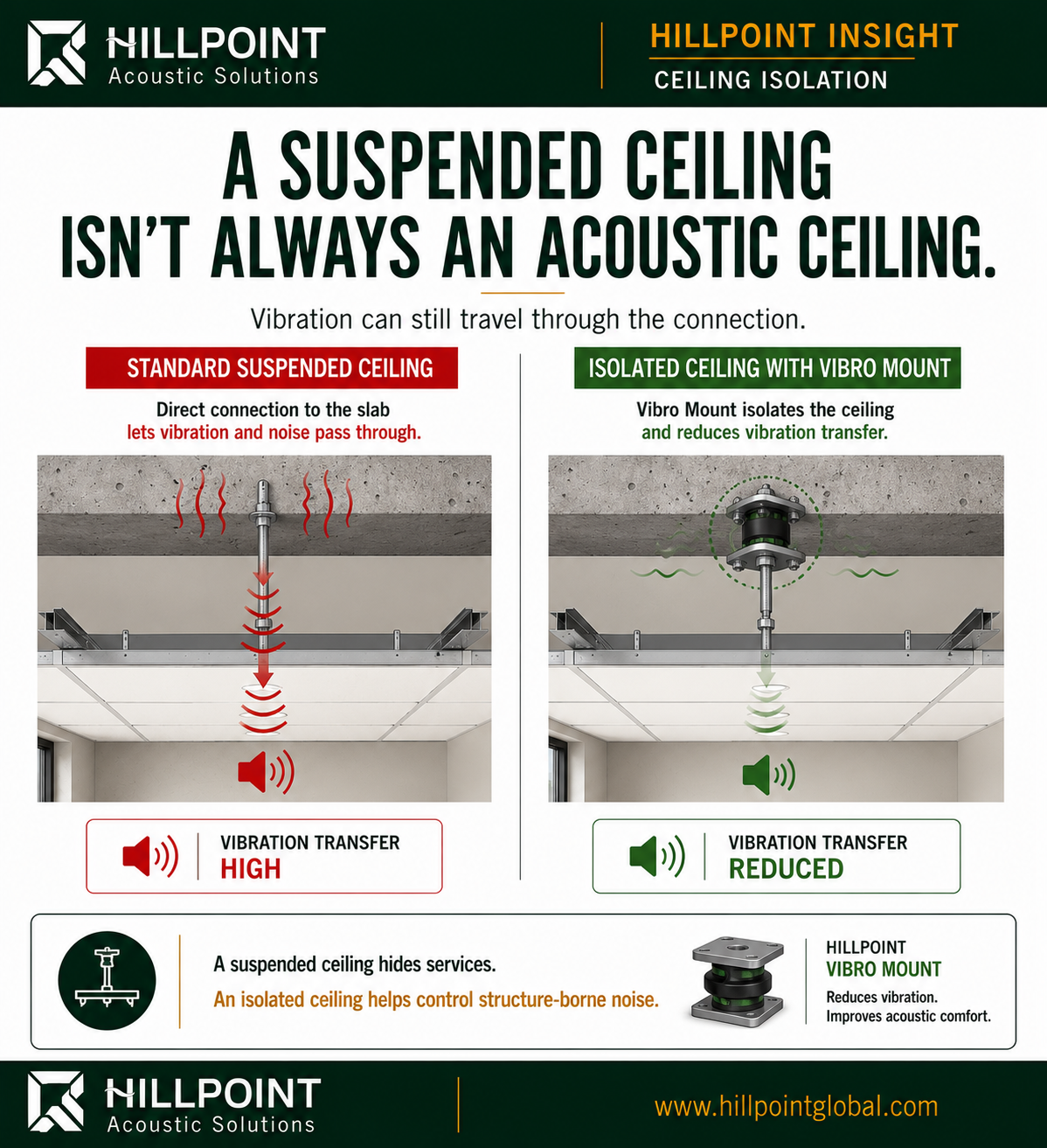
It can reduce some airborne sound in the room, especially when the tiles add absorption. What it usually does not do is stop vibration. If the hangers connect rigidly to the slab above, structure-borne noise travels straight down that connection into the room, no matter how good the tiles are. For vibration, the ceiling being suspended isn't the same as it being isolated.
The misconception that costs projects
The assumption goes: install a suspended ceiling, the noise goes away. For some airborne issues, fair enough. For vibration and low-frequency noise, it often isn't true at all.
A rigid hanger is a direct mechanical link to the structure. Vibration in the slab doesn't care that there's a ceiling hanging off it. It rides down the hanger and radiates into the space below. The ceiling is suspended. It just isn't isolated, and for this particular problem that distinction is the whole game.
What is an isolated ceiling?
An isolated ceiling places a resilient element, a spring or a rubber-type mount, into the hanger between the structural slab and the ceiling framing. Instead of a rigid metal-to-metal link, the connection flexes, which breaks the path that carries vibration down from the slab. Most of the structure-borne energy gets stopped at that break before it reaches the ceiling and the room.
How the noise gets in
Picture a mechanical unit, a pump or a chiller on the floor above. As it runs, it feeds vibration into the structural slab. From there the path is simple and continuous: equipment into the structure, structure into the hanger, hanger into the ceiling, ceiling into the occupied space. The person below ends up with a low-frequency rumble, a mechanical hum, sometimes a buzz, and it sits there underneath whatever absorption the room already has, because absorption was never going to catch it.
Structure-borne noise behaves differently from airborne sound in a way that makes it stubborn. Airborne sound weakens fairly fast as it crosses a room. Vibration in rigid concrete and steel travels a long way without losing much, so the source can be well away from the complaint.
How isolation works, and why it has to be designed
The principle is to interrupt the path, not to pile on more material. A resilient hanger lets the ceiling move slightly independently of the slab, and that small amount of give is what dissipates the energy. It sits in the same family as floating floors, equipment isolation mounts and resilient wall systems. Same idea, different location.
Here's the part worth getting right: an isolator only works when it's matched to the problem. A vibration mount has its own natural frequency, and to do its job that frequency has to sit well below the frequency of the disturbing vibration. Pick the wrong stiffness for the load and the mount can do little, or in a bad case amplify things at certain frequencies. So ceiling isolation is a sizing exercise, not a part you simply add. The load per hanger, the equipment's running frequencies and the deflection you need all feed into it. The three axes of acoustic design explains why isolation is a separate discipline from absorbing and blocking in the first place.
Where isolated ceilings earn their place
Recording studios use them to keep outside vibration from bleeding in. Home theatres lean on them for low-frequency control, which is exactly where structure-borne energy lives. Hotels use isolation to keep noise from travelling between stacked occupied spaces. Meeting rooms get a privacy and comfort benefit. And anywhere with mechanical plant nearby, commercial floors under services, rooms next to plant rooms, the slab-to-ceiling connection becomes a real acoustic decision rather than a detail.
Confirm where the energy is coming from first
One honest caveat before anyone specs this. An isolated ceiling only helps when the vibration is genuinely arriving through the slab above. If the actual source is the equipment's own mounts that were never isolated properly, or a flanking path through the walls, then isolating the ceiling spends money on the wrong link and the rumble stays. Worth confirming where the energy enters the structure before committing to the fix. I've seen the ceiling get blamed when the real culprit was a pump bolted straight to a floor with no isolation under it.
That diagnostic step is how we'd start at HillPoint Global. We manufacture the Acousstop Vibro Mount, the resilient ceiling hanger that goes into the suspension, and we'd size it to the load and the equipment rather than treat it as a catalogue add-on. If a space has plant above it or sits in a vibration-sensitive use, the slab-to-ceiling connection is worth resolving while the ceiling is still on the drawings.
For the product, see the Acousstop Vibro Mount. ASHRAE is the standard reference for mechanical vibration isolation in buildings if you want to go deeper (ashrae.org).
Technical Guides
Need the full acoustic treatment and soundproofing guides?
The long-form acoustic panels India guide covers panel types, NRC logic, standards, and room treatment. The soundproofing solutions India guide covers STC logic, doors, walls, floors, and the block-and-isolate side of the same design problem.