HVAC Duct Cross-Talk: Why Soundproof Rooms Still Leak
A great acoustic wall can't stop sound that travels through a shared HVAC duct. Here is how duct cross-talk works and where the fix actually sits.
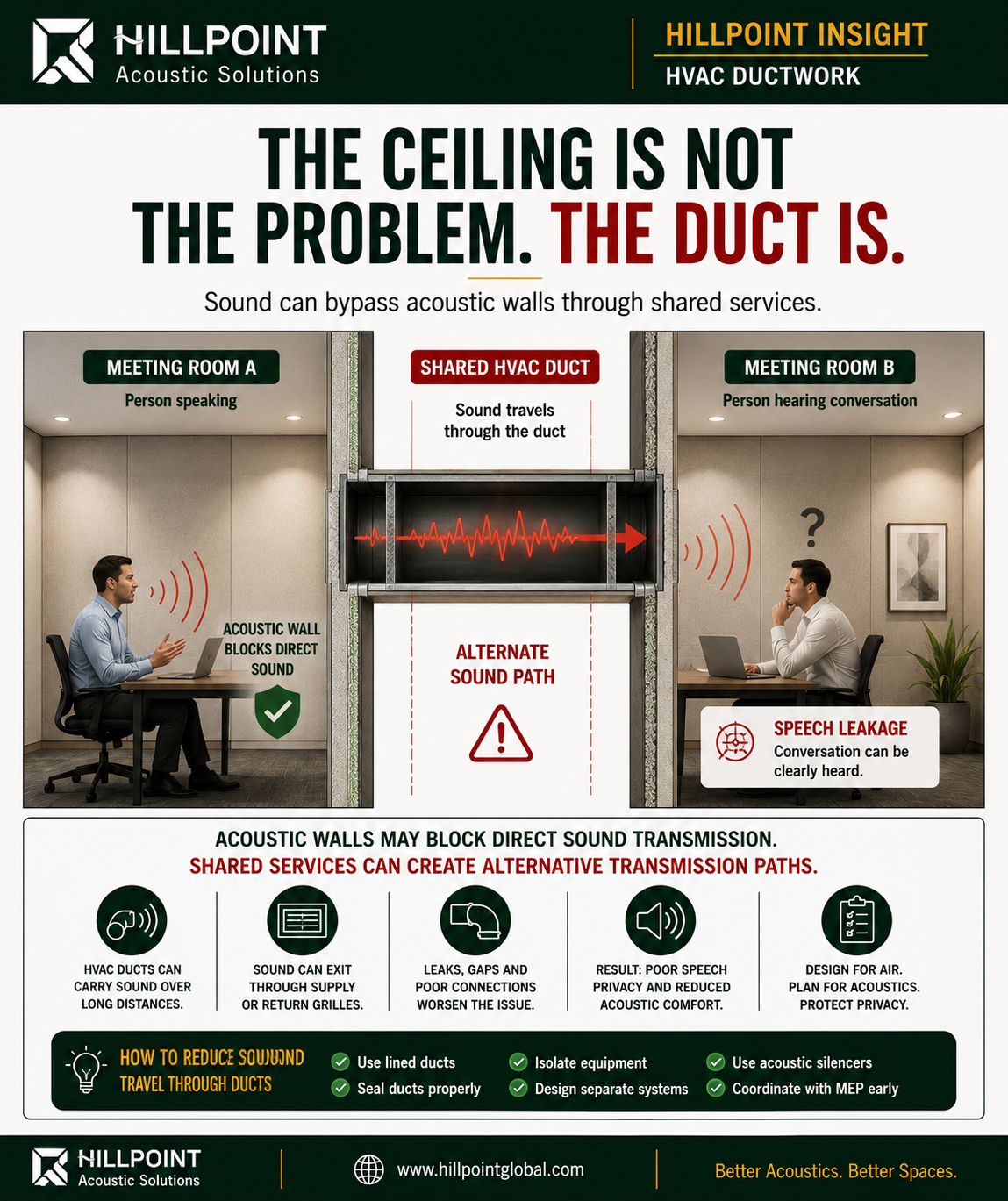
Two meeting rooms share a wall. The wall is a good one, insulated, properly sealed, with a rated acoustic door. The brief was speech privacy and on paper it's covered. People in one room can still make out the conversation in the other.
The first instinct is that the wall was oversold. Usually it wasn't. The sound didn't go through the wall at all. It went up into the air supply, along the shared duct, and back down into the next room through its grille. The partition never had a chance to stop it, because the sound bypassed the partition entirely.
This is duct cross-talk, and it's one of the more frustrating privacy failures precisely because the visible thing, the wall, is innocent.
The path nobody looks at
Most commercial buildings move conditioned air through one connected network. Supply ducts, return ducts, transfer ducts, sometimes a common ceiling plenum used as a return. All of it is essential, and all of it can carry sound between spaces that the architecture treats as separate.
So two rooms can be acoustically separated by the wall and still be acoustically connected by the mechanical system. The drawings show a partition between them. The ductwork shows a pipe linking them. Both are true at once.
What is duct cross-talk?
Duct cross-talk is speech or noise travelling from one room to another through shared HVAC ductwork instead of through the wall. Sound enters the duct at a supply or return grille in the first room, travels along the airway, and re-emerges through a grille in the next room. The separating wall is bypassed completely, so its rating barely affects the result.
Why can I hear the next room through the vent?
Because the vent in your room and the vent next door can be two ends of the same short pipe. A grille is an open acoustic path into the duct. If the duct branch serving your room connects to the branch serving the next room over a short, straight run, speech has an easy trip from one grille to the other. You're effectively talking through a tube that happens to also carry air.
What makes it worse
A few conditions turn a minor path into an obvious one. Short, straight duct runs between two rooms give sound a clean shot with little chance to lose energy. Bare, rigid sheet-metal ducts with no lining reflect sound along their length instead of absorbing it. Large open grilles let more sound in and out. And a shared ceiling plenum acting as a common return is one of the easiest cross-talk paths there is, since both rooms are dumping into the same volume.
None of these are faults exactly. They're efficient ways to move air that happen to be efficient ways to move sound too.
How you actually fix it
The honest part first: most of this lives in the mechanical design, not the wall build-up. The acoustic consultant and the MEP engineer own it together, and the moves are well established.
Acoustic duct lining puts absorptive material inside the duct so sound loses energy as it travels. Cross-talk attenuators, which are short acoustic silencers fitted into the branch ducts, are the targeted fix for exactly this problem. Transfer-duct design matters where a room is ventilated through a transfer path, since a longer, lined, offset route maintains airflow while cutting the direct sound line. And for genuinely sensitive rooms, separating the ductwork so the room isn't sharing a branch with its neighbour is the clean, if more expensive, answer.
The thread is the same as the rest of building acoustics. The three axes of acoustic design covers why blocking the wall doesn't help when the sound is taking a path around it.
The frequency caveat worth knowing
One detail that catches people out: acoustic duct lining mostly works on mid and high frequencies. It's good at taking the edge off speech, less effective down low. Low-frequency cross-talk and duct breakout, where sound radiates through the duct wall itself, usually need silencers or added mass rather than lining alone. So "we lined the duct" isn't automatically the end of the story if the problem is a low rumble rather than intelligible speech. Match the fix to the frequency that's actually causing trouble.
Coordinate it early, and be clear about scope
Duct cross-talk is painful to retrofit. Adding attenuators or re-routing ducts after the ceiling is closed means disruption, cost, and working around a live system. Catching it in the MEP and acoustic coordination, before the ductwork is set, is far cheaper and usually far more effective.
This is where being a manufacturer with a consultant's habits actually helps. At HillPoint Global we make the wall, door and absorption side of a privacy brief, and we'll flag a likely cross-talk path early, but we won't pretend a better panel solves a duct problem, because it doesn't. The duct fix belongs in the mechanical scope, and the most useful thing we can do is make sure it isn't forgotten while everyone studies the wall. If speech privacy genuinely matters in a room, the ductwork serving it deserves a look before the partition spec gets all the attention.
For the privacy side we do build, see the acoustic doors and the wider product range, and the meeting-room acoustics piece for why the room itself shapes how speech carries. ASHRAE is the standard reference for HVAC noise and duct cross-talk if you want the engineering detail (ashrae.org).
Technical Guides
Need the full acoustic treatment and soundproofing guides?
The long-form acoustic panels India guide covers panel types, NRC logic, standards, and room treatment. The soundproofing solutions India guide covers STC logic, doors, walls, floors, and the block-and-isolate side of the same design problem.