NRC 0.90 Means Nothing Without the Mounting
The same acoustic panel can show two different NRC numbers depending on how it was mounted for the test. Here is how to read an NRC rating with confidence.
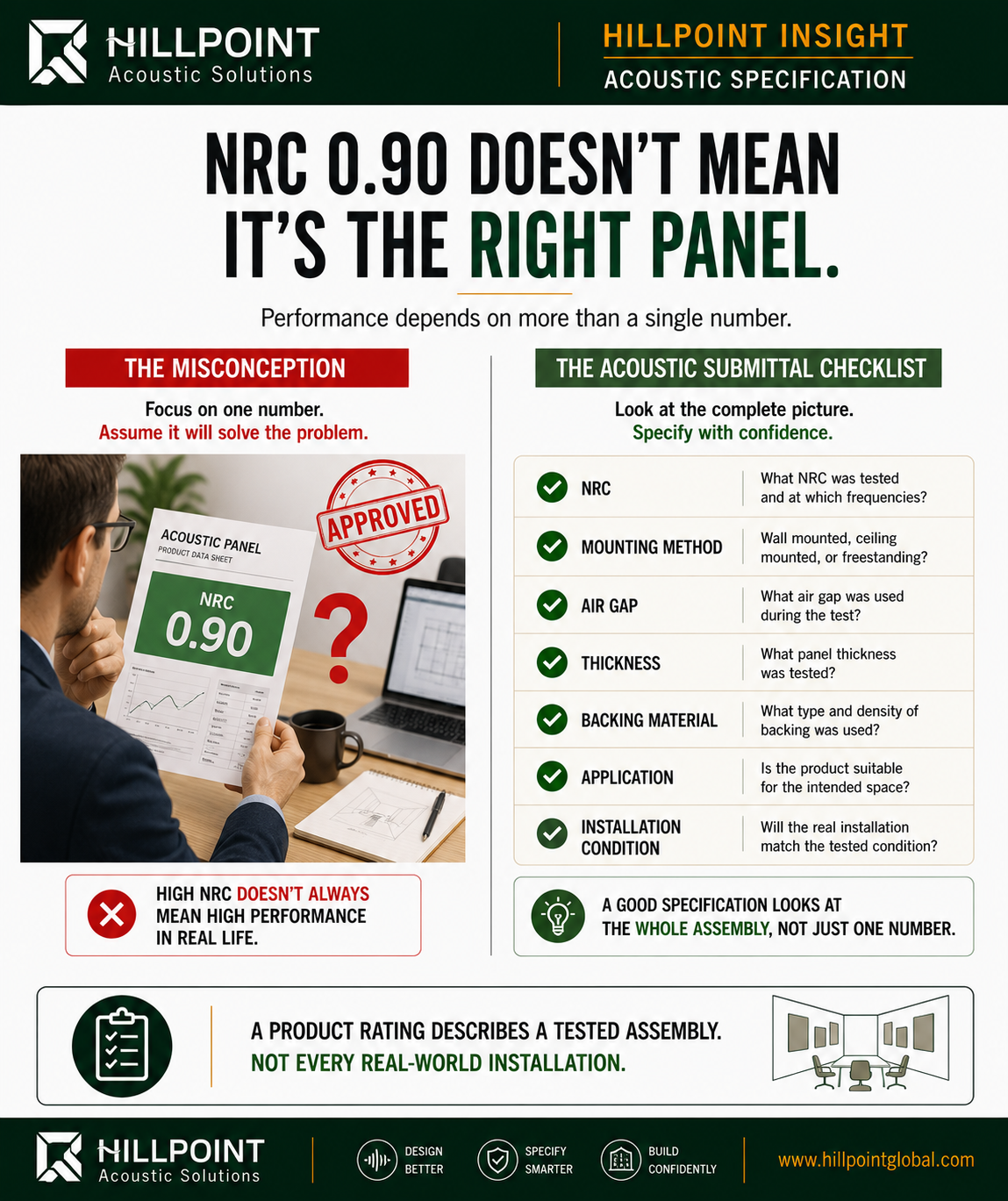
Two acoustic panels land on your desk. One says NRC 0.90, the other says 0.75. The choice looks made before you've read anything else. Pick the 0.90, move on.
That instinct is where a lot of acoustic specs quietly go wrong. An NRC value isn't a fixed property of a panel, the way density or fire rating is. It's the result of one test, in one specific set-up, and change the set-up and the number changes. The 0.75 panel and the 0.90 panel might be closer than they look, or the 0.90 might only hit that figure in a configuration you can't reproduce on your job.
If you want the groundwork on what NRC actually measures and what it averages out, two earlier pieces cover that: what the NRC number means and hides, and what a 0.95 ceiling panel actually does. This one is about the variable that moves the number most and gets read least: how the panel was mounted.
A rating measures a set-up, not a product
Absorption tests run under controlled lab conditions. A defined mounting, a defined cavity, a specific backing, a known thickness. The NRC that comes out describes that assembly. The panel is part of it, but only part.
So the honest way to read a data sheet is to treat the number and its test conditions as one thing. An NRC with no mounting stated next to it is half a specification. It tells you the panel can perform, not how it performed or whether you can repeat it.
Does mounting affect NRC?
Yes, more than almost any other single factor. The same panel tested flat against a hard surface and then tested with a deep air gap behind it will produce two different NRC values, and the gap version is usually higher. The cavity lets the panel absorb more low-frequency energy, which lifts the overall figure. Same panel, different mounting, different rating.
Why the same panel has two NRC numbers
This is the part worth understanding properly. Absorption mounting methods are standardised, and the two you'll meet most are a direct mount, where the panel sits tight against the test surface with no air space, and a plenum mount, where the panel is tested a set distance off the surface, often around 400 mm, to mimic a suspended ceiling with a void above it.
That air gap does real acoustic work. Sitting a panel away from the backing surface improves its absorption at lower frequencies, because the cavity behind it becomes part of the absorbing system. So a ceiling tile tested with a 400 mm plenum can post a noticeably higher NRC than the identical tile tested flat. Neither result is dishonest. They're just answering different questions.
The catch is obvious once you see it. If you specify that ceiling tile and then bond it straight to a concrete soffit with no void, you've thrown away the conditions that produced the rating. The number on the sheet was earned with a plenum you didn't build.
What mounting actually changes
The air gap mostly buys you low-frequency absorption, which is the hardest range to treat and the part NRC is most sensitive to at the margins. A panel that looks average flat to the wall can look excellent suspended in a deep ceiling, purely because of what the cavity adds. Thickness plays into the same story, since a thicker panel and a deeper cavity both push absorption further down the frequency range. Read the tested thickness, not just the NRC.
The questions that belong in every panel spec
Before approving a product on its NRC, a few questions turn the headline figure into something you can trust. How was it mounted for the test, direct or with a cavity? If there's an air gap, how deep? What thickness was actually tested, and is it the thickness you're buying? What backing or infill was behind the visible face? And the one that ties it together: does that tested assembly resemble how this panel will sit in your room?
Run a product through those and a clean 0.90 sometimes turns out to depend on a plenum you don't have, while a modest 0.75 tested flat might be the safer bet for a wall application. The highest number on the table isn't automatically the right panel. It's the right number for a set-up that may or may not be yours.
Match the test to the installation
The whole game is alignment. The closer your real installation sits to the tested configuration, the closer your real performance lands to the published figure. Drift from it, mount it differently, lose the cavity, change the thickness, and the data sheet stops predicting your room.
Real buildings add their own slack on top of that. Construction tolerances, services running through, site conditions, finishes that change late. None of that is in the lab number, which is why a spec built on a single NRC and nothing else tends to under-deliver. The product matters. The conditions around it matter just as much.
Read it like a spec-writer
Worth saying plainly: this isn't a reason to distrust NRC. It's a useful, fast metric, and we use it constantly. It's a reason to read the conditions attached to it, because that's where the number becomes a real prediction rather than a marketing line.
That's the standard we hold at HillPoint Global. We manufacture our acoustic range and we'd always hand over the mounting, cavity and thickness behind an NRC figure, not just the headline value, because a number with no test conditions isn't really a specification. If you're writing an acoustic spec, ask every supplier "0.90 under what conditions" and watch how much the comparison changes. The ones who can answer cleanly are usually the ones worth shortlisting.
See the full product range for the panel families and their finishes, and the room coverage piece for turning panel performance into a treated-area decision. Absorption is measured under ASTM C423, with mounting methods defined in ASTM E795, if you want the testing detail (astm.org).
Technical Guides
Need the full acoustic treatment and soundproofing guides?
The long-form acoustic panels India guide covers panel types, NRC logic, standards, and room treatment. The soundproofing solutions India guide covers STC logic, doors, walls, floors, and the block-and-isolate side of the same design problem.