Fire-Rated Acoustic Panels: What Class A, B, and C Mean for Your Project
Class A, B, and C fire ratings determine where acoustic panels can go in your building. Here is what each class means under NBC 2016 and ASTM E84.
Acoustic panels sit on walls and ceilings in spaces where people work, learn, and gather. If a fire starts, the speed at which those panels contribute fuel or flame spread directly affects how much time occupants have to evacuate. That's why fire rating isn't optional on commercial projects, and why picking the wrong class for the wrong space can stop a project at building approval.
The fire classification system is simpler than it looks once you strip away the jargon. The core question is: how fast does flame travel across the panel surface, and how much smoke does it produce?
The classification system
Fire ratings for interior finish materials follow two main testing standards depending on the market.
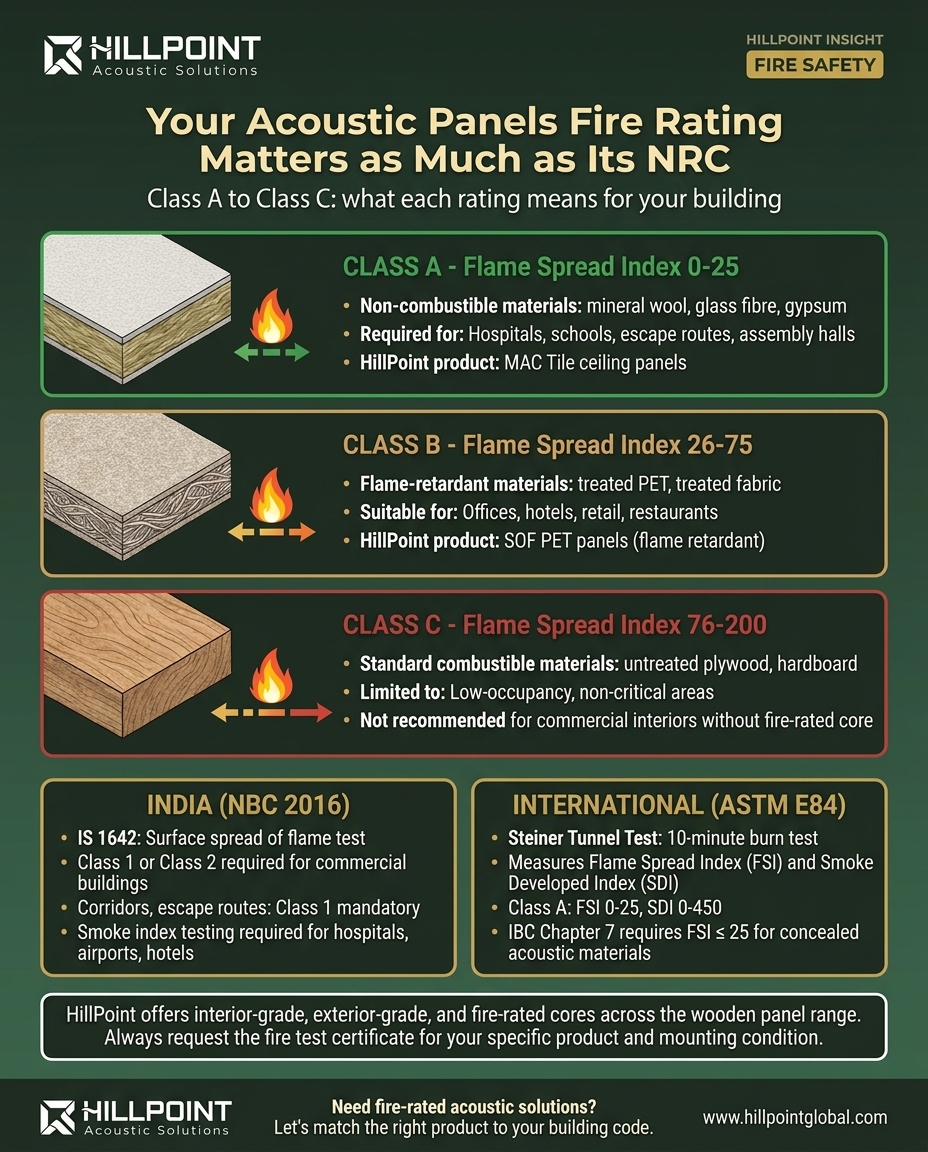
In India, NBC 2016 (National Building Code Part 4) references IS 1642, which measures the surface spread of flame. Materials are classified from Class 1 (low flame spread) through Class 4. Commercial buildings must use Class 1 or Class 2 materials on interior surfaces, with Class 1 mandatory for escape routes, corridors, and assembly areas. Smoke index testing is an additional requirement for hospitals, hotels, airports, and public assembly buildings.
Internationally, ASTM E84 (the Steiner Tunnel Test) is the reference standard used across North America, the GCC, and most international projects. The test places a 25-foot-long sample in a steel tunnel, applies a gas flame at one end for 10 minutes, and measures how far the flame travels along the sample. The result is a Flame Spread Index (FSI) and a Smoke Developed Index (SDI).
Class A: FSI 0 to 25, SDI 0 to 450. These materials barely sustain flame. Mineral wool, glass fibre, gypsum board, and stone wool panels fall here naturally because the base materials are non-combustible. Class A is the highest standard and is required for hospitals, schools, escape routes, and high-occupancy assembly spaces.
Class B: FSI 26 to 75. These materials burn slowly. Most PET acoustic panels with flame-retardant treatment, treated fabric-wrapped panels, and fire-retardant-treated wood fall into this range. Class B is generally acceptable for offices, hotels, retail, and restaurants.
Class C: FSI 76 to 200. These materials burn at a moderate rate. Untreated plywood, hardboard, and standard MDF panels sit here. Class C is not suitable for most commercial interiors and is typically limited to low-occupancy utility spaces.
How this maps to HillPoint's product range
HillPoint manufactures acoustic panels across three material families, each with different fire performance characteristics.
MAC Tile ceiling panels are mineral fibre based. Mineral fibre is inherently non-combustible, which means MAC Tile panels achieve Class A fire rating without any chemical treatment. They're the default specification for hospitals, schools, and any space where Class A is mandatory. At NRC 0.95, they also deliver the highest acoustic performance in HillPoint's ceiling range.
SOF PET panels are made from recycled polyester fibre. PET is not naturally non-combustible, but the SOF range uses flame-retardant treatment to achieve Class B fire rating. This makes them suitable for offices, hospitality, retail, co-working spaces, and most commercial interiors where Class B compliance is sufficient. The trade-off for going with PET over mineral fibre is that you gain moisture resistance, washability, and colour options while accepting a slightly lower fire class.
Wooden panels (Niche, Perf, Grille, and other profiles) are available in three core options: interior-grade MDF, exterior-grade MDF, and fire-rated MDF. The fire-rated core option brings the panel's fire performance into a range acceptable for commercial applications. The veneer or melamine face is the same regardless of core type, so the aesthetic doesn't change.
This is worth emphasising: the fire rating depends on the core, not the face. Two visually identical wooden panels can have completely different fire classifications depending on what's inside. Always specify the core grade on the drawing and in the procurement schedule, not just the finish.
What to ask the manufacturer
When specifying fire-rated acoustic panels, four pieces of documentation matter:
The fire test certificate for the specific product profile you're specifying. A test certificate for a 12mm perforated panel doesn't automatically apply to a 24mm slatted panel from the same manufacturer. The profile, thickness, and perforation pattern can change fire behaviour.
The mounting condition tested. A panel tested flush-mounted on a non-combustible substrate may behave differently when mounted with an air gap, because the air cavity can affect flame behaviour. If the installation uses standoff mounting, the fire test should reflect that condition.
The fabric fire test (for fabric-wrapped panels). The fabric covering a Comfy or fabric-wrapped panel needs its own fire test certificate, typically IS 11871 in India or BS 5867 Part 2 Type B internationally. PVC-coated or waterproof fabrics that block sound from reaching the panel core (reducing acoustic performance) may also have different fire behaviour from acoustically transparent fabrics.
The smoke index data, if the building is classified as a hospital, airport, hotel, or public assembly occupancy. NBC 2016 requires smoke testing in addition to flame spread testing for these occupancy types.
At HillPoint, we provide fire test certificates for every product profile and core option. If a project needs a specific fire classification for a specific panel and mounting condition, we test for it rather than extrapolating from a different product in the range.
For projects across India and the GCC where fire compliance is a building approval requirement, getting the fire documentation right at specification stage prevents delays at inspection stage. The cost of re-testing or re-specifying after procurement is always higher than getting the original specification right. If that conversation starts with “which manufacturer can actually support the paperwork?”, our acoustic panel manufacturer page is the right next step.
Technical Guides
Need the full acoustic treatment and soundproofing guides?
The long-form acoustic panels India guide covers panel types, NRC logic, standards, and room treatment. The soundproofing solutions India guide covers STC logic, doors, walls, floors, and the block-and-isolate side of the same design problem.