
Classroom Acoustics: Why Students in the Back Row Miss What the Teacher Says
Students in the back row can lose 40 percent of speech clarity in untreated classrooms. STI and RT60 explain why. Here is what treatment fixes.
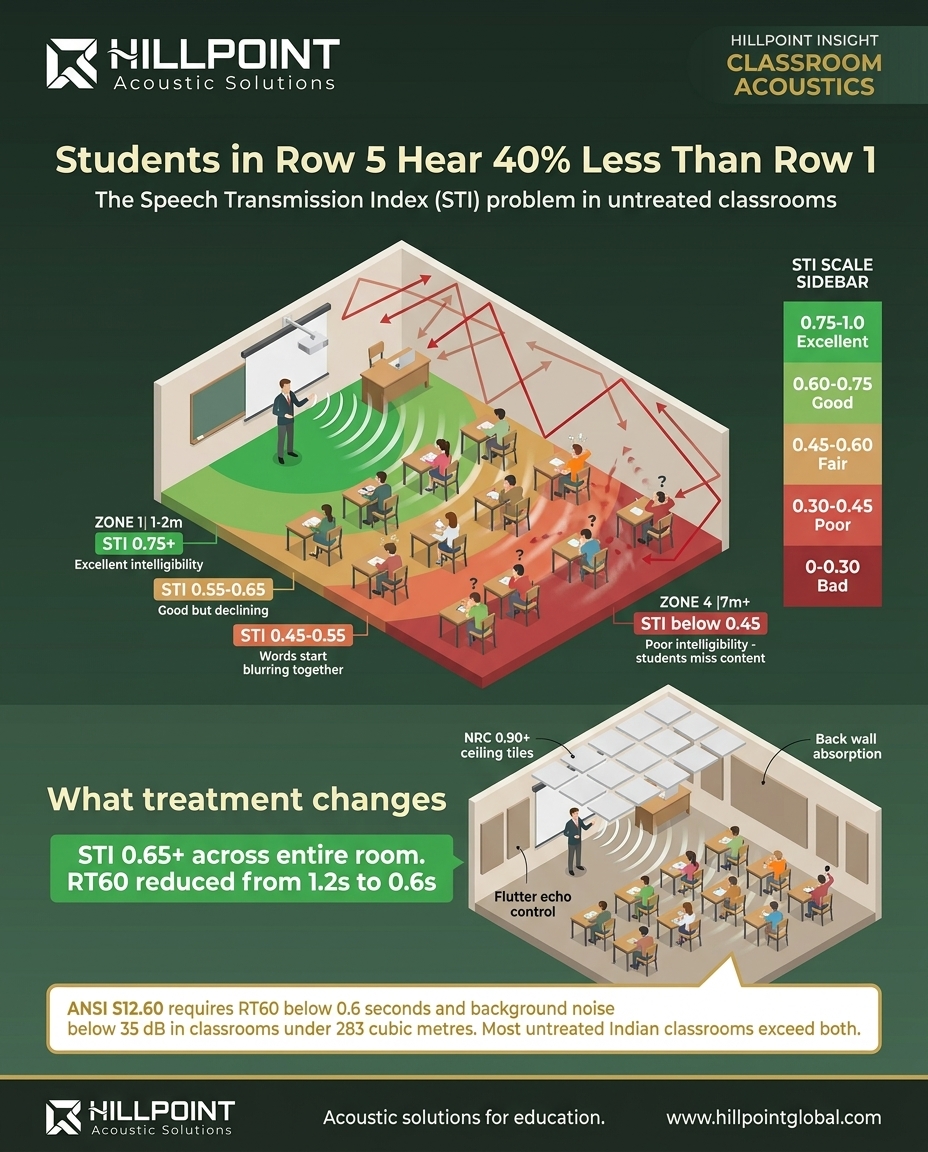
A teacher's voice leaves their mouth at roughly 60 to 65 dB at 1 metre. By the time it reaches a student 7 metres away in the back row of a typical classroom, the direct sound level has dropped by about 17 dB just from distance alone. In a well-treated room, the reflected energy from walls and ceiling reinforces the direct sound early enough to support intelligibility. In an untreated room, the reflections arrive late, overlap with subsequent syllables, and smear the speech signal into something the brain has to work hard to decode.
This is measurable. The Speech Transmission Index (STI) quantifies how much of the original speech signal reaches the listener intact, on a scale from 0 to 1. In an untreated classroom with hard parallel walls and a bare ceiling, STI in the front row might sit at 0.75 (excellent), while the back row drops to 0.45 or below (poor). That difference means a student 7 metres from the teacher is hearing roughly 60 percent of consonant content clearly enough to distinguish "fifteen" from "fifty" or "bat" from "bad."
What ANSI S12.60 requires
ANSI/ASA S12.60 is the acoustic performance standard for classrooms. It sets two primary targets.
Reverberation time (RT60) below 0.6 seconds for classrooms with volumes under 283 cubic metres (10,000 cubic feet). For larger classrooms and lecture halls, the target extends to 0.7 seconds. These numbers apply at the mid-frequency range (500 Hz to 1000 Hz) where speech energy is concentrated.
Background noise below 35 dB (NC-25 to NC-30). This target exists because even in a room with perfect reverberation control, high background noise from HVAC systems or exterior traffic degrades the signal-to-noise ratio and reduces STI. A classroom with RT60 of 0.5 seconds but background noise of 45 dB will still have poor speech intelligibility in the back rows.
Most classrooms in India and across the GCC don't meet either threshold without acoustic treatment. Typical untreated classrooms have RT60 between 0.8 and 1.5 seconds, depending on room volume and surface materials. Concrete walls, tiled or bare ceilings, and hard flooring reflect nearly all sound energy back into the room, extending the decay time well beyond the ANSI target.
Where the speech clarity breaks down
Three surfaces do most of the damage in a typical classroom.
The ceiling is the largest untreated reflective surface, and it sits directly above the speech path between teacher and students. Sound radiates upward from the teacher's voice, hits the hard ceiling, and reflects back down across the entire room. In a room 8 metres deep, this ceiling reflection arrives at the back row approximately 15 to 20 milliseconds after the direct sound, which is just late enough to reduce consonant clarity without being perceived as a distinct echo.
The rear wall receives the teacher's voice full-force and bounces it back toward the front of the room. This is the strongest single late reflection in most classrooms, arriving at students in the middle rows as a delayed copy of the original speech that directly competes with the current syllable.
Parallel side walls create flutter echo at mid and high frequencies, adding a metallic quality to the room sound and further reducing STI, particularly for students seated along the walls.
What treatment changes
Ceiling treatment is the priority. Replacing standard ceiling tiles (often NRC 0.50 to 0.55) with high-performance acoustic tiles brings the ceiling absorption up to the level where it handles the bulk of the RT60 reduction. HillPoint's Acousstop MAC Tile panels reach NRC 0.95 in 600x600 T-grid systems. In many classrooms, upgrading the ceiling alone is enough to bring RT60 from 1.0+ seconds down to 0.5 to 0.6 seconds and meet the ANSI target.
Rear wall absorption is the second priority. A panel covering 40 to 60 percent of the back wall catches the strongest late reflection and prevents it from returning to the mid-room seating area. This is where coverage calculations matter: too little and the reflection persists, but you don't need to cover the entire wall to get the benefit.
Side wall treatment at seated head height (1.0 to 1.5 metres from the floor) controls flutter echo between parallel surfaces. Panels don't need to extend from floor to ceiling. A band of absorption at the height where most reflected speech energy crosses the room is sufficient.
HillPoint manufactures all panel types needed for classroom treatment: MAC Tile ceiling panels, wooden wall panels (Niche, Perf, Grille series), and SOF PET panels for environments where moisture resistance and colourful design options matter. For education projects across India and the Gulf, we provide the acoustic products and installation as one package so the coverage, placement, and mounting details are handled correctly.
The practical difference
A classroom treated with NRC 0.90+ ceiling tiles and targeted wall absorption typically improves from STI 0.45 to 0.50 in the back row (poor to fair) up to STI 0.65+ (good). That shift means the student in row 5 hears consonants distinctly, follows the lesson without extra cognitive effort, and performs measurably better on tasks that depend on listening comprehension.
Teachers notice it too, usually describing the treated room as "easier to talk in" or "less tiring" rather than "quieter." That's because the room stops fighting their voice. They don't need to project as hard, their vocal strain drops, and they can use a wider range of vocal dynamics (quieter for emphasis, louder for attention) without losing the back rows.
For education projects where classroom acoustics are a design requirement, the most cost-effective approach is specifying the right ceiling tile from the start. Retrofitting later costs more and disrupts the teaching schedule. The ANSI S12.60 targets are achievable with standard commercial acoustic products. The question is whether the spec includes them.
Technical Guides
Need the full acoustic treatment and soundproofing guides?
The long-form acoustic panels India guide covers panel types, NRC logic, standards, and room treatment. The soundproofing solutions India guide covers STC logic, doors, walls, floors, and the block-and-isolate side of the same design problem.