Recording Studio Acoustic Treatment: First Reflections, the Mirror Trick, and Where to Place Panels
First reflection points colour your monitor sound. The mirror trick finds them. Here is where to place absorption and diffusion in a control room.
Your studio monitors are only as accurate as the room they sit in. If the room adds early reflections from the side walls, ceiling, or desk surface, the sound arriving at your ears is a mixture of the speaker output and the room's contribution. Mix decisions made in that environment are based on what the room does to the sound, not what the sound actually contains.
First reflections are the specific reflections that cause the most damage, and treating them correctly is the highest-return investment in any studio acoustic treatment plan.
What first reflections are and why they matter
Sound leaves the monitor speaker and travels directly to the listener. That's the direct sound, and it's what the speaker was designed to reproduce. At the same time, sound also travels from the speaker to the nearest wall surface, bounces off it, and then arrives at the listener from a different angle.
This reflected sound arrives just a few milliseconds after the direct sound. The delay is typically 5 to 15 milliseconds depending on the room size and the distance from the speaker to the reflecting surface. That's too short for the brain to perceive it as a separate echo. Instead, the reflection fuses with the direct sound and modifies what the listener hears.
The modification is called comb filtering. At certain frequencies, the direct and reflected sound waves arrive in phase and reinforce each other (making those frequencies louder). At other frequencies, they arrive out of phase and cancel each other (making those frequencies quieter). The result is an uneven frequency response at the listening position that changes depending on where the listener's head is.
For music production, this means the mix decisions you make, the EQ, the panning, the relative levels between instruments, are partially based on artifacts of the room rather than the content of the music. A mix that sounds balanced in a room with strong first reflections will sound different in every other room because the corrections you applied were compensating for the room's problems, not actual problems in the mix.
Finding first reflection points with the mirror trick
The mirror trick is the simplest and most reliable method for finding first reflection points in any room. It requires a hand mirror, a chair, and one other person.
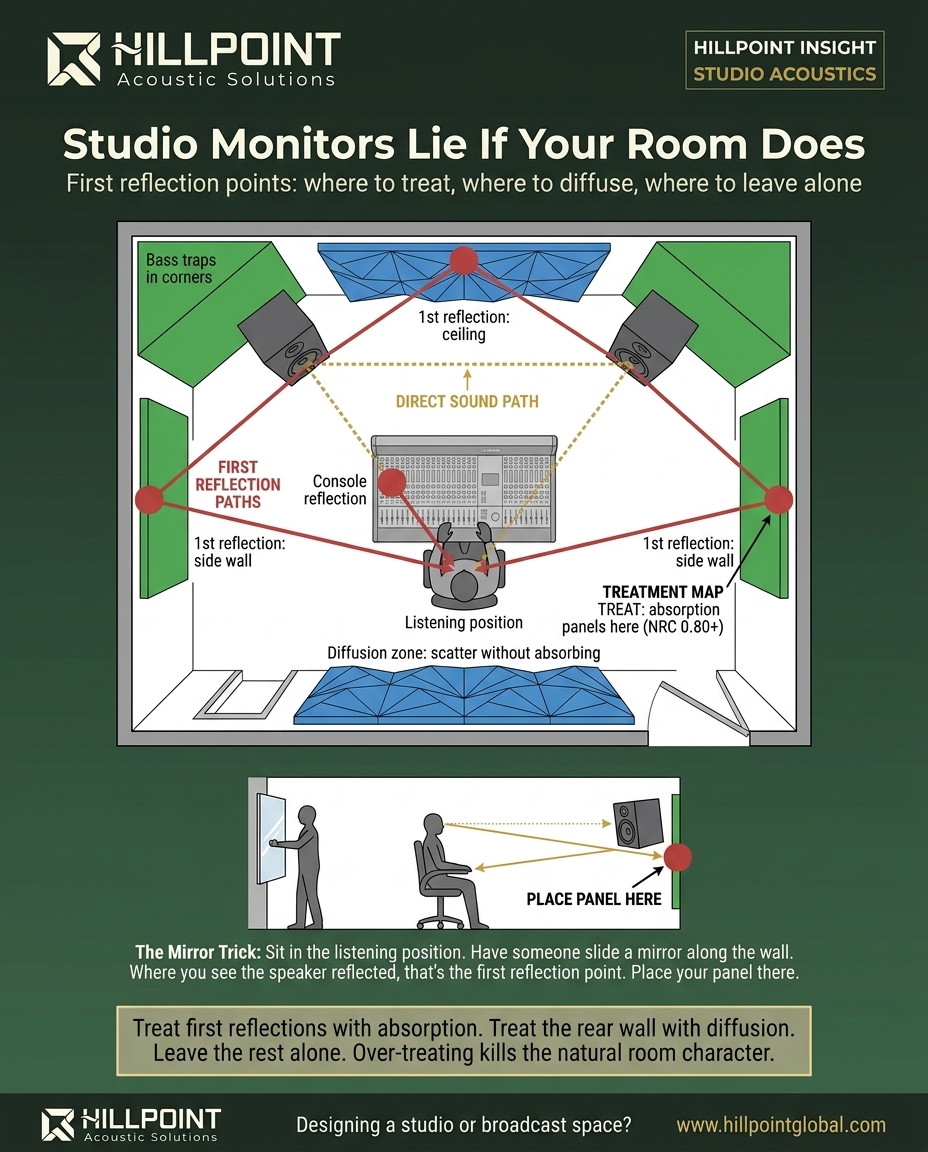
Sit in your normal listening position at the sweet spot between the monitors. Have someone hold a small mirror flat against the side wall at the height of your ears (roughly 1.0 to 1.2 metres from the floor in most setups). Ask them to slide the mirror slowly along the wall, starting from the front of the room near the speakers.
Watch the mirror. The moment you can see the cone of either monitor speaker reflected in the mirror, stop. That's the first reflection point on that wall. Mark it. Repeat on the other side wall. Then do the same on the ceiling directly between the speakers and the listening position.
Each marked point is where an acoustic panel will have the maximum impact on reducing comb filtering at the listening position.
What to put at each position
First reflection points need broadband absorption. Panels with NRC 0.80 or above are the target. Thicker panels (50mm+) or panels with an air gap behind them extend the absorption into lower frequencies, which matters in studios where bass guitar, kick drum, and low synths are part of the content being monitored.
HillPoint's wooden acoustic panels (Niche, Perf, and Grille profiles) handle first reflection treatment with an aesthetic that works in professional studio environments. The slatted and perforated profiles allow sound to pass through the timber face and into the acoustic backing, providing broadband absorption while maintaining a warm, natural visual quality. SOF PET panels are an alternative for studios where cost is a constraint, and the colourful design options can add visual character to the room.
The rear wall behind the listening position is better served with diffusion rather than absorption. A diffuser scatters the rear reflection into many directions rather than absorbing it, which maintains the sense of room ambience without creating a focused slap-back echo. Over-absorbing the rear wall makes the room feel unnaturally dead, which can lead to overcompensating with reverb in the mix.
Bass traps in the front corners of the room handle low-frequency build-up that panel treatment at first reflection points can't address. Room modes below 200 Hz are determined by the room dimensions and can only be controlled with corner treatment or purpose-built bass traps.
The ceiling reflection
The ceiling is often the forgotten first reflection surface in studios. Sound from the monitors hits the ceiling between the speakers and the listening position and reflects down to the listener. In rooms with low ceilings (2.4 to 2.7 metres), this reflection arrives early and strong, making it one of the most damaging first reflections in the room.
A ceiling cloud panel suspended at the first reflection point handles this effectively. The panel should be roughly 1.2 to 1.5 metres square, centred between the speakers and the listening position, and mounted with an air gap above it for improved low-frequency absorption.
For studio projects in India and across the Gulf, HillPoint provides acoustic panels, ceiling clouds, and consultation on reflection point geometry. The first reflection calculation is part of every studio project we scope, because getting these 4 to 6 panel positions right delivers more acoustic improvement than randomly covering every wall.
Technical Guides
Need the full acoustic treatment and soundproofing guides?
The long-form acoustic panels India guide covers panel types, NRC logic, standards, and room treatment. The soundproofing solutions India guide covers STC logic, doors, walls, floors, and the block-and-isolate side of the same design problem.