
Hospital Acoustics: What Quiet Zone Standards Require and Why Most Hospitals Miss Them
WHO recommends 35 dB overnight in hospitals. Most ICUs average 52 to 59 dB. Here is where the noise comes from and what acoustic treatment actually changes.
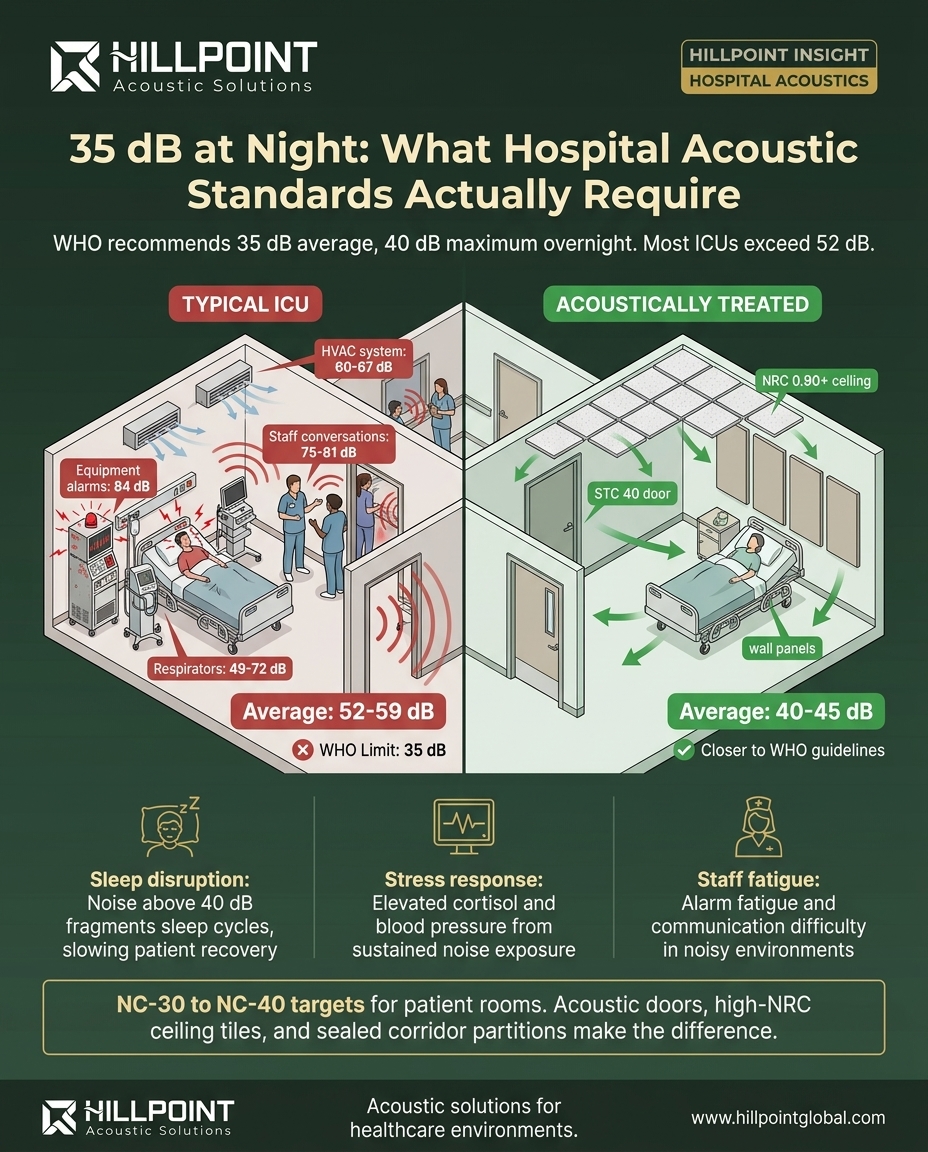
The World Health Organization recommends average hospital sound levels should not exceed 35 dB, with a maximum of 40 dB overnight. Those numbers are from the WHO Community Noise Guidelines, and they've been the reference standard for healthcare acoustic design for decades.
Almost no hospital meets them.
A study published in Critical Care journal monitored five adult ICUs in the UK and found average sound levels always exceeded 45 dB. For half the measurement period, levels sat between 52 and 59 dB in individual units. Peaks above 85 dB occurred at all sites, up to 16 times per hour during the night. The researchers concluded that WHO recommended levels are so low they are probably not achievable in a functioning ICU.
That doesn't mean acoustic treatment is pointless. It means the target needs to be realistic.
Where hospital noise comes from
The sources are well documented. ICU equipment alarms generate up to 84 dB. Staff conversations at the central station run 75 to 81 dB. HVAC systems contribute a constant baseline of 60 to 67 dB. Respirators and ventilators operate between 49 and 72 dB depending on mode and flow rate. Oxygen equipment adds 70 to 77 dB.
Outside the ICU, corridor traffic is a persistent source. Housekeeping, trolleys, conversations between staff, and visitors all contribute. A 2021 systematic review of 33 studies found indoor hospital noise levels ranging from 37 to 88.6 dB during the day and 38.7 to 68.8 dB in the evening, across ICUs, waiting rooms, private rooms, dental clinics, and emergency departments.
The cumulative effect creates an environment where patients struggle to sleep, staff experience alarm fatigue, and communication errors increase. Research consistently links sustained ICU noise exposure to elevated cortisol levels, increased blood pressure, fragmented sleep architecture, and longer recovery times.
What the acoustic targets should actually be
The Facility Guidelines Institute (FGI) publishes more practical targets for healthcare spaces than the WHO guidelines. Their recommendations, which are widely used in healthcare design across North America and increasingly referenced internationally: patient rooms at NC-30 to NC-40 (35 to 45 dB), multiple-occupant care areas at NC-35 to NC-45 (40 to 50 dB), NICU at NC-25 to NC-35 (30 to 40 dB), operating rooms at NC-35 to NC-45 (40 to 50 dB), and corridors and public spaces at NC-35 to NC-45 (40 to 50 dB).
These targets are achievable with proper acoustic design. They won't bring a busy ICU down to WHO's 35 dB, but they represent a meaningful reduction from the 52 to 59 dB reality, and the clinical evidence suggests that every 5 to 10 dB reduction in ambient noise produces measurable improvements in sleep quality and patient satisfaction scores.
HCAHPS surveys (Hospital Consumer Assessment of Healthcare Providers and Systems) include a specific question about nighttime quietness. Hospitals that score poorly on this question face reputational and financial consequences, because HCAHPS scores affect Medicare reimbursement rates in the US and increasingly influence patient choice everywhere.
What acoustic treatment looks like in hospitals
Ceiling treatment carries the most weight in healthcare settings, just as it does in offices and classrooms. Standard hospital ceiling tiles often have NRC values around 0.50 to 0.55, which means nearly half the sound energy bounces back into the room. Replacing these with high-performance tiles at NRC 0.90 or above makes the single biggest difference to ambient noise levels.
HillPoint's Acousstop MAC Tile panels reach NRC 0.95 in standard 600x600 T-grid systems. They're designed for exactly this kind of application: drop into an existing ceiling grid without changing the infrastructure, and immediately reduce reverberation time across the room.
Acoustic doors on patient rooms are the second priority. Standard hospital doors often have STC ratings of 25 to 30, which means corridor noise passes through with minimal resistance. Upgrading to STC 40 to 45 acoustic doors with drop seals and perimeter gaskets reduces corridor-to-room noise transfer substantially. HillPoint manufactures acoustic doors rated STC 38 to 50 and installs them with adjusted seals to ensure on-site performance matches the lab rating.
Wall absorption panels in high-noise zones, such as central nursing stations, medication preparation areas, and staff break rooms, reduce the internal noise floor that contributes to the overall ambient level. These don't need to be on every wall. Targeted placement at first reflection points and behind the primary noise sources produces the best return on investment.
NICU environments deserve special mention. Neonatal units have the strictest acoustic targets (NC-25 to NC-35) because premature infants are particularly vulnerable to noise-induced stress. Achieving these levels requires a combined approach: high-NRC ceilings, acoustic doors on every incubator bay, sealed wall penetrations, and HVAC noise control through duct lining or silencers.
The realistic outcome
An ICU treated with NRC 0.90+ ceilings, STC 40 doors, and targeted wall panels can realistically bring average ambient levels from the typical 52 to 59 dB range down to 42 to 48 dB. That's still above WHO's 35 dB guideline, but it's a reduction that crosses clinically meaningful thresholds for sleep disruption and stress response.
For healthcare projects where HillPoint is involved from the design stage, we can coordinate ceiling, door, wall, and partition specifications as one integrated acoustic system rather than piecemeal product selections. The gap between the spec and the outcome is usually in the coordination details, the same lesson that applies to hotel soundproofing and office acoustic privacy. The soundproofing solutions India guide covers those transmission paths in the broader commercial-specification context.
Technical Guides
Need the full acoustic treatment and soundproofing guides?
The long-form acoustic panels India guide covers panel types, NRC logic, standards, and room treatment. The soundproofing solutions India guide covers STC logic, doors, walls, floors, and the block-and-isolate side of the same design problem.